


Gas price: Ukraine and Europe. Market overview
During the last week, natural gas prices in Ukraine fluctuated, following the trends of European hubs.
Ukrainian Energy Exchange
Last week, trading in October, November 2024 and subsequent months continued. In total, 7 companies formed positions for the purchase and sale of natural gas: D.Trading, GTS Operator of Ukraine, Nadra-Geoinvest, MC Ukrnaftoburinnya, GSP Oil and Gas Trading, Ukrnafta, and Kyiv Metro.
The starting prices of resources were growing throughout the week. As a result, as of Friday, the average starting price of October resources in the GTS was 0.26% higher than on Monday.
Last week, both sell and buy positions were sold. In total, 29860 thousand cubic meters of natural gas were sold. The largest volume - 18,300 thousand cubic meters of October and November resources in the GTS - was purchased by the GTS Operator of Ukraine. The quotation prices formed as a result of the auction are shown in the chart below.
On the short-term natural gas market of the UEEX, participants formed bids in the GTS and UGS. During the week, there was an upward trend in prices. On Friday, October 18, the weighted average price of the SSP amounted to UAH 14,933.33 excluding VAT.
European market
Last week, European gas markets remained concerned about supplies due to the conflict in the Middle East. Concerns about a reduction in LNG supplies from Qatar also affected the settlement prices of TTF gas futures.
British short-term gas prices rose on Thursday, with spot NBP up 1% to close at 96.00 p/therm. Growth was supported by maintenance on the UK Continental Shelf (UKCS) and a one-day maintenance workover at the Norwegian Useberg field. The Sum-2025 contract remained stable, closing at 93.39 p/term on steady supplies.
Prices of contracts with delivery within the relevant period, EUR/MWh, 10/17/2024
| Instrument | THE | CEGH | TTF | TGE/POLPX | CEEGEX/HUDEX | Average price |
|---|---|---|---|---|---|---|
| Day1 | 39,77 | 39,76 | 39,24 | 40,98 | 37,52 | 39,45 |
| M+1 | 40,46 | 40,24 | 39,64 | 41,20 | 40,16 | 40,34 |
| Q +1 | 41,28 | 41,06 | 40,28 | 41,08 | 40,94 | 40,93 |
| S +1 | 39,33 | 39,98 | 38,28 | 37,41 | 39,05 | 38,81 |
Month-ahead contracts at all the analyzed hubs showed the same trend in terms of spot prices, with an average increase of 2.31%. Prices a quarter ahead were 3.82% higher than spot prices on average. Season-ahead prices with an average value of EUR 38.81/MWh tended to decrease by an average of 1.53% compared to spot prices.
The November futures for LNG in Asia, the JKM Platts Future index, settled last Thursday at USD 469.30 per thousand cubic meters. The LNG North West Europe Marker closed last Thursday at USD 436.80 per thousand cubic meters.
Storage facilities in the EU are 95.05% full of the total volume of 106.5 bcm, according to the Aggregated Gas Storage Inventory. Last Wednesday, the European gas group TSO Entso-G said that gas storage facilities across the EU could be 40% full by the end of next winter, provided demand is moderate, supplies from Norway are constant and supplies are unimpeded.
European LNG terminals operated at an average capacity of 75.67%.
As of October 16, LNG stocks in the EU amounted to 5.378 million cubic meters, according to the Aggregated LNG Storage Inventors.
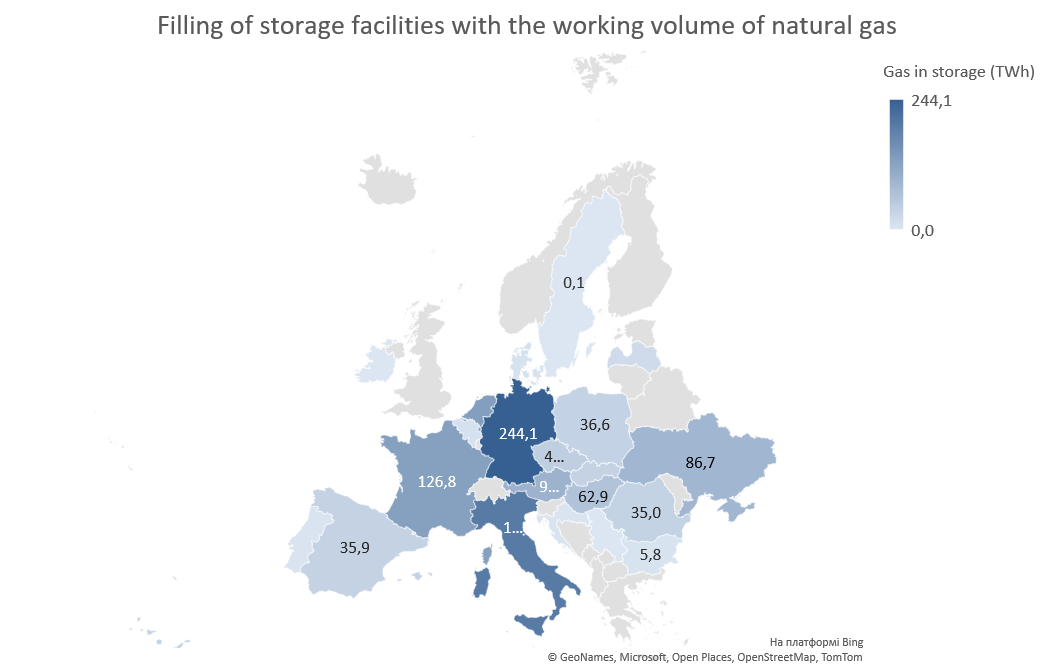
The storage level of the largest LNG exporter, the United States, according to the latest EIA data as of October 11, 2024, was 3.705 billion cubic feet. On October 16, the International Energy Agency said that there is a “high” probability that the ongoing conflict in the Middle East could affect LNG exports from the region.
In the neighboring oil market, Iran reduced its crude oil exports to 237 thousand bpd, the lowest level in 2 years. China’s independent refineries are expected to buy less Iranian crude oil and look for alternative sources of supply due to the reduction in Iranian supplies, which will increase competition in Asia for other spot crude oil. Brent crude oil prices were trading at USD 74.15 per barrel on October 18. Hurricane Milton also caused caution in halting oil and gas production in the Gulf of Mexico (USA), and last week the storm’s impact on supply dynamics and prices was evident.
Gas balance in Ukraine
Last week, natural gas imports from Hungary and Slovakia averaged 11 mcm per day, while exports from the customs warehouse amounted to 1.1 mcm to Poland and Slovakia. Ukraine had about 12.8 billion cubic meters in storage facilities. Injections amounted to approximately 20 million cubic meters per day.
Interesting for the week
An increase in the number of tankers and new supply chains help reduce transportation costs. Ships carrying liquefied natural gas are being built faster than new batches of fuel enter the market, which helps to reduce transportation costs and mitigate the tariff impact on consumers. Bloomberg writes that the cost of short-term LNG tanker leases has fallen to the lowest level for this time of year since 2018. At the same time, LNG tankers are increasingly staying in the Atlantic or Pacific regions. In other words, gas is consumed closer to the places of its production, which contributes to an overabundance of ships and reduces the cost of its transportation. This is good news for consumers. In Europe, gas prices are at their highest level this year-even before the heating season begins-which is partly due to the war in Ukraine and the Middle East.