
Gas price: Ukraine and Europe. Market review July 3 - 7, 2023

Gas price: Ukraine and Europe. Market overview
During the last week UEEX`s natural gas prices were fluctuated, while the downward trend continued at European hubs.
Ukrainian Energy Exchange
Last week, trading in the July and August 2023 resource continued. In total, 10 companies formed positions for the purchase and sale of natural gas: Energy Trade Group, Ukrenergoexport, Naftogaz of Ukraine, LLC TAS ENERGY COUNTRY, Kraft Energy, GTS Operator of Ukraine, etc.
Resources starting prices had mixed trends over the past week. As a result, for example, as of Friday, the average starting price of July resources in the GTS was 3,04% lower than on Monday.
Over the past week positions for purchase were sold. In general 2600 th.c.m. of natural gas were sold. Resource for July in UGS were purchased by NJSC Naftogas of Ukraine, LLC TAS ENERGY COUNTRY, GasenergoTrade and GTS Opertor of Ukraine.
At UEEX short-term natural gas market participants formed applications in GTS and UGS. Gas sale was conducted at GTS intraday market. The marginal prices formed as a result of the auction are shown in the chart below.
European market
In the early QIII natural gas prices started download trade, as traders were watching the supply forecast for the current quarter. Some market experts expected that an additional risk premium would be added to the TTF after the events with the russian uprising, but there was no direct impact on prices. Currently, the gas market is following the maintenance schedule in Norway. Currently gas market following the maintenance schedule in Norway.
The results of the first half of 2023 can be summarized as follows: for most of the first half of 2023, TTF gas futures prices gradually declined due to significant LNG shipments by sea and lower demand, which led to high levels of European stocks. However, in June, supplies from Norway were disrupted. In addition, prices were affected by competition for LNG supplies from the US with Asian markets. News of the closure of Europe’s largest gas field in October also raised concerns about end-of-period supplies.
Prices of contracts with delivery in the relevant period, EUR/MWh, July 6, 2023
| Instrument | THE | CEGH | TTF | TGE/POLPX | CEEGEX/HUDEX | Average meaning |
|---|---|---|---|---|---|---|
| Day1 | 32,29 | 34,09 | 31,89 | 33,66 | 36,25 | 33,64 |
| M+1 | 32,82 | 33,99 | 32,37 | 35,52 | 33,37 | 33,61 |
| Q+1 | 48,54 | 49,4 | 47,45 | 51,15 | 48,64 | 49,04 |
| S+1 | 51,92 | 52,38 | 50,94 | 54,78 | 52,01 | 52,41 |
Month-ahead contracts at all analyzed hubs showed a different trend from spot prices, with an average increase of 0,09%. Quarter-ahead prices were higher than spot prices by 46,03% on average. The season-ahead prices with an average value of 52,41 EUR/MWh tended to increase compared to the spot prices by an average of 56,08%.
As for the TTF gas futures on the ICE Front-Month market, the average price of these futures registered in the first half of 2023 was 44,34 euros/MWh. Compared to the Front-Month futures traded in the previous half of the year, with 164,88 euros/MWh, the average value decreased by 73%. Compared to the Front-Month futures traded in the same half of 2022, when the average price was 100,99 EUR/MWh, there was a 56% decrease.
Since the beginning of the third quarter, European LNG terminals have been loaded by 54%.
The EU storage capacity is at 79%. If the storages are full by the end of the summer, traders can use free storage facilities in Ukraine to store excess gas. This was the case in 2020 after the pandemic led to a decrease in gas demand.
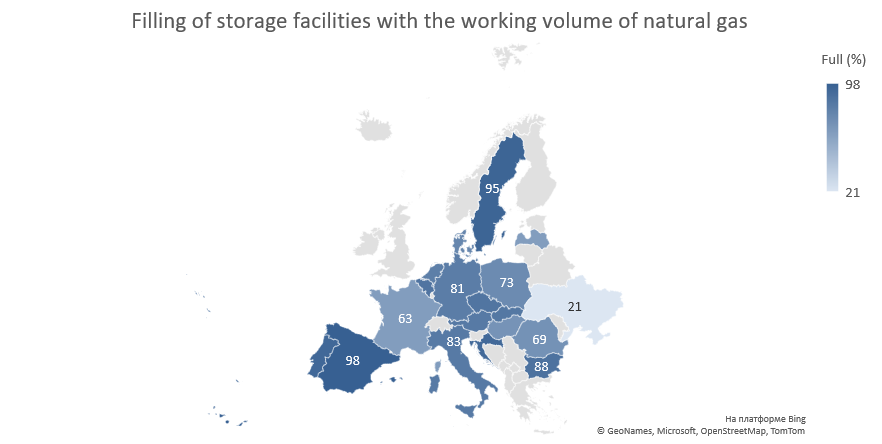
Repair work on the Norwegian continental shelf continues to affect gas exports to Europe, with recent market volatility linked to short-term changes in work schedules. The key Nyhamna plant remains closed and is not expected to restart until July 15. Any further delay will exacerbate the current market tensions.
As for Brent front-month futures on the ICE market, they registered an average six-month price of USD 79.97 per barrel in the first half of 2023. This value was 14% lower than Front-Month futures in the previous half of the year at USD 93.26 per barrel. It was also 24% lower than Front-Month futures traded in the first half of 2022 at USD104.94 per barrel.
Last week, crude oil prices ignored the failed russian revolution and continue to be shaped by concerns about the global economy. Brent crude oil was trading at USD 76.87 per barrel on the London ICE Futures exchange on Friday, July 7.
Gas balance in Ukraine
During the week, natural gas imports from the European direction averaged about 14 million cubic meters per day, up almost 3 times compared to the previous week. Hungary was the leader in sending commercial gas flows to Ukraine among other European countries with a share of 80%. Imports from Poland and Slovakia were also present. Moldova, as before, sent natural gas to the Ukrainian customs warehouse in an average volume of 4,4 mcm per day. There were no export deliveries during the week. Ukraine’s storage facilities had about 10,7 bcm of natural gas. Injections into the UGS facilities amounted to about 40 million cubic meters per day. The summer season is now allowing to increase the volume of injections into the storage facilities due to lower consumption.
Public procurements
Last week, 15 tender procedures were held for the purchase of natural gas by budgetary institutions and state-owned enterprises. In total, 420 thousand cubic meters of natural gas worth UAH 4,8 million were sold in the largest tenders (top 10). The largest contract was awarded to Gazenergo-Trade, which will supply 265 thousand cubic meters of natural gas to the Kharkiv Zoological Park at an initial price of UAH 11,20 per cubic meter. The average price increased and amounted to UAH 11,68 per cubic meter. Prices ranged from UAH 11,20 to UAH 12,72 per cubic meter, excluding VAT.
Interesting for the week
The role of russian pipeline gas has now significantly diminished, as has its influence on the market. According to official data from the European Commission, russian pipeline gas supplies historically accounted for about 45-50% of EU gas imports before the military invasion of Ukraine in February 2022, but by March of this year, this figure had dropped to 8%. Russian LNG from the Yamal LNG plant operated by Novatek is also reportedly being shipped to the EU, with deliveries estimated to reach 7,7 million tons in 2023. russia also continues to supply gas to Europe via the Turkish Stream and related onshore infrastructure in Bulgaria and Serbia.
Egypt has free capacity of 4 million tons per year for liquefied natural gas (LNG), which it is ready to export to Europe. Egyptian Minister of Petroleum and Mineral Resources Tarek al-Molla told reporters about this. "We are exporting LNG to Europe, this is a priority for us. Our liquefied natural gas (LNG) production capacity is 12 million tons per year. The maximum we reached last year was 8 million tons per year. We still have opportunities to export 4 million tons per year," he said.
People’s deputies propose to amend the Customs Code of Ukraine regarding customs control and customs clearance of biomethane transported by pipeline across the customs border of Ukraine. The relevant draft law No. 9456 has been registered in the Verkhovna Rada. As stated in the explanatory note, Ukraine currently lacks legislative mechanisms, has not created favorable conditions for biomethane production, and there is an issue of its unregulated customs clearance. At the same time, Ukraine has the largest area of agricultural land in Europe, and the raw material for biomethane is agricultural waste, so the potential for its production is great.
Exports of liquefied natural gas from the United States in June decreased by 10% to 6,82 million tons compared to May due to reduced production and lower demand for the resource in Europe. This is evidenced by preliminary data from Refinitiv Eikon. According to consulting company Rystad Energy, planned outages by two major suppliers have recently hampered US LNG production, which, combined with a warmer-than-usual winter, has led to a build-up of gas stocks and lower prices.