

Gas price: Ukraine and Europe. Market overview September 9 - 13, 2024

Gas price: Ukraine and Europe. Market overview
Last week, natural gas prices in Ukraine fluctuated, following the trends of European hubs.
Ukrainian Energy Exchange
Last week, trading in September and October 2024 continued. In total, 6 companies formed positions for the purchase and sale of natural gas: MC Ukrnaftoburinnya, Ukrnafta, Naftogaz Trading, DDZ Service, Electricity UA, and Electro-Gas.
Starting prices for resources were stable throughout the week. Positions for sale were sold. In total, 700.00 thousand cubic meters of natural gas were sold by Electro-gas and Electriya UA. The prices of sold items for the September resource in UGS facilities were in the range of UAH 14160-14191.67 excluding VAT.
On the short-term natural gas market of the UEEX, participants formed bids in the GTS and UGS. No significant price fluctuations were recorded on the short-term market during the week. The weighted average price of the SSP on Friday, September 13, amounted to UAH 14,205.77 excluding VAT.
European market
Last week, the impact on supply due to maintenance work in Norway and weather forecasts led to higher prices for TTF gas futures, although M+1 on Wednesday TTF fell to 34.67 EUR/MWh, the lowest in six weeks. Annual maintenance in Norway may be extended further (for example, the Kollsnes outage was extended for 5 days, affecting the supply of 55 mcm per day), and there is some uncertainty about the near-term prospects for Russian gas flows through Ukraine.
On Wednesday, prices rose on market participants’ expectations that Hurricane Francine in the US Gulf will affect the export of some LNG terminals from Texas and Louisiana to European ports in addition to production problems at 3 plants: Australia’s Ichthys LNG and North West Shelf LNG, as well as Malaysia LNG. On Thursday, fears of supply disruptions eased, although European gas prices rose on Friday.
Prices of contracts with delivery in the respective period, EUR/MWh, 12.09.2024
| Instrument | THE | CEGH | TTF | TGE/POLPX | CEEGEX/HUDEX | Average price |
|---|---|---|---|---|---|---|
| Day1 | 35,41 | 36,25 | 35,45 | 36,26 | 35,16 | 35,71 |
| M+1 | 35,48 | 36,41 | 35,19 | 37,01 | 35,35 | 35,89 |
| Q +1 | 37,14 | 37,82 | 36,58 | 38,48 | 36,61 | 37,33 |
| S +1 | 37,93 | 38,36 | 37,26 | 38,85 | 37,54 | 37,99 |
Month-ahead contracts at all the analyzed hubs showed a different trend in relation to spot prices, with an average rise of 0.51%. Quarter-ahead prices were higher than spot prices by an average of 4.53%. The seasonal forward prices with an average value of 37.99 EUR/MWh tended to increase compared to the spot prices by an average of 6.39%.
The NBP spot price rose on Thursday, closing at 85.25 p/therm on lower demand. The limited impact of Hurricane Francine on LNG export plants in Louisiana affected the Win-2024 contract, which fell by almost 3% to settle at 94.42 p/therm.
The October futures for LNG in Asia, the JKM Platts Future index, settled last Thursday at USD 489.92 per thousand cubic meters. According to Kpler vessel tracking data, Asian LNG imports in September increased by almost 4% month-on-month to 13.8 million tons. Temperatures in Japan will remain above normal until early October, boosting demand from the Asian region.
Futures for LNG delivered to North-West Europe (LNG North West Europe Marker) closed last Thursday at the level of USD 430.67 per thousand cubic meters. Spark Commodities estimates that the profitability of shipping cargo from the US loaded in October, including all costs and delivery via the Cape of Good Hope, is higher to Europe than to Asia by USD 25 per thousand cubic meters.
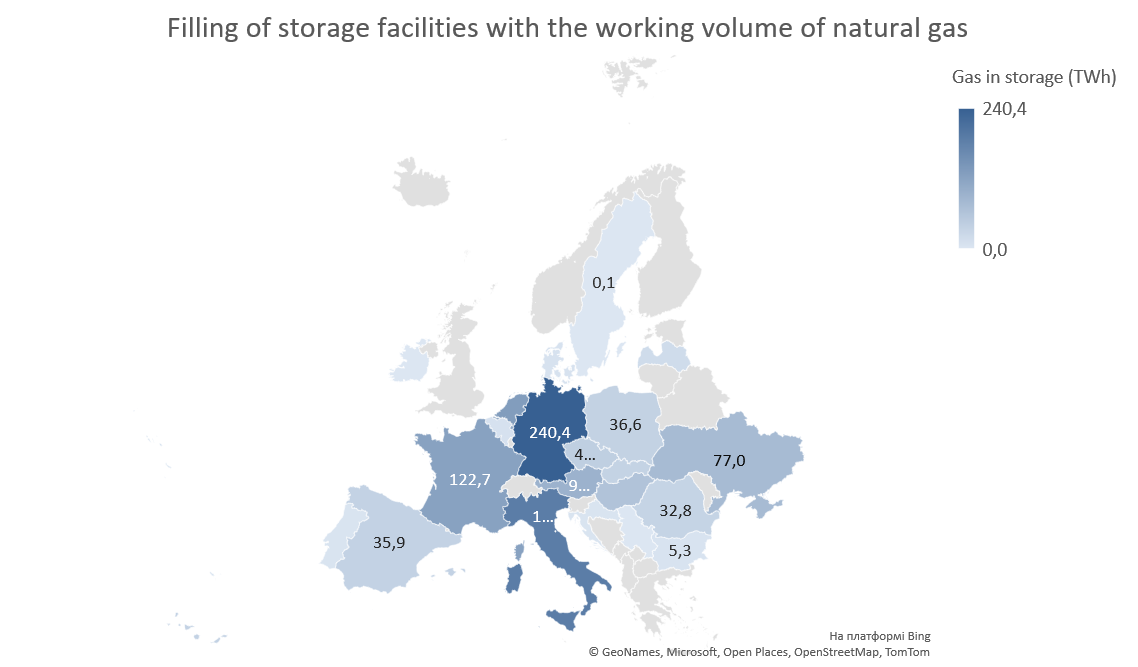
Storage facilities in the EU are 93.24% full, according to the Aggregated Gas Storage Inventory as of September 11, which is 0.1% higher than the previous day and compared to about 88% a month ago. European storage facilities are expected to reach their maximum in early November.
European LNG terminals operated at an average capacity of 73.27%.
As of September 11, LNG stocks in the EU amounted to 4.647mcm, according to the Aggregated LNG Storage Inventors. Last week, market analysts reported that LNG demand in Europe fell by 20% year-on-year in the first half of 2024 after gas consumption fell to a 10-year low and LNG may have already reached its peak consumption.
The storage level of the largest LNG exporter, the United States, according to the latest EIA data as of September 6, 2024, was 3.387 billion cubic feet.
Last Friday, gas supplies through pipelines from Norway reached 191.63 million cubic meters per day, according to TSO Gassco.
On the related oil market, oil prices rose on Friday. Brent was trading at USD 72.67 per barrel due to supply disruptions from Hurricane Frances, but weak demand from China and the US continues to limit long-term recovery prospects.
Gas balance in Ukraine
Last week, natural gas imports from Hungary and Moldova averaged 5.25 mcm per day, while exports from the customs warehouse were observed at 6.95 mcm to Poland and Slovakia. Imports and exports (to/from the customs warehouse) increased compared to the previous week as the heating season approached. Ukraine had about 12 bcm in storage facilities. Injections amounted to approximately 22 million cubic meters per day.
Interesting for the week
European Commissioner for Energy Kadri Simson confirmed the possible closure of Russian gas imports through Ukraine. In January 2025, the transit agreement between Ukraine and Russia will be finalized. Europe is not ready to extend it. Instead, Russia is open to suggestions. Simson emphasized that the EU countries have had more than 2 years to diversify their gas imports, excluding Russia, Energozhynka reports.
This was stated by GTSOU representatives during a working meeting of the Vertical Corridor initiative participants. “Our short-term goal is to create 7 million cubic meters of guaranteed capacity at one of the interstate points by April 2025. To do this, both GTS operators have to reconstruct several facilities along the route,” said Andriy Prokofiev, Head of the Customer Relations Department at GTSOU. This was stated by GTSOU representatives during a working meeting of the Vertical Corridor initiative participants. “Our short-term goal is to create 7 million cubic meters of guaranteed capacity at one of the interstate points by April 2025. To do this, both GTS operators have to reconstruct several facilities along the route,” said Andriy Prokofiev, Head of the Customer Relations Department at GTSOU.


