

Gas price: Ukraine and Europe. Market overview September 4 - 8, 2023

Gas price: Ukraine and Europe. Market overview
During the last week, natural gas prices in Ukraine fluctuated, following the trends of European hubs.
Ukrainian Energy Exchange
Last week, the September, October 2023 resource was traded. In total, positions for the purchase and sale of natural gas were formed by 7 companies: Kraft Energy, Naftogaz of Ukraine, Electro-gaz, New Energy Ukraine, Alternative Supplier, Operator of the GTS of Ukraine, Energy Sales Trans.
Starting prices of resources decreased during the week. As a result, as of Friday, the average starting price of the September resource in the GTS was lower than Monday’s figure by 3.42%.
Over the last week, buy positions were sold. A total of 25,100 thousand cubic meters of natural gas were sold. The initiator of buyer positions was the Operator of GTS of Ukraine, which purchased the resource in September and October at prices in the range of UAH 15,398-15,420 excl. VAT.
On the short-term natural gas market of UEEX, participants formed applications in GTS and UGS. Marginal prices formed based on the results of the auctions are shown in the graph below.
European market
Summarizing August for TTF gas futures on the ICE market at Front-Month, their average price was 35.00 EUR/MWh. Compared to Front-Month futures traded in July at a price of 29.48 EUR/MWh, the average increased by 19%. Compared to Front-Month futures traded in August 2022, when the average price was 235.96 EUR/MWh, the decline was 85%. In general, in August, TTF gas futures prices were affected by news about the possibility of strikes in Australia. A possible decline in gas exports from this country has led to a decrease in LNG supplies to Europe as supplies have been diverted to Asian markets. However, the high level of European reserves prevented further price increases.
European gas prices traded in a narrow range last week after a strike at LNG plants in Australia was postponed. The strike was originally scheduled to begin on September 7, but was postponed a day for an additional round of talks. Workers at two LNG plants of US oil and gas company Chevron in Western Australia did go on strike on Friday, pushing DA quotes higher at the TTF hub in the Netherlands. On September 14, they announced the transition to a full-scale protest action. It is predicted that its consequences will not cause price destabilization due to large reserves in gas storage facilities in Europe.
Prices of contracts with delivery in the relevant term, EUR/MWh, 09/07/2023
| Instrument | THE | CEGH | TTF | TGE/POLPX | CEEGEX/HUDEX | Average price |
|---|---|---|---|---|---|---|
| Day1 | 32,83 | 34,23 | 32,68 | 33,74 | 33,93 | 33,48 |
| M+1 | 33,18 | 34,15 | 32,76 | 37,40 | 33,88 | 34,27 |
| Q+1 | 42,27 | 42,73 | 41,66 | 46,59 | 42,94 | 43,24 |
| S+1 | 47,05 | 47,1 | 46,45 | 53,02 | 46,88 | 48,10 |
Contracts for a month ahead in all analyzed hubs had a different trend in relation to spot prices - an average price increase of 2.36%. Quarter-on-quarter prices were higher than spot prices by an average of 29.14%. Prices for the season ahead with an average value of 48.10 EUR/MWh had a tendency to increase compared to spot prices by an average of 43.67%.
LNG prices in the Asia-Pacific region eased on September 7 as market players were undeterred by supply uncertainty, despite the announced delay of strikes at Gorgon and Wheatstone plants. October LNG futures in Asia, the JKM Platts Future Index, traded at USD 476 per thousand cubic meters last Thursday. Futures for LNG delivered to North-West Europe (LNG North West Europe Marker) traded at $394 per thousand cubic meters. m.
European LNG terminals are 57% loaded. Europe has already imported more LNG from January to September — 88.02 million tons — than for all of 2021 — 79.34 million tons.
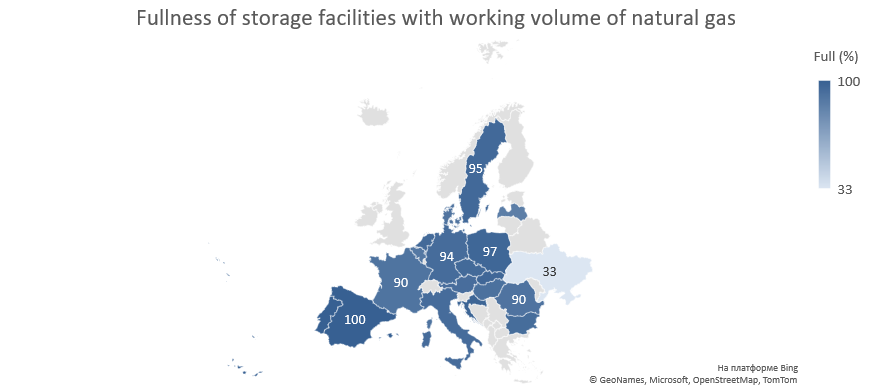
The current inventory level has reached 93.5%, which is significantly higher than the average for the same dates the last 5 years. A number of countries are still behind the 90% standard, which must be reached before the start of the selection season, including Belgium and last year’s outsider Latvia. Therefore, they actively accumulate gas. In particular, underground natural gas storage facilities in Poland are already 97% full.
According to the results of August, Brent oil futures on Front-Month on the ICE market registered an average monthly price of USD 85.10 per barrel. After the publication of the report of the USA Department of Energy on the reserves of energy carriers in the country for the previous week on Friday, September 8, oil quotations decreased and traded at the level of USD 89.33 per barrel.
Gas balance in Ukraine
Natural gas imports rose last week. On average, receipts amounted to 33.35 million cubic meters per day, from all four directions. The largest volumes in terms of structure came from Slovakia - 71%. Imports from other directions were present daily, but in smaller volumes. All the indicated volumes were delivered to the "customs warehouse" directly or using the short haul service. There were no export deliveries during the week. About 14.5 billion cubic meters were in Ukraine’s storage facilities.
The volumes of natural gas stored in the "customs warehouse" of Ukrainian UGS have exceeded 2 billion cubic meters on September 2, according to ExPro calculations. In August, gas imports to Ukraine rose to a three-year high - almost 1.1 billion cubic meters.
Interesting for the week
The Romanian company Vestmoldtransgaz (which previously belonged to the Moldovan government SE "Vestmoldtransgaz") has been given management of Moldova’s gas transportation system for a period of five years, the Ministry of Energy of the republic reported. The agency notes that the transfer of gas transmission networks is conditioned by Moldova’s obligations under the EU’s third energy package, which provides for the division of supplies, transportation and distribution on the gas market.
In Europe, there is concern that a large part of Europe’s accumulated gas reserves is liquefied natural gas (LNG, or LNG), reports CNN. Its origin is difficult to trace. This means that indirectly part of the LNG can come from Russia, which will still contribute to its revenues. The EU claims that the majority of LNG is purchased from the US, Qatar and Nigeria, and contracts are often concluded for volumes without reference to origin.


