Gas price: Ukraine and Europe. Market overview September 28 – October 2, 2026
Trading for September and October resources — within the gas transmission system and UGS —continued in the "Medium- and Long-Term Market" section of the UEEX. In total, 14 companies established positions for the sale or purchase of natural gas: GSC Naftogaz Trading, Cherkasyteplokomunenergo, MHP Eco Energy, Concern MTM, Gas TSO of Ukraine, D.Trading, and others. Trading was active amidst price volatility. In total, 33 million cubic meters of natural gas were sold in the section. Buy orders from Cherkasyteplokomunenergo, Naftogaz Trading, Concern MTM, and Energo Zbut Trans, as well as sell orders from D.Trading and Energycenter, were successful. Prices resumed their upward trend, crossing the 19,000 mark.
On the UEEX short-term natural gas market, participants placed orders on the within-day and day-ahead markets, as well as for the GTS and UGS. In total, 55 exchange trades were concluded with an aggregate volume of 1,235 thousand cubic meters.
Prices for the upcoming winter in Europe are reacting quickly to news regarding negotiations, while longer-term contracts remain stable. The market is pricing in expectations of a conflict resolution, although fundamental risks remain: the Strait of Hormuz is effectively closed to Qatari LNG shipments to Europe, gas inventories are at record lows for this time of year, and heating demand is forecast to surge in late October. Supplies from Norway are only just recovering following two weeks of unplanned disruptions. Until an agreement is reached, factors supporting high prices remain in place, despite the market’s optimistic reaction to news of the negotiations.
The US rejection of Iran’s proposal to open the strait over the last weekend of September drove prices up on Monday, September 28. However, by Tuesday, TTF prices had closed below €70/MWh, compared to €73/MWh a week earlier.
Competition with Asia for LNG remains a significant factor. Despite the conflict in the Middle East, Southeast Asia alone is building new import capacity totaling 70 million tonnes per year; consequently, Europe will likely be competing for the same cargoes next summer. At the same time, European prices—which were higher than those in Asia this week—made US LNG shipments to Europe more profitable and helped replenish storage facilities.
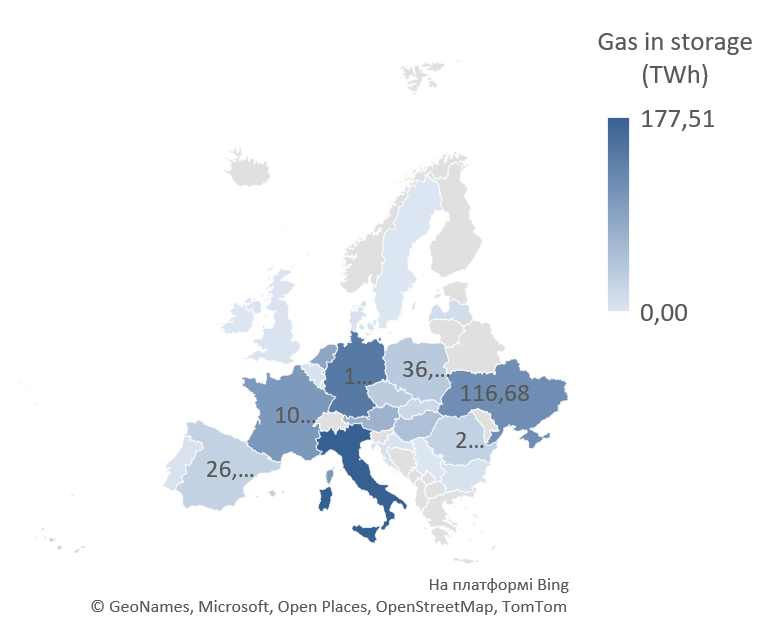
As of September 30, EU storage facilities were 71.54% full, compared to 82% at the end of September last year and about 85% on average over five years. A cold winter could drive storage levels below 10% by the end of the season, worsening the starting conditions for restocking in 2027.
Following the completion of maintenance work, nominated gas outflows from Norway rose to 315.7 million cubic meters for the gas day of September 30, compared to 290.7 million cubic meters the previous day and 226.1 million cubic meters a week earlier.
Natural gas imports from Europe rose to 2.5 million cubic meters per day on Thursday, October 1. Imports came from Poland, Hungary, and Moldova. Exports from the customs warehouse averaged 8.3 million cubic meters per day and were directed towards Poland, Slovakia, and Hungary. Ukraine’s storage facilities held 15.6 billion cubic meters of natural gas. There was virtually no withdrawal from underground gas storage facilities; instead, injection was observed at a rate of approximately 18 million cubic meters per day.