Gas price: Ukraine and Europe. Market overview October 26 – 30, 2026
In the "Medium- and Long-Term Market" section of the UEEX, trading continued for October and November resources, involving the GTS and UGS. In total, 11 companies established the starting positions, including GSC Naftogaz Trading, the GTS Operator of Ukraine, Ukrnafta, D.Trading, and others. The initiators primarily entered the market with buy orders for natural gas. In total, 59.43 million cubic meters of natural gas were sold in this section. Successful buy orders were placed by Naftogaz Trading, the GTS Operator of Ukraine, Cherkasyteplokomunenergo, Teplovyk, and Kyivvodokanal, while successful sell orders came from Ukrnafta and MBE. The largest volume was purchased by Naftogaz Trading, with delivery to underground gas storage facilities scheduled for November. Last week, district heating companies and municipal utilities once again purchased natural gas on the UEEX. The price showed an upward trend.
Trading also took place in the "Export of domestically produced natural gas" section. In total, approximately 11.4 million cubic meters of natural gas were sold in the section against the quota authorized for October. Quoted prices in the section ranged from 82.71 to 89.96 euros per MWh.
In the short-term natural gas market at the UEEX, participants submitted bids on the intraday market for the GTS and UGS facilities. In total, 40 exchange trades were concluded, with an aggregate volume of 2,297 thousand cubic meters.
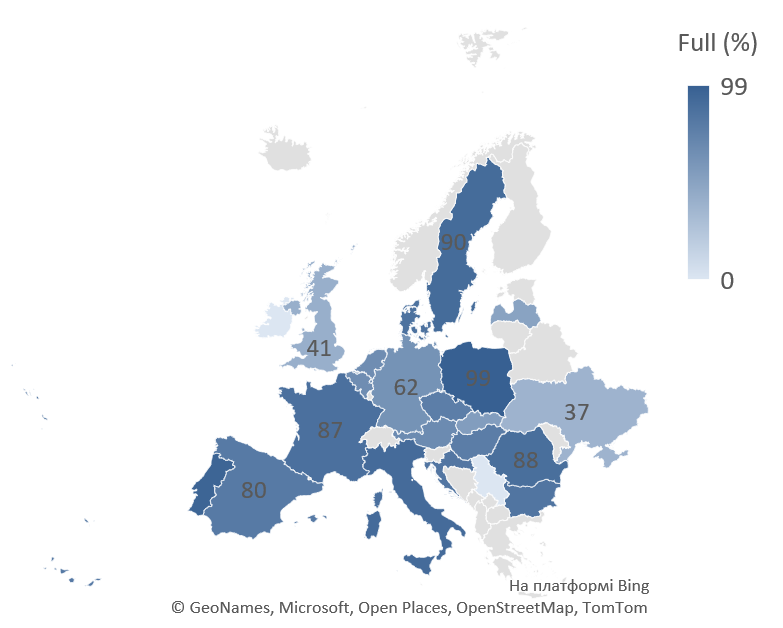
Across Europe, gas supplies are shrinking as winter approaches. Typically, Europe continues to replenish its gas storage facilities throughout October; however, as of October 20, 2026, gas injection into EU storage sites has effectively ceased, leaving them 74.89% full as of October 29. Europe is also receiving lower volumes of seaborne LNG, as it competes with Asia for cargoes. This pressure has been most evident in contracts for the coming months.
The TTF gas contract for November 2026 closed on Thursday, October 29, at 98.45 euros per MWh—9.3% higher than a week earlier, when it stood at 90.06 euros per MWh.
TTF seasonal contract prices are deviating from the typical seasonal pattern: while summer gas is usually cheaper than winter gas due to lower heating demand, gas for the summer of 2027 remains more expensive than the supply for the upcoming winter.
The two deadlines for Russian gas supplies to the EU fall on either side of the upcoming summer season. Supplies of Russian LNG to the EU are set to cease on January 1, 2027—three months before the start of the 2027 summer season—while supplies of Russian pipeline gas are to end by September 30, 2027.
In addition to the 2027 deadlines for supplies from Russia, prices are also being influenced by expectations surrounding the U.S. midterm elections on Tuesday, November 3. According to an analysis by ING, a Republican victory in both the House of Representatives and the Senate would likely embolden President Trump in his stance toward Iran and lead to an intensification of military actions. Further escalation could increase pressure on these contracts, while progress toward an agreement might ease it somewhat—though neither outcome is guaranteed, and the impact on prices may not be immediate.
In late October and early November 2026, an expected drop in temperatures across continental Europe, combined with light winds and fog—particularly in the United Kingdom—could boost demand for gas for heating and power generation, against a backdrop of declining output from renewable energy sources.
Natural gas imports from Europe averaged 1.3 million cubic meters per day (-0.5 million cubic meters from the previous week). Imports were recorded from Hungary and Moldova. Exports from customs warehouses averaged 14.1 million cubic meters per day (a 16% decrease compared to the previous week) and were directed toward Poland, Slovakia, and Hungary. Ukraine’s storage facilities held 15.9 billion cubic meters of natural gas, remaining unchanged from the previous week. Both withdrawals from and injections into underground gas storage facilities were virtually non-existent, signaling a transition in the injection season.