Gas price: Ukraine and Europe. Market overview October 19 - 23, 2026
In the "Medium- and Long-Term Market" section of the UEEX, trading continued for resources for October and subsequent months, involving the GTS and UGS. In total, 10 companies—including Naftogaz Trading, the Gas Transmission System Operator of Ukraine, and Ukrnafta—placed buy or sell orders for natural gas. A total of 62.1 million cubic meters of natural gas was sold in this section, a volume 38 times higher than the previous week’s figure. Successful transactions included buy orders from Naftogaz Trading and the Gas Transmission System Operator of Ukraine, as well as sell orders from Ukrnafta. Additionally, several combined heat and power (CHP) plants purchased natural gas on the UEEX last week. Prices showed an upward trend.
Trading also took place in the "Export of domestically produced natural gas" section. In total, approximately 30 million cubic meters of natural gas were sold in the section out of the quota authorized for October. Quoted prices in the section ranged from 76.67 to 82.52 euros per MWh.
On the UEEX short-term natural gas market, participants submitted bids on the within-day and day-ahead markets for the GTS and UGS. In total, 43 exchange trades were concluded, with an aggregate volume of 1,164 thousand cubic meters.
European gas prices are supported by risks of supply disruptions from the Middle East. On October 20, the TTF reached €90/MWh, subsequently falling to €88 amid unconfirmed reports of a potential resolution to the conflict with Iran. However, prices quickly resumed their upward trend, and on October 23, the TTF reached €93.43/MWh—an increase of 3.8% for the week.
Competition for LNG from Asia is intensifying: the Platts JKM index has exceeded $30/MMBtu for the first time since December 2022. Morgan Stanley has raised its forecast for European prices for the current winter to €90/MWh. Expected LNG imports to Europe in October stand at 9.11 million tonnes, compared to 10.59 million tonnes last year.
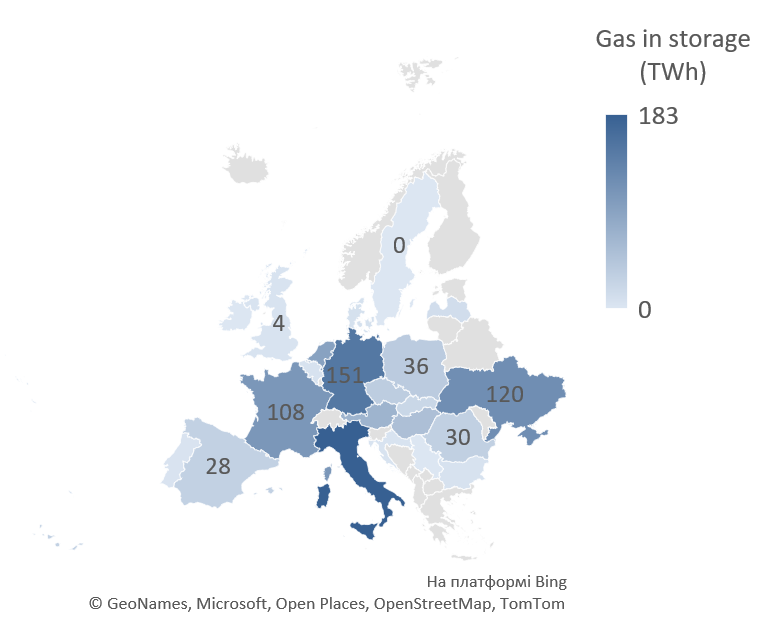
As of October 21, European gas storage facilities were only 74.6% full—the lowest level for this date since 2011. Gas injection has effectively ceased, and several countries have already begun withdrawing gas. Additional pressure stems from reduced Norwegian supplies due to maintenance at the Troll and Oseberg fields, as well as a decline of approximately one-third in Algerian gas supplies to Spain.
For the second consecutive week, investment funds have increased their long positions on the TTF, reaching 193.1 TWh—a sign that they anticipate further price increases. Should disruptions in the Middle East persist into the first quarter of 2027, the LNG deficit could worsen, making the European market more sensitive to cold spells and new supply constraints.
Natural gas imports from Europe averaged 1.8 million cubic meters per day (-0.4 million cubic meters from the previous week). Imports were recorded from Hungary and Moldova. Exports from customs warehouses averaged 16.71 million cubic meters per day (an increase of 17.43% compared to the previous week) and were directed toward Poland, Slovakia, and Hungary. Ukraine’s storage facilities held 15.9 billion cubic meters of natural gas. Both withdrawals from and injections into underground gas storage facilities were virtually non-existent, signaling an imminent transition from the injection season to the withdrawal season.