Gas price: Ukraine and Europe. Market overview October 12 – 16, 2026
In the "Medium- and Long-Term Market" section of the UEEX, trading continued for resources for October and subsequent months, involving the GTS and UGS. In total, 7 companies placed buy or sell orders for natural gas, including Naftogaz Trading, the Gas Transmission System Operator of Ukraine, Kyiv Metro, D.Trading, and others. A total of 1.65 million cubic meters of natural gas was sold in this section. Buy orders from the Gas Transmission System Operator of Ukraine, Kyiv Metro, and Concern MTM were successfully executed. The price trend was upward.
On Thursday, October 15, trading took place for the first time in the "Export of Domestically Produced Natural Gas" section. Four Ukrainian gas-producing enterprises offered a total volume of 135,706 MWh of natural gas. As a result, 100% of the volume was sold. The quoted price was established at 69.01 EUR/MWh, excluding VAT.
In the short-term natural gas market at the UEEX, participants submitted bids on the intraday market for the GTS and UGS facilities. In total, 43 exchange trades were concluded, with a combined volume of 1,053 thousand cubic meters.
On European gas markets, prices for the coming months currently remain high. A genuine improvement in traffic through the Strait of Hormuz will lead to lower prices. New disruptions or a prolonged cold spell could just as quickly cause short-term prices to rise. Traders expect this volatility to persist until the Strait is fully reopened.
In a market that changes so rapidly, attempting to buy at the lowest possible price is virtually impossible. A trader who waits for the perfect moment risks being caught out by the next price surge. Contracts for future years remain significantly cheaper than those for the coming months, but they have begun to rise as the risks associated with short-term prices extend further out in time.
The rise in natural gas prices this week was driven not by a single high-profile event, but by mounting risks to energy supplies. Iranian strikes on vessels outside the Strait of Hormuz have jeopardized the gradual recovery of Qatari LNG exports; following an attack on a Qatar-linked ship, shipments have slowed down once again. Threats by the Houthis to attack Aramco facilities have heightened concerns regarding the security of the region’s energy infrastructure, although they do not in themselves imply a reduction in LNG supply. Prices are receiving further support from forecasts of colder weather expected toward the end of October.
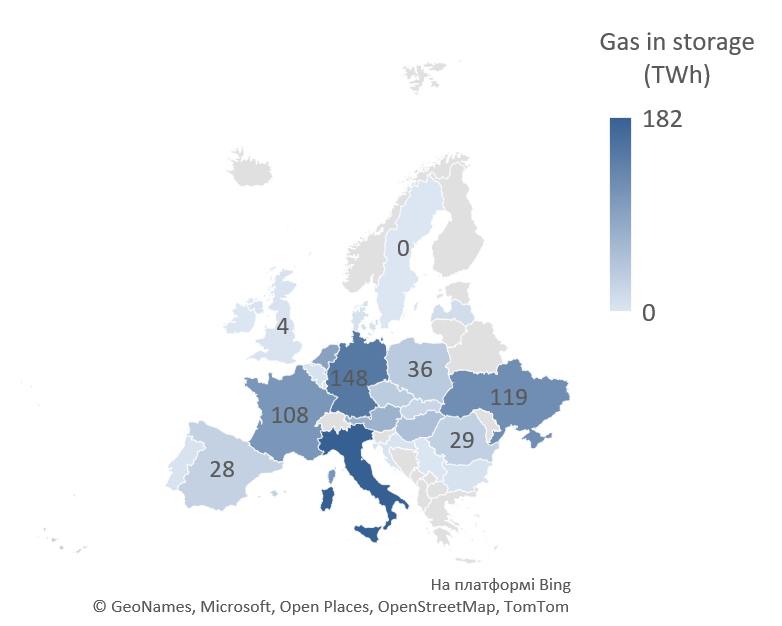
As of October 15, gas storage facilities in the EU were 74.10% full. Although stocks are nearly 15 percentage points below the five-year average (and in Germany, approximately 27.5% below the five-year norm), the German gas storage regulator has stated that there is currently no immediate threat to supply, even as the market approaches the peak of the winter season.
Supplies from Norway remain stable, despite a number of unplanned outages: volumes nominated for transport amount to approximately 338 million cubic meters per day.
Earlier this week, ENTSOG released its winter outlook. According to the report, if the upcoming winter proves to be the coldest since 2009—and one of the major import pipelines is lost—Europe would need to reduce demand by 12–15%. It should be noted, however, that this scenario was presented as an intentionally extreme case rather than a realistic forecast.
Natural gas imports from the European direction stood at 2.2 million cubic meters per day, remaining unchanged from the previous week. Imports were recorded from Hungary and Moldova. Exports from the customs warehouse averaged 14.23 million cubic meters per day—double the figure from the previous week—and were directed toward Poland, Slovakia, and Hungary. Ukraine’s storage facilities held 15.85 billion cubic meters of natural gas. Withdrawals from underground gas storage facilities were virtually non-existent; instead, injection was observed at a rate of approximately 13 million cubic meters per day.