Gas price: Ukraine and Europe. Market overview November 9 - 13, 2026
In the "Medium- and Long-Term Market" section of the UEEX, trading continued for resources for November and December 2026, as well as January 2027, within the GTS and UGS. In total, 7 companies established the initial positions, including GSC Naftogaz Trading, the GTS Operator of Ukraine, Ukrtransinvest, and others. The initiators primarily entered the market with positions to purchase natural gas. In total, 136.27 million cubic meters of natural gas were sold in this section. Successful buy orders were placed by GSC Naftogaz Trading, the GTS Operator of Ukraine, Teplovyk, and Cherkasyteplokomunenerho. The largest volume was purchased by Naftogaz Trading, with delivery into underground gas storage facilities scheduled for November and December 2026, and January 2027.
Trading also took place in the "Export of Domestically Produced Natural Gas" section. In total, approximately 13.24 million cubic meters of natural gas were sold within this section, drawn from the quota authorized for November. On Friday, November 13, the quoted price in this section stood at 78.12 euros per MWh.
On the UEEX short-term natural gas market, participants submitted bids on the within-day market for the GTS and UGS. In total, 38 exchange trades were concluded, with an aggregate volume of 956,000 cubic meters.
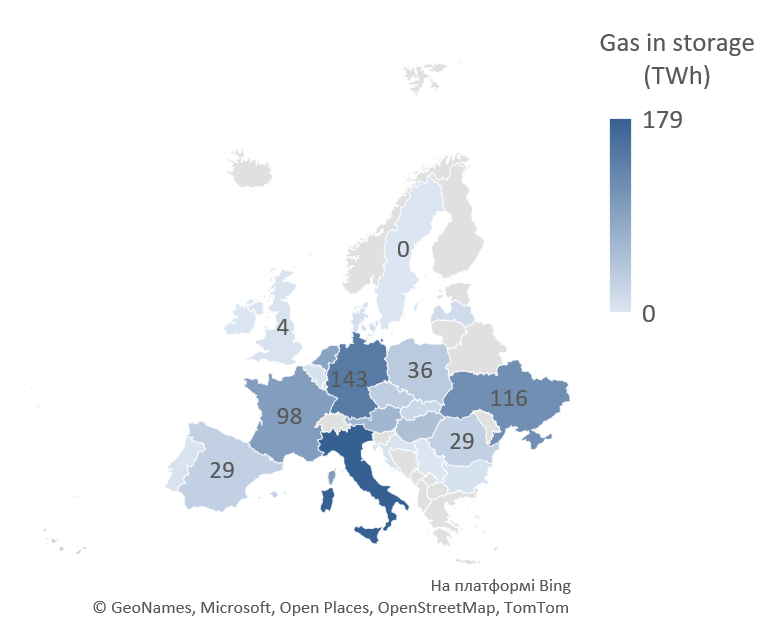
Prices for European contracts have risen due to intensifying geopolitical tensions. President Trump has made it clear that negotiations with Iran are being halted and that the U.S. naval blockade will continue. Iran’s seven conditions for the resumption of shipping in the Strait of Hormuz remain unchanged, leading the market to fear prolonged disruptions in energy supplies. Prices were also supported by a reduction in gas reserves in the EU: from 74.63% at the beginning of November to 71.25% as of November 12. Withdrawals from storage are proceeding faster than usual: 0.21 pp per day versus 0.12 pp for the same periods of the three previous winter.
Gas supplies to Europe are being constrained by disruptions along two routes. In Norway, there have been unplanned outages at the Oseberg and Åsgard fields, while the Visund field has been completely shut down until November 16. Despite this, supplies from Norway remain at a level of approximately 332 million cubic meters per day. Meanwhile, in the Strait of Hormuz, vessels continue to strike sea mines, and attacks on tankers are ongoing. All this is happening at a time when stocks in European storage facilities are 16 percentage points below the five-year average, making the market highly sensitive to new disruptions.
Forecasts for Northwestern Europe indicate that temperatures could drop 1.5°C below the norm over the weekend. From Monday through November 21, they are expected to return to or exceed normal levels. If disruptions in the strait persist and the winter proves colder than average, reserves could fall below 10% by the end of the season. In that case, more gas than usual would need to be purchased during the summer, and prices for long-term contracts would rise. A peace agreement between the US and Iran would ease the situation, but it would still take time to compensate for such a shortfall.
The situation regarding LNG is significantly better: in October, 31 loaded tankers passed through the strait—the highest monthly figure since the conflict began in February. The number of vessels arriving from the UAE has returned to pre-war levels, while Qatar’s share has exceeded 30%. Nevertheless, the International Energy Agency has maintained its forecast: global LNG supplies are set to decline by nearly 20 billion cubic meters (3%) this year, marking the sharpest drop on record. In addition, ORLEN has terminated one of its two long-term contracts with QatarEnergy. The company cited force majeure—a condition declared by QE back in March, which will remain in effect until at least January 2027.
There were no imports of natural gas from European directions. Exports from customs warehouses averaged 15.1 million cubic meters per day (an increase of 6% compared to the previous week) and were directed toward Poland, Slovakia, Moldova, and Hungary. Natural gas stocks in Ukrainian storage facilities stood at 15.58 billion cubic meters, down 0.27 billion cubic meters from the previous week. There was no injection into underground gas storage facilities, while withdrawals increased to 46 million cubic meters.