Gas price: Ukraine and Europe. Market overview November 2 - 6, 2026
In the "Medium- and Long-Term Market" section of the UEEX, trading continued for resources for November and December 2026, involving the GTS and UGS. In total, six companies—including GSC Naftogaz Trading, the GTS of Ukraine, and MBE—established the initial positions. Initiators primarily entered the market with buy orders for natural gas. In total, 54.25 million cubic meters of natural gas were sold within this section. Successful buy orders were placed by GSC Naftogaz Trading, the GTS of Ukraine, Teplovyk, MBE, and Concern MTM. The largest volume was purchased by GSC Naftogaz Trading, with delivery into UGS scheduled for November.
In the short-term natural gas market at the UEEX, participants submitted bids on the intraday market for the GTS and UGS. In total, 40 exchange trades were concluded, with an aggregate volume of 1,797 thousand cubic meters.
The rise in prices for European gas contracts was driven by uncertainty regarding the resolution of the conflict involving Iran, fresh attacks on vessels and incidents involving mines in the Strait of Hormuz, as well as a one-week extension to the production shutdown at Norway’s Visund field, which constrained Norway’s export capacity.
The market remains sensitive to geopolitical news. On Friday, November 6, prices fell following reports of discussions between President Trump and Qatar regarding the de-escalation of tensions in the Middle East. The price for TTF gas for delivery next month declined, whereas the previous week it had exceeded €100 per MWh, reaching a four-year high.
QatarEnergy has extended the force majeure status regarding supplies until at least the end of December 2026. Meanwhile, the Republicans’ defeat in the midterm elections—and Vice President J.D. Vance’s acknowledgment that the war with Iran influenced the outcome—have heightened expectations for a diplomatic resolution to the conflict. Analysts note that the situation in the European gas market after the winter ends will depend largely on the resumption of LNG supplies from the Persian Gulf. Given limited supply, weather conditions will also be a decisive factor for prices throughout the winter.
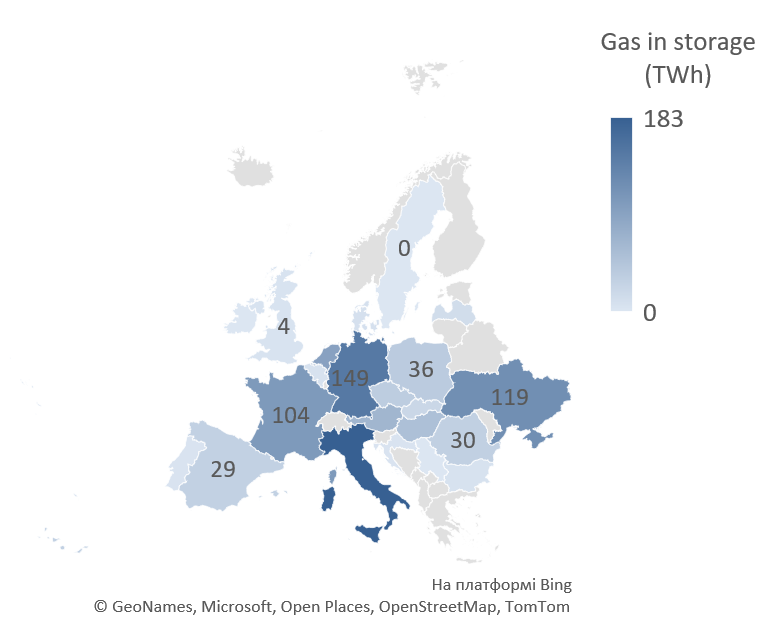
As of November 5, European gas storage facilities are 73.75% full—16 percentage points below the five-year average. A cold start to November has led to a net withdrawal of gas, contrasting with the injection typically seen during this period. Analysts estimate that prolonged freezing temperatures, combined with potential disruptions to Qatari LNG supplies, could cause winter stock levels to fall to 80% below the five-year average. This will significantly increase the need for gas injection in 2027 and put additional pressure on the prices of term contracts.
There were no natural gas imports from the European direction. Exports from the customs warehouse averaged 14.25 million cubic meters per day (1% higher than the figure for the previous week) and were directed toward Poland, Slovakia, and Hungary. Ukraine’s storage facilities held 15.85 billion cubic meters of natural gas—a decrease of 0.05 billion cubic meters compared to the previous week. Injection into UGS was virtually non-existent, while withdrawals rose to 18 million cubic meters, signaling a shift from the injection season.