Gas price: Ukraine and Europe. Market overview November 16 – 20, 2026
In the "Medium- and Long-Term Market" section of the UEEX, trading continued for resources for November and December 2026, within the GTS and UGS. In total, 10 companies established the initial positions, including the Gas Transmission System Operator of Ukraine, Ukrtransinvest, and several CHP. The initiators primarily entered the market with buy orders for natural gas. In total, 19.05 million cubic meters of natural gas were sold in this section. The buy orders placed by the GTS Operator of Ukraine and district heating companies were successful.
Trading also took place in the "Export of Domestically Produced Natural Gas" section. In total, approximately 28.5 million cubic meters of natural gas were sold within this section, drawn from the quota authorized for November. On Friday, November 20, the quoted price in this section stood at 78 euros per MWh.
In the UEEX short-term natural gas market, participants submitted bids on the within-day market for GTS and UGS. In total, 7 exchange trades were concluded, with a combined volume of 485,000 cubic meters.
The rise in volatility in European gas prices was driven by a combination of geopolitical risks, declining gas storage levels, and uncertainty regarding future LNG supply volumes. At the beginning of the week, prices at the Dutch TTF hub were falling, but by November 20, quotes had risen to 89 euros/MWh.
The primary geopolitical risk remains the tension in the Middle East, particularly the situation surrounding the Strait of Hormuz, through which a significant portion of global LNG supplies from Persian Gulf countries passes. Potential disruptions to Qatari gas exports could intensify competition between European and Asian buyers for available LNG cargoes, drive up transportation and insurance costs for tankers, and add a premium to European price quotes; meanwhile, US LNG could serve as an additional factor supporting supply. Nevertheless, competition from the Asian market remains a significant risk, as increased demand in Asia may divert part of the LNG tankers from the European direction, limiting the availability of spot lots for the EU.
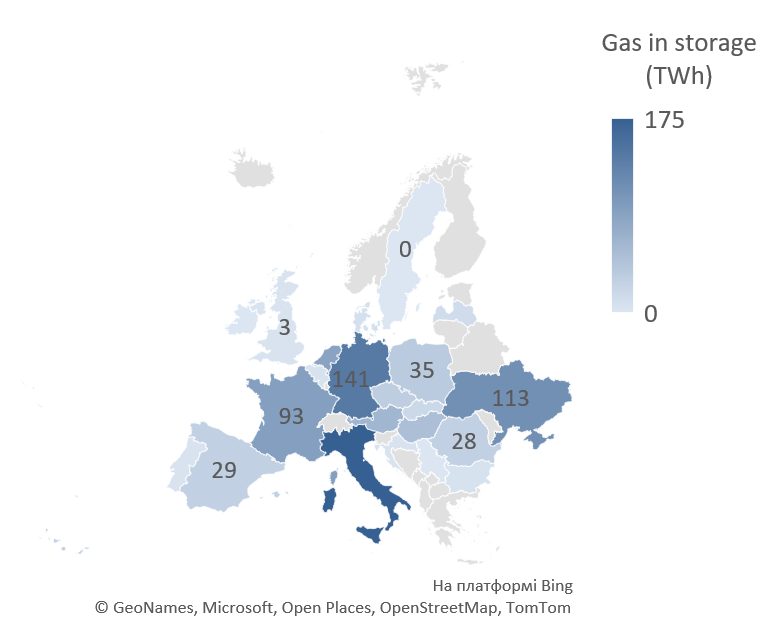
European gas storage levels continue to decline as the heating season begins. As of November 18, storage facilities were approximately 69.8% full—amounting to roughly 790 TWh—which is 1.4 percentage points lower than the figure from the previous week. Further cooling could accelerate withdrawal rates, increase the need for additional LNG purchases, and heighten risks for price-linked contracts throughout the winter period.
Norway remains a key supplier of pipeline gas to Europe, compensating for the reduction in Russian exports. Based on flow estimates for November 18, Norwegian supplies amounted to approximately 3.96 TWh per day, or 42.3% of the total supply volume under consideration. LNG imports accounted for about 3.77 TWh per day, or 40.3%, while other routes provided the remaining 17.4%. Algeria—which exports gas to Spain and Italy—and Azerbaijan—via the Southern Gas Corridor—also play an important role in supply diversification. Thus, the stability of Norwegian exports and the uninterrupted operation of LNG terminals remain critical for maintaining the European gas balance.
Imports of natural gas from the European direction were practically non-existent. Exports from bonded warehouses and permitted exports of own production averaged 15.72 million cubic meters per day (4% more than the previous week). Exports were directed toward Poland, Slovakia, Moldova, and Hungary. Ukraine’s storage facilities held 15.28 billion cubic meters of natural gas—a decrease of 0.3 billion cubic meters compared to the previous week. There was no injection into underground gas storage facilities, while withdrawals averaged 42 million cubic meters per day.