Gas price: Ukraine and Europe. Market overview May 25 - 29, 2026
In the "Medium and Long-Term Market" section of the UEEX, trading in the resource continued in May and June 2026. In total, positions for the sale or purchase of natural gas were formed by 7 companies: MC Ukrnaftoburinnia, GSC Naftogaz Trading, Concern "MTM", Energo Zbut Trans, etc. During the week, 1,518 thousand cubic meters of natural gas were sold in the section - the June resource in the GTS. Successful were the positions for the purchase of Concern "MTM", Energo Zbut Trans, Ukrzaliznytsia. The sale prices were in the range of 21458-21900 UAH/thousand cubic meters excluding VAT.
On the short-term natural gas market of the UEEX, participants formed applications on the within-day market and the day-ahead market. In total, 120 deals were concluded with a total volume of 3,799 thousand cubic meters.
Progress towards a Middle East agreement has renewed optimism in the European region. Gas prices reversed course on Thursday after Reuters sources reported that the United States and Iran had reached a preliminary agreement to extend a ceasefire and lift restrictions on shipping through the Strait of Hormuz, which is awaiting approval from President Donald Trump. However, Iranian state media reported that the deal had not yet been finalized. Futures fell on Friday morning, heading for their biggest weekly drop since early April, after signs that a deal was on the cards.
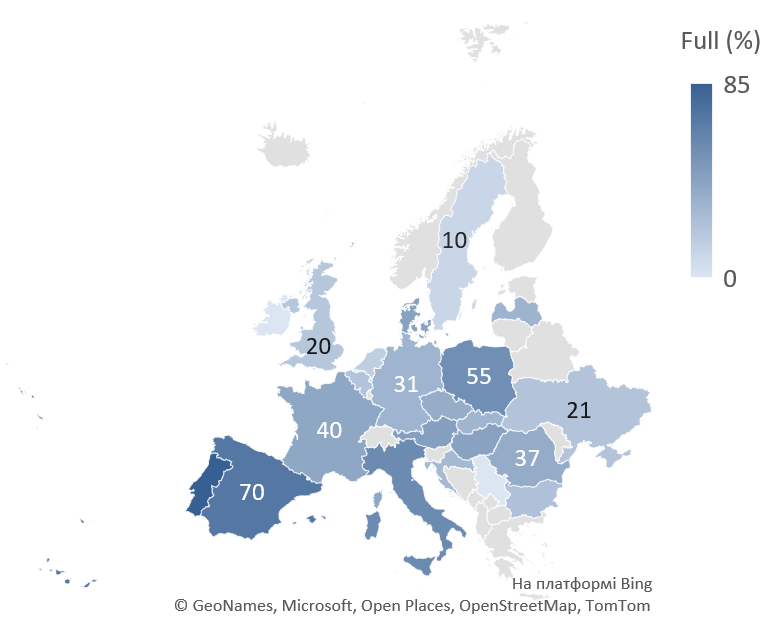
The occupancy rate of European gas storage remains at 39.1% (442.74 TWh) as of 28.05.2026. This is not yet a crisis level for the end of May, but it creates a tighter injection schedule for the summer.
Gas injection into storage in Central and Eastern Europe is happening too slowly to fully close the gap from last year: at the current pace, reserves can only reach about 70% by November 1, compared to 82% last year. Austria, the Czech Republic and Slovakia have the largest deficits, with the region as a whole at 15.7 TWh. Poland, Hungary and Slovakia are gaining momentum thanks to stable pipeline gas supplies and could exceed 80% fill, while the Czech Republic risks reaching only around 60% instead of the target of 90%. Bulgaria and Croatia also remain vulnerable due to limited storage and dependence on LNG imports, which increases the risks of shortages, price volatility and competition for gas supplies.
In the background remain strikes at Australian LNG facilities, which are restricting global exports, and a decline in pipeline imports due to the shutdown of the Norwegian Oseberg gas field, which is now completely shut down. The calendar of maintenance restrictions included Troll, Oseberg, Nyhamna and Ormen Lange. Against a backdrop of low storage, even short-term declines in pipeline flows support TTF’s sensitivity to infrastructure news.
Natural gas imports from Europe were at 0.11 million cubic meters per day, unchanged from the previous week. Imports were present from Poland and Hungary. Exports from bonded warehouses were absent. Ukraine’s storage facilities contained 11.03 (+2.22%) billion cubic meters of natural gas. Withdrawals from underground storage facilities were almost non-existent, but there was injection - about 36 million cubic meters per day.