

Gas price: Ukraine and Europe. Market overview May 20 - 24, 2024

Gas price: Ukraine and Europe. Market overview
Over the last week, natural gas prices in Ukraine showed a moderate downward trend until Friday, unlike the prices of European hubs.
Ukrainian Energy Exhange
Last week, trading in May 2024 and June 2024 continued. In total, positions for the purchase and sale of natural gas were formed by 3 companies: Ukrnafta, GTS Operator of Ukraine, and PPC Naftogaz Trading.
The starting prices of resources were decreasing throughout the week. As a result, as of Friday, the average starting price of May resources in the GTS was 0.14% lower than on Monday.
Last week, both sell and buy positions were sold. A total of 29200 thousand cubic meters of natural gas were sold. Of these, PPC Naftogaz Trading purchased 7,700 thousand cubic meters of June resource in the GTS, GTS Operator of Ukraine purchased 15,500 thousand cubic meters of June resource in the GTS, and Ukrnafta sold 6,000 thousand cubic meters of May and June resource in the UGS facilities.
Last week, the prices of items sold ranged from UAH 12163 to UAH 12375 excluding VAT.
On the short-term natural gas market of the UEEX, participants formed bids in the GTS and UGS. Gas was sold on the within-day market. The marginal prices resulting from the auction are shown in the chart below.
European market
Last week was marked by a rise on natural gas prices ahead of the expiration of the June option contract. On Tuesday evening, May 21, Austrian gas importer OMV issued a statement saying that a legal dispute with Russian Gazprom could lead to a suspension of payments. News that gas flows from Russia may end earlier than expected pushed prices up. M+1 gas contracts at the Dutch hub TTF reached 36.24 EUR MWh, the highest level since December 27. The benchmark gas price for Europe on Friday, May 24, fell from a five-month high in the previous session as fears of supply cuts eased.
Prices of contracts with delivery within the relevant period, EUR/MWh, 05/23/2024
| Instrument | THE | CEGH | TTF | TGE/POLPX | CEEGEX/HUDEX | Average price |
|---|---|---|---|---|---|---|
| Day1 | 35,43 | 36,55 | 35,45 | 35,31 | 31,78 | 34,90 |
| M+1 | 35,4 | 36,54 | 35,29 | 38,99 | 35,68 | 36,38 |
| Q +1 | 36,24 | 37,73 | 36,12 | 39,79 | 37,32 | 37,44 |
| S +1 | 41,15 | 42,32 | 40,56 | 46,15 | 41,89 | 42,41 |
Month-ahead contracts at all analyzed hubs showed the same trend as spot prices, with an average increase of 4.43%. Quarter-ahead prices were higher than spot prices by an average of 7.51%. Season-ahead prices with an average value of EUR 42.41/MWh tended to increase by an average of 21.78% compared to spot prices.
The NBP also hit 4.5-month highs as supply concerns from Norway and technical trading fueled market sentiment. The price of Win-24 gas increased by 1.5% last Thursday, settling at 104.57 p/therm, under the influence of potential supply disruptions.
Additionally, maintenance work in Norway, rising demand for LNG in China, and fears of a decline in US exports due to delays in the construction of the Golden Pass LNG terminal have heightened concerns about supply stability.
High demand in Asia increased further last week. The July futures for LNG in Asia, the JKM Platts Future Index, closed on May 23 at USD 439 per thousand cubic meters. The LNG North West Europe Marker futures for LNG delivered to Northwest Europe amounted to USD 384 per thousand cubic meters.
Gas consumption increased. The rather weak situation with the supply of renewable energy sources on the continent and in the UK also contributed to the increase in the need for gas for electricity generation. The average temperature in Europe’s largest gas consumer, Germany, is expected to be 1.1 degrees above normal this week, while in neighboring France the average temperature will be 16.5°C, 0.2°C below normal.
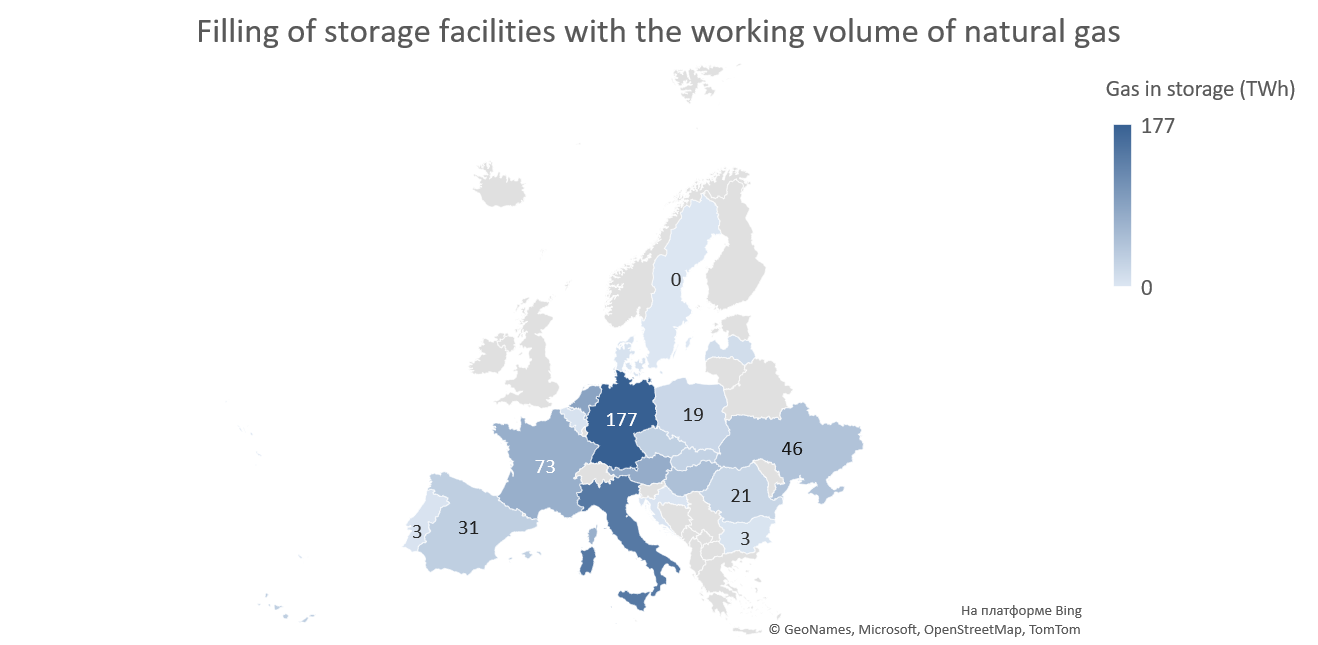
The European gas storage capacity was 67.7% as of May 22, according to the latest Aggregated Gas Storage Inventory data, up 1.6% from the week before last and 0.9% from a year ago. Low levels of renewable energy generation on the continent and in the UK have led to a halt in storage injections.
Flows through the Norwegian pipeline to Europe to European entry points increased by 8.6 million cubic meters to 269.8 million cubic meters on May 22, despite an unplanned failure at the Troll gas field that reduced supplies by 12 million cubic meters per day. Norwegian flows to the rest of Europe were observed at 286.6 million cubic meters per day on May 24, compared to 264.7 million cubic meters per day on Thursday, according to Gassco data.
European LNG terminals operated at an average capacity of 70.603%. As of May 22, LNG stocks in the EU amounted to 3.987 million cubic meters, according to the Aggregated LNG Storage Inventors.
The storage level of the largest LNG exporter, the United States, according to the latest EIA data as of May 17, 2024, was 2.711 billion cubic feet.
On the related market, oil prices fell to a 3-month low on Thursday, May 23, amid weak demand and high Fed rates. Brent crude oil was trading at USD 80.71 per barrel on May 24.
Gas balance in Ukraine
Last week, natural gas imports were present only from Hungary, averaging 1.5 million cubic meters per day. Exports to Poland and Slovakia averaged 1 million cubic meters per day. Exports decreased compared to previous periods. Ukraine had about 9 bcm in storage facilities. Injections amounted to approximately 33 million cubic meters per day.
Interesting for the week
Ukrnaftoburinnya hopes that the court will be able to return the revoked special permits to Ukrainian companies, which led to the suspension of production at the Sakhalin field in Kharkiv region. It is noted that due to the suspension of production at the Sakhalin field, the state annually loses UAH 10 billion in taxes and dividends and 500 million cubic meters of gas. The press service reminded that gas has not been produced since December 1, 2023. According to the company, the estimated losses reach UAH 5 billion and 250 million cubic meters of gas.
Austria may stop buying Russian gas this summer earlier than expected, former regulator chairman Walter Bolz said on Wednesday evening, following a warning from the country’s main gas company, OMV. Market observers had expected Russian supplies to stop by the new year, as the transit agreement with Ukraine expires. OMV has warned that it may have to stop paying for gas to Russia’s Gazprom Export due to legal problems, which could affect supplies of up to 6 billion cubic meters a year. Bolz said that the legal issues are likely to relate to one of the arbitration lawsuits that European companies have launched after Gazprom cut supplies following Russia’s full-scale invasion of Ukraine in 2022. The reduction in Russian gas supplies has hit several companies, such as Germany’s Uniper, VNG and Sefe, as well as Italy’s Eni and France’s Engie. In the case of OMV, Gazprom Export’s payments can be redirected to a third party through a court decision, and then “Gazprom will stop supplying no later than in one or two months,” Bolz said. “Therefore, I would assume that Russian gas supplies will stop at some point this summer, perhaps in two to three months,” he added.


