

Gas price: Ukraine and Europe. Market overview May 13 - 17, 2024

Gas price: Ukraine and Europe. Market overview
During the last week natural gas prices in Ukraine were declined, despite of Europen hubs quotations.
Ukrainian energy Exchange
Trading with resource of May 2024 and June 2024 was ongoing last week. In total, 3 companies formed positions for the purchase and sale of natural gas: Ukrnafta, PPC Oil & Gas Trading, and GTS Operator of Ukraine.
Resources starting prices were decreased during the week. To sum it up, as of Friday, medium starting price of May resource in GTS was lower than the Monday indicator for 0,88%.
During the last week purchase positions were sold. In general 11500 th.c.m. of natural gas of May and June resource were sold. GTS Operator of Ukraine purchased all volume of the last week. Prices of sold positions are in the range of UAH 12384,88 – 12688 with a downward trend.
In the short-term natural gas market of the UEEX, participants placed applications to the GTS and UGS facilities. Gas was sold on the intraday market. During the week, the short-term market saw diverse price movements. The marginal prices formed as a result of trading are shown in the chart below.
European market
Gas injections in Europe and seasonally high demand in Asia supported prices, while various outages at Norwegian fields and facilities provided some momentum for price growth last week. The Gullfaks and Visund gas fields are still experiencing outages (ending in early June), while the Troll gas field and Kollsness processing plant will be completely shut down on Tuesday, resulting in a loss of 158 million cubic meters per day of capacity supplied to Europe. British gas prices rose on Thursday as Norway scheduled maintenance for next week. As a result, the NBP spot price increased by about 3% and settled at 73,40 p/therm.
The risk of supply disruptions due to geopolitical problems in the Middle East, which could disrupt cargo supplies from the energy-rich region, and russia’s war against Ukraine, as well as reduced LNG supplies, supported prices for the next season. The price of gas for Win-24 delivery increased on the TTF to 36,17 EUR/MWh, and on the NBP by 1,3% to close at 93,71 p/therm.
Prices of contracts with delivery in the relevant period, EUR/MWh., 16.05.2024
| Instrument | THE | CEGH | TTF | TGE/POLPX | CEEGEX/HUDEX | Average value |
|---|---|---|---|---|---|---|
| Day1 | 30,11 | 30,7 | 30,10 | 30,77 | 27,82 | 29,90 |
| M+1 | 30,2 | 30,67 | 30,21 | 33,58 | 30,55 | 31,04 |
| Q +1 | 30,99 | 31,62 | 30,97 | 34,14 | 31,72 | 31,89 |
| S +1 | 36,53 | 37,04 | 36,17 | 41,48 | 36,92 | 37,63 |
Month-ahead contracts at all analyzed hubs showed the same trend as spot prices, with an average increase of 3,90%. Quarter-ahead prices were higher than spot prices by an average of 6,76%. Season-ahead prices with an average value of 37,63 EUR/MWh tended to increase compared to spot prices by an average of 25,93%.
Demand for LNG in Asia remained fairly strong and coincided with some outages at LNG export facilities such as Australia’s Gorgon terminal. The June LNG futures in Asia, the JKM Platts Future index, closed on May 16 at USD 375 per thousand cubic meters. The LNG North West Europe Marker futures for LNG delivered to Northwest Europe amounted to USD 333 per thousand cubic meters.
Gas consumption fluctuated about a quarter below the 5-year average. Last week’s spring weather was neither cool enough to provide heating nor hot enough to stimulate demand for air conditioning. Particularly high levels of solar power generation in Europe last week further restrained the use of gas for electricity generation. The average temperature in Europe’s largest gas consumer, Germany, is expected to be almost 4 degrees above normal this week and 1 degree above normal next week.
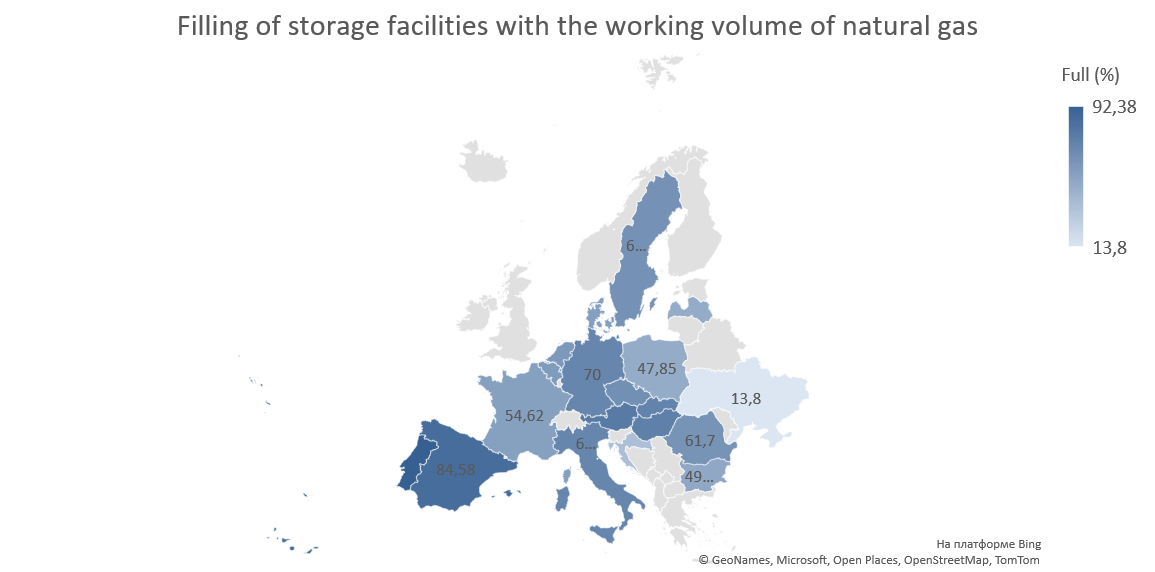
European gas storage facilities are at 66,1% as of May 15, according to the latest Aggregated Gas Storage Inventory data. This is 2% more than last year, and the daily injection rate during May was 0,33%. Storage facilities in the UK are 38% full.
Flows through the Norwegian pipeline to Europe on Thursday amounted to 322 million cubic meters per day, which is 31 million cubic meters per day more than the volume the day before last Thursday. According to Gassco, the availability of the Norwegian gas pipeline on Tuesday, May 21, will be reduced by 177 million cubic meters per day, and then drop to about 55 million cubic meters per day by the end of the month.
European LNG terminals operated at an average capacity of 70,6%.
As of May 15, LNG stocks in the EU amounted to 4,588 million cubic meters, according to the Aggregated LNG Storage Inventors.
The storage level of the largest LNG exporter, the United States, according to the latest EIA data as of May 10, 2024, was 2,663 billion cubic feet.
On the adjacent market, Brent crude oil was trading at USD 83,54 per barrel on May 17. Market optimism is driven by signs of growing demand from China and the United States. China’s strong annual industrial production figures, combined with government stimulus measures, indicate a potential increase in demand.
Gas balance in Ukraine
Last week, natural gas imports were present only from Hungary, averaging 1,73 mcm per day. Export flows to Poland and Slovakia were observed with an average volume of 1 mcm per day. Exports decreased compared to previous periods. Ukraine had about 8,7 bcm in storage facilities. Injections amounted to approximately 24 million cubic meters per day.
Interesting for the week
The Cabinet of Ministers has adopted a resolution that simplifies the location of gas turbine and gas piston installations and related networks. This was announced by the Prime Minister of Ukraine Denys Shmyhal. In particular, the CMU resolutions No. 1010 "On Approval of Criteria for Determining Planned Activities Not Subject to Environmental Impact Assessment and Criteria for Determining Expansions and Changes in Activities and Facilities Not Subject to Environmental Impact Assessment" dated 13.12.2017 and No. 1320 "On Certain Issues of Placing Gas Piston Cogeneration Units During the Period of Martial Law" dated 07.12. 2023 No. 1320 "Some Issues of Deployment of Gas Piston Cogeneration Units for the Period of Martial Law" to improve and increase simplified conditions for the construction and/or deployment of gas piston and gas turbine units, including cogeneration, block-modular boiler houses, diesel/gasoline and gas generators (with a capacity of 1 MW or more), as well as related electricity, gas and water supply networks, heat, gas, water supply, metering units, and other related equipment during martial law to create conditions for the sustainable passage of the 2024/25 heating season and to provide consumers and social institutions with heat and electricity due to the constant damage to heat and electricity generation facilities amid Russia’s military aggression.
Leading European industry and energy experts say cutting red tape and speeding up the approval of new renewable energy projects is vital, warning that red tape is threatening the continent’s environmental goals. Barbara Flesche, executive vice president of the European division of Norwegian energy company Statkraft, said the firm’s renewable energy projects are hampered by long authorization periods in most European markets. Grid access has also been a big issue, causing viable projects to be delayed. If there are further delays, European countries will remain dependent on expensive fossil fuels for much longer than they should be.


