
Gas price: Ukraine and Europe. Market overview March 4 - 8, 2024

Gas price: Ukraine and Europe. Market overview
Last week, natural gas prices in Ukraine fluctuated, following the trends of European hubs.
Ukrainian Energy Exchange
Last week, trading in March 2024 and April 2024 resources continued. In total, positions for the purchase and sale of natural gas were formed by 3 companies: Ukrnafta, GTS Operator of Ukraine, and Naftogaz Trading.
Starting prices of resources were growing throughout the week. As a result, as of Friday, the average starting price of resources in UGS facilities was 0.37% higher than on Monday.
Last week, both sell and buy positions were sold. In total, 20.5 million cubic meters of natural gas were sold. The price range of the sold items was UAH 11116.7-11308 excluding VAT.
On the UEEX short-term natural gas market, participants placed applications in the GTS and UGS facilities.
The marginal prices formed as a result of the auction are shown in the chart below.
European market
Europe’s gas balance is secure amid stable supply, "cool" demand and high storage levels, market participants say. The benchmark monthly contract on the Dutch hub TTF was trading lower on Friday due to high volumes of European gas storage facilities, according to Ice Endex.
LNG spot prices in Asia and European gas prices for April delivery fell below USD 9 per million BTU . The April futures for LNG in Asia, the JKM Platts Future index, traded last Thursday, March 7, at USD 301 per thousand cubic meters (EUR 26.30/MWh). LNG prices in Asia may recover later this year due to growing demand and limited additional export capacity, according to market analysts. Futures for LNG delivered to Northwest Europe (LNG Northwest Europe Marker) were trading at USD 268 per thousand cubic meters.
The warming of the forecasted temperatures on working days next week by 1-2°C according to key European forecasting models indicates a decrease in the likely demand of end consumers for heating. In the UK, a sharp rise in temperature over the weekend and especially next week is expected to reduce demand. The background seasonal warming of 0.5C/week is now also a factor in structuring demand.
Prices of contracts with delivery within the relevant period, EUR/MWh, 07.03.2024
| Instrument | THE | CEGH | TTF | TGE/POLPX | CEEGEX/HUDEX | Average price |
|---|---|---|---|---|---|---|
| Day1 | 26,03 | 27,52 | 25,67 | 29,12 | 23,73 | 26,41 |
| M+1 | 26,18 | 27,12 | 25,97 | 30,44 | 26,01 | 27,14 |
| Q+1 | 26,28 | 27,3 | 26,07 | 30,45 | 26,2 | 27,26 |
| S+1 | 26,48 | 27,45 | 26,29 | 30,94 | 26,42 | 27,52 |
Month-ahead contracts at all the analyzed hubs showed a different trend in relation to spot prices, with an average increase of 2.88%. Prices a quarter ahead were 3.34% higher than spot prices on average. Season-ahead prices with an average value of EUR 27.52/MWh tended to increase by an average of 4.29% compared to spot prices.
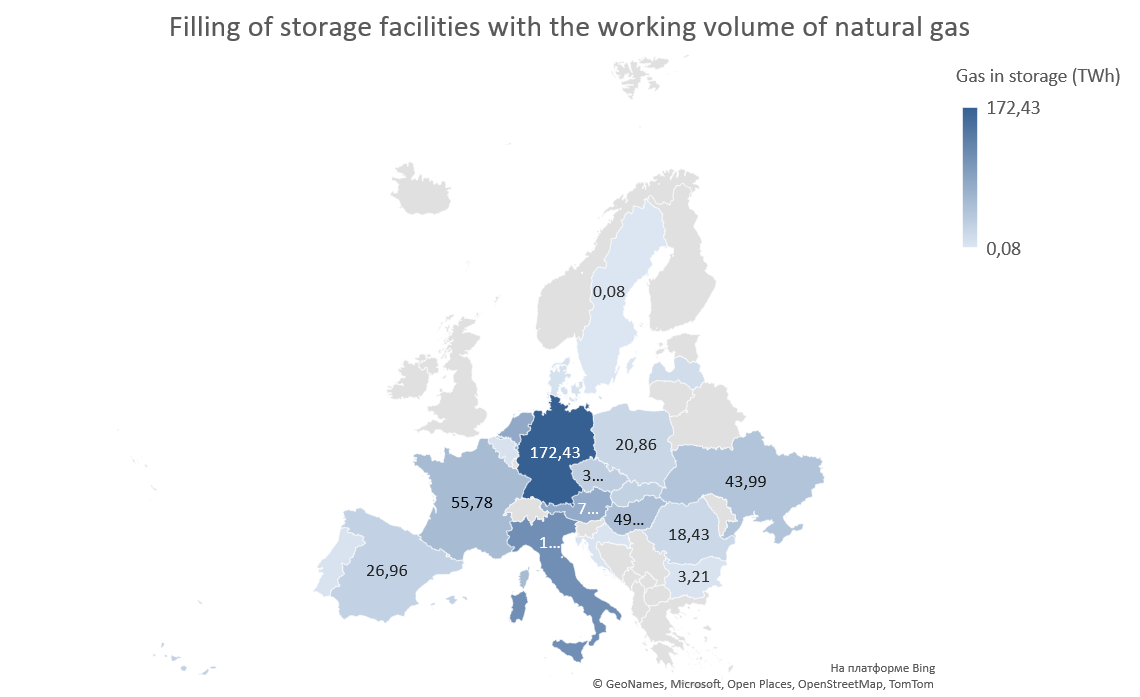
The level of gas storage in the EU has fallen to 61.3% (~700 TWh) of capacity, according to the latest Aggregated Gas Storage Inventory data as of March 6, which is almost 3% higher than last year. Another mild European winter has resulted in gas storage levels in Europe well above the five-year seasonal average. Storage facilities are expected to end the winter season at least half full, with some southern countries publishing their intentions to start feathering injections earlier in the week, and Germany expected to follow soon.
As of March 6, LNG stocks in the EU amounted to 5.251 million cubic meters, according to the Aggregated LNG Storage Inventors. LNG imports to Europe and Turkey last week may have nearly hit their lowest level of the year at 2.7 bcm, according to preliminary ship tracking data from Kpler, down from 3.4 bcm the week before.
European LNG terminals operated at an average capacity of 69.8%.
According to Gassco, on March 8, gas bids from Norway to the rest of Europe were pegged at 347 million cubic meters per day, up slightly from 344 million cubic meters per day on Thursday.
The storage capacity of the largest LNG exporter, the United States, according to the latest EIA data, was 2.334 billion cubic feet as of March 1, 2024. In the US, high reserves and production, as well as low domestic and global demand, are keeping market prices down. US LNG exports totaled 680,000 tons in March. Of the total volume, 54% was delivered to Europe and about 15% to Asia.
Gas balance in Ukraine
Last week, natural gas imports were available from Hungary, at an average daily level of 2.15 million cubic meters. Export flows from the "customs warehouse" to neighboring countries were observed. Exports decreased compared to the previous periods, remaining at an average level of 3.1 million cubic meters per day. Ukraine’s storage facilities contained about 8.6 bcm, with daily withdrawals of 38 mcm per day due to the warm weather.
Public procurement
Last week, nine tender procedures were held for the purchase of natural gas by budgetary institutions and state-owned enterprisesIn total, 457,198.88 cubic meters of natural gas worth UAH 5,461,590.73 were sold at the largest tenders. The largest contract was awarded to Midas Holding, which will supply 181,248.71 cubic meters of natural gas to the EDUCATION DEPARTMENT of Horodenka City Council at an initial price of UAH 12.92 per cubic meter. The average price increased and amounted to UAH 11.53 per cubic meter. Prices ranged from UAH 10.97 to UAH 12.92 per cubic meter.
Interesting for the week
Icis predicts that the LNG market will be undersupplied by 15 million tons this year and by 7 million tons next year. In 2023, only 13 million tons (17.7 billion cubic meters) of new LNG capacity was commissioned globally, and another 20 million tons are expected in 2024, said Alex Siew, an analyst at Icis from Singapore, at the event. But gas demand is projected to grow by 8% this year compared to last year and by another 6% in 2025. Demand growth will come from China, as well as new importers in South and Southeast Asia, where domestic gas production and pipeline imports are not keeping pace with growing gas needs.
The world’s most powerful methane detection satellite was launched into space on a SpaceX Falcon rocket on March 5. The MethaneSat project from the US Environmental Defense Fund offers the market unparalleled accuracy in measuring global methane emissions in real time. The MethaneSAT data will help to better hold companies and governments accountable for methane emissions, which is a potent greenhouse gas. The satellite tracks more than 80% of the world’s hydrocarbon production, in many cases at specific sites and assets, according to Gas United.