Gas price: Ukraine and Europe. Market overview March 2 - 6, 2026
In the "Medium and Long-Term Market" section of the UEEX, trading in the resource continued in March and April 2026. In total, positions for the sale or purchase of natural gas were formed by 5 companies: Ukrnafta, MC Ukrnaftoburinnia, JV BNK, LTK Electrum, Energy Business. The section sold 8.6 million cubic meters of natural gas, which is half as much as in the previous week. Natural gas was sold with delivery to the GTS and UGS in March. The positions of two selling companies - Ukrnafta and MC Ukrnaftoburinnia - were successful. The prices of the sold positions were in the range of 20069.44-22826.13 UAH/thousand cubic meters excluding VAT. A sharp upward trend in stock quotes was observed during the week.
In addition, Ukrnafta sold 8 million cubic meters of natural gas in the differential trading section with a premium of 4.6-8.82 euros to TTF.
On the short-term natural gas market of the UEEX, participants formed applications on the intraday market, in the GTS and UGS. In total, 43 agreements were concluded with a total volume of 2,247 thousand cubic meters. (+106,72%).
Gulf conflict tests Europe’s new reliance on LNG. Analyzing the first week of March, it is worth noting that on Monday gas prices in Europe rose sharply again. At the same time, interest in "long" products (summer/winter 2027) intensified, the prices of which began to rise after QatarEnergy suspended LNG production at key facilities following a drone attack on the export center of Ras La. The market’s attention is now more focused on the timing of the war and has moved away from the primary shock.
Shipping data shows that many tankers have dropped anchor or changed their route, as a result of which the Strait of Hormuz - the world’s most important narrow passage for gas - is effectively closed to most commercial shipping, commercial traffic has decreased by ≈ 90%, which effectively "narrows" the corridor for supplies. At the same time, production shutdowns and shipping disruptions are forcing governments, shipowners and energy buyers to confront a risk that has gone unnoticed for years: what would happen if a fifth of the world’s LNG supply were suddenly at risk.
As of March 6, the conflict has been ongoing for seven days and statements note that new incidents are increasing risks to shipping and security.
Regarding supplies, the key escalation is QatarEnergy’s declaration of force majeure. It is emphasized that it will take about 2 weeks to return to work after a complete shutdown of the LNG plant. It also notes that Goldman Sachs expects that flows in Hormuz can be restored in 5 days and fully normalized in 4 weeks, but even a “fast” path to return to normal still involves weeks of limited logistics and increased risk.
As for prices, Wednesday saw a broad pullback from Tuesday’s extremes across much of the curve. Latest analysis suggests the market is no longer moving in a straight line; it is oscillating between "short war" optimism and renewed overvaluation as new incidents enter the market. This is exactly the type of environment where “waiting for clarity” can turn into buying after a price change, not before it.
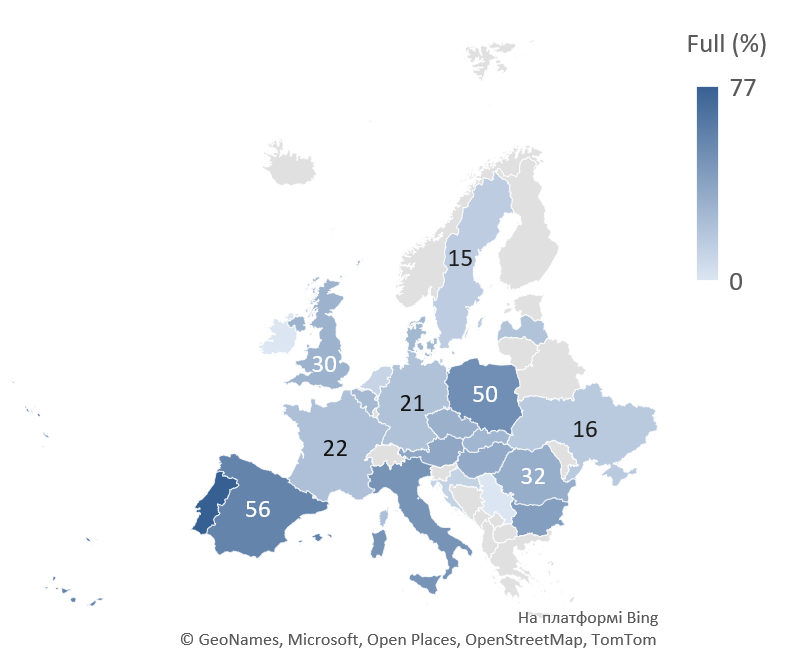
In terms of fundamentals, temperature forecasts have been revised slightly colder towards the end of the 15-day forecast, although they remain above seasonal norms for now, providing some support to demand. Wind energy forecasts remain broadly unchanged, with renewable generation expected to increase next week. EU gas inventories remain historically low for this time of year at 29.59%.
Natural gas imports from Europe averaged about 27 million cubic meters per day (+7,14%). Imports were present from all neighboring European countries. The basis was the Polish direction. Exports from customs warehouses were present in the direction of Moldova and Poland, with a volume of up to 0.7 million cubic meters per day. Ukraine’s storage facilities contained 9.45 (-3.38%) billion cubic meters of natural gas. Withdrawals amounted to about 11 million cubic meters per day.