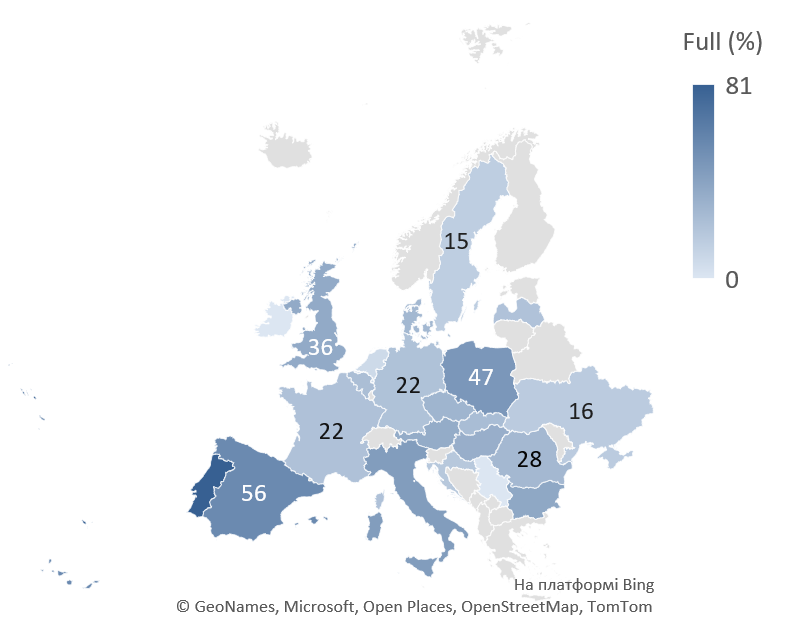
Gas price: Ukraine and Europe. Market overview March 16 - 20, 2026
In the "Medium and Long-Term Market" section of the UEEX, trading in the resource for March and April 2026 continued. In total, positions for the sale or purchase of natural gas were formed by 9 companies, including: Ukrnafta, Ukrnaftoburinnia, JV BNK, GTS Operator of Ukraine, Tepla, etc. During the week, trading participants took wait-and-see positions, given the increase in prices. The section sold 100 thousand cubic meters of natural gas. Natural gas was sold with delivery to the GTS during April. The position of the Energy Center company was successful. The sales price was 23,545 UAH/thousand cubic meters excluding VAT. Thus, a sharp upward trend in stock market quotes was recorded last week.
On the short-term natural gas market of the UEEX, participants formed applications on the intraday market, in the GTS and UGS. In total, 42 agreements were concluded with a total volume of 2,227 thousand cubic meters.
European energy markets started the week on a strong note, with wholesale gas prices up around 3-5% as tensions between the United States and Iran escalated. US strikes targeting Iranian military facilities around Kharg Island, one of the country’s most important oil export hubs, raised concerns about further disruptions to global energy supply routes.
Gas prices surged on Thursday, March 19, following Iran’s strikes on Qatar’s Ras Laffan facility. In response, Trump warned Iran against further attacks on Qatar’s LNG plants, threatening to "massively blow up the entire South Pars gas field" if they continued. QatarEnergy’s CEO has since confirmed that 17% of capacity will not be operational over the next 3–5 years (12.8 million tonnes of LNG per year), which has changed the outlook and added clear pressure on growth across the curve.
Markets reacted violently in response. European gas prices jumped as much as 35% on the news, and the forward curve was adjusted higher in all directions. The British M+1 contract closed 12.33% above its previous close. The reaction further down the curve was more pronounced: Summer 28 and Winter 28 rose 15% and 10%, respectively.
This situation is not just about an immediate shortage, it represents a long-term supply disruption from the world’s largest LNG exporter. Earlier this month, Qatar suspended exports after initial attacks and the de facto closure of the Strait of Hormuz. At one point, nearly 20% of global LNG supplies were cut off.
Sol Kavonik, head of research at Australia’s MST Marquee, said the strikes on Ras Laffan could lead to a prolonged global gas shortage, although this situation would not put pressure on the Trump administration, which benefits economically from high global gas prices.
Now the damage is physical, not just logistical, making it much harder to get back to normal. Europe, which has already depleted its storage after the winter, will have to increase competition for spot cargoes with Asia to replenish stocks, which were 28.7% full as of March 19, before the next winter.
On the fundamentals side, temperatures are approaching seasonal normals. Meanwhile, wind power generation is expected to increase in early April, which should limit demand for gas as a source of electricity.
Natural gas imports from Europe averaged about 24.9 million cubic meters per day (-1.11%). Inflows decreased against the background of rising quotations in Europe. Imports were present from all neighboring European countries. The basis was the Polish and Hungarian directions. Exports from the customs warehouse were present only in the direction of Moldova with a volume of 0.1 million cubic meters on March 18. Ukraine’s storage facilities contained 9.48 (+0.42%) billion cubic meters of natural gas. There was practically no withdrawal from underground storage facilities, but small volumes of injection were observed - about 13 million cubic meters per day.