

Gas price: Ukraine and Europe. Market overview June 3-7, 2024

Gas price: Ukraine and Europe. Market overview
Last week, natural gas prices in Ukraine fluctuated, with stable activity among bidders.
Ukrainian Energy Exchange
Last week, trading in June and July 2024 continued. In total, 3 companies formed positions for the purchase and sale of natural gas: GTS Operator of Ukraine, Ukrnafta, and PPC Naftogaz Trading.
The starting prices of resources had a diverse dynamics during the week. As a result, as of Friday, the average starting price of June resources in the GTS was 0.60% lower than on Monday.
Last week, both sell and buy positions were sold. In total, 43.6 million cubic meters of natural gas were sold. The majority of the sales, namely 41.2 million cubic meters, were for Ukrnafta. The following quotation prices were established as a result of the auction:
On the short-term natural gas market of the UEEX, participants formed bids in the GTS. Gas was sold on the within-day market. The marginal prices resulting from the auction are shown in the chart below.
European market
European TTF M+1 gas prices reached an eight-month high early last week, and then dropped to 32.85 EUR/MWh, the lowest level since May 21.
At the end of last week, the benchmark TTF M+1 was down 6% on Ice Endex and NBP was 10.5% below Monday’s closing price, reinforcing the fact that gas markets have largely pulled back from the extreme gains made on Monday.
However, the recent surge in the gas and electricity markets underscores how much European countries and the UK rely on Norwegian gas fields to bridge the supply gap, as any restriction of these flows usually leads to severe pressure on the markets. With the resolution of the problem on the Norwegian Sleipner Riser platform caused by a cracked pipeline, the market received a 79.8 mcm/d recovery in capacity, which ultimately reduced pressure on the M+1 contract. Meanwhile, the price of S+1 gas rose due to increased competition for LNG from Asia, despite the large supply.
Prices of contracts with delivery within the relevant period, EUR/MWh, 06.06.2024
| Instrument | THE | CEGH | TTF | TGE/POLPX | CEEGEX/HUDEX | Average price |
|---|---|---|---|---|---|---|
| Day1 | 33,24 | 34,47 | 33,18 | 34,22 | 33,4 | 33,70 |
| M+1 | 33,66 | 34,81 | 33,68 | 34,13 | 34,36 | 34,13 |
| Q +1 | 34,08 | 35,23 | 34,06 | 34,86 | 34,79 | 34,60 |
| S +1 | 38,13 | 39,21 | 39,18 | 38,75 | 38,82 |
Month-ahead contracts at all the analyzed hubs showed a different trend in relation to spot prices, with an average increase of 1.27%. Quarter-ahead prices were higher than spot prices by an average of 2.69%. The seasonal forward prices with an average value of 38.82 EUR/MWh tended to increase compared to the spot prices by an average of 14.74%.
Temperatures in Asia remain high, leading to an increase in electricity demand due to the use of air conditioning systems. As a result, LNG shippers are finding it much more profitable to send LNG tankers towards Asia rather than the UK and Europe, which is causing prices in these regions to rise to attract LNG cargoes to European shores.
The July futures for LNG in Asia, the JKM Platts Future index, settled at USD 429 per thousand cubic meters on June 6. The futures for LNG delivered to Northwest Europe (LNG Northwest Europe Marker) amounted to USD 380 per thousand cubic meters. The low level of imports may change as recent price spikes have made European markets more competitive with Asia and there may be an increase in supply as Europe seeks to fill storage ahead of the winter period.
The occupancy rate of pan-European gas storage facilities is 70.9%, according to the latest Aggregated Gas Storage Inventory data, which is 0.2% more and about the same level as a year ago. The current level of almost 71% is about 12% higher than the five-year average, but concerns about the level of gas storage remain. The UK and Europe rely heavily on ample Norwegian supplies and LNG for gas storage. However, as LNG flows are shifting to Asia, there are concerns that the pace of injection into storage will be slow. In addition, the likelihood of severe storms in the Atlantic in August and September could further limit LNG supplies to Europe.
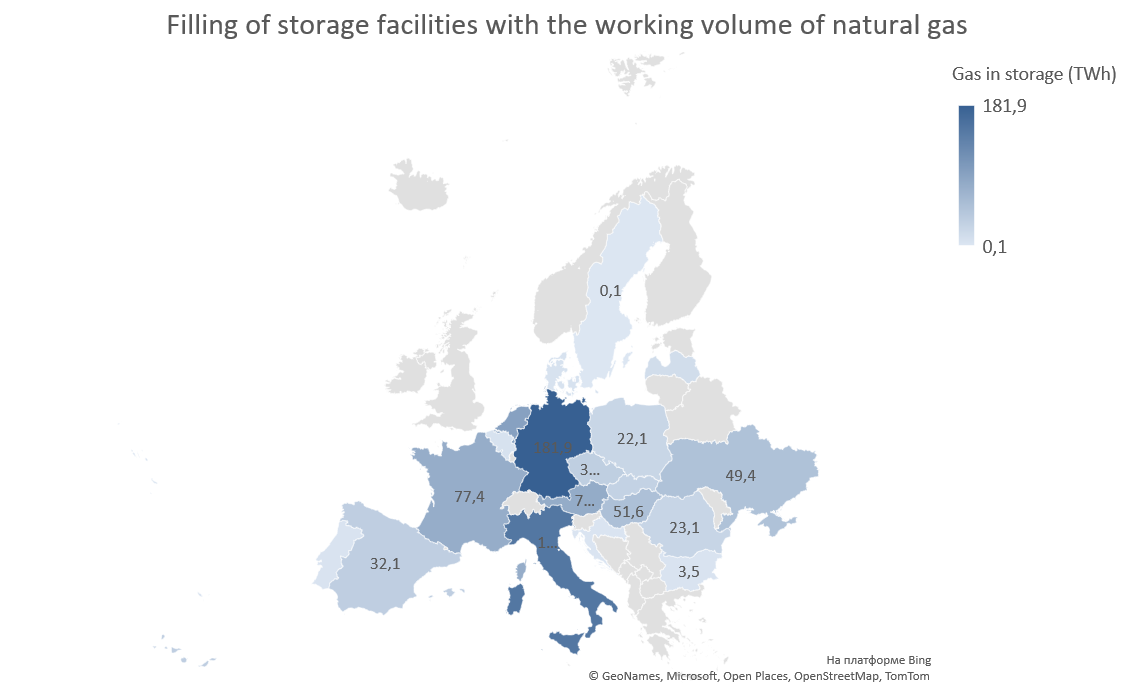
European LNG terminals operated at an average capacity of 70.727%.
LNG stocks in the EU amounted to 4.347 million cubic meters as of June 5, according to the Aggregated LNG Storage Inventors.
The storage level of the largest LNG exporter, the United States, according to the latest EIA data, as of May 31, 2024, was 2.893 billion cubic feet.
Gas supplies through pipelines saw a decrease in flows last week, but adherence to the repair schedule returned Norwegian gas flows through the Langeled pipeline last Friday. The IUK and BBL pipelines connecting the UK with Belgium and the Netherlands, respectively, export 22 mcm/d in total due to higher gas prices on the continent compared to the UK. Norwegian gas flows to the rest of Europe were observed at 309.4 mcm on June 7.
On the adjacent market, Brent crude oil traded at $79.68 per barrel on June 7 amid growing expectations that the US Federal Reserve will actually cut interest rates in September, stimulating economic activity and thus oil demand.
Gas balance in Ukraine
Last week, natural gas imports were present only from Hungary, averaging 0.2 mcm per day. Export flows from the customs warehouse to Poland, Slovakia, and Moldova were observed with an average volume of 4.63 mcm per day. Exports increased compared to previous periods. Ukraine had about 9.34 bcm in storage facilities. Injections amounted to approximately 21 million cubic meters per day.
Interesting for the week
The transit of Russian gas to the EU through Ukraine could be cut almost in half if Gazprom stops supplying gas for transportation to Austria. It is not yet known when exactly gas supplies from Russia to Austria may be cut off, but OMV has reported a high probability of such a development. The company noted that its customers will be provided with resources from alternative sources.
The Finnish Ministry of Economic Affairs and Employment is appointing a working group to prepare a complete ban on Russian gas imports, said Riku Huttunen, CEO of the Energy Department of the Ministry of Economic Affairs and Employment of Finland. According to Finland’s foreign trade statistics, 65% of gas imports in the last quarter of 2023 came from the United States, 23% from Norway, and 7% from Russia. It is clarified that no direct sanctions have been imposed on Russian gas imports so far. This is because imports of pipeline gas have decreased, while imports of Russian liquefied gas have increased. First of all, the sanctions are aimed at LNG. The REPowerEU program, launched by the European Union in May 2022, aims to end dependence on Russian gas by 2027, the report says.


