Gas price: Ukraine and Europe. Market overview June 15 - 19, 2026
In the "Medium and Long-Term Market" section of the UEEX, trading in the resource continued in June and July 2026. In total, 12 companies formed positions for the sale or purchase of natural gas: Ukrnafta, GSC Naftogaz Trading, MHP Eco Energy, GTS Operator of Ukraine, etc. In total, 4,450 thousand cubic meters of natural gas were sold in the section - resources for June and July. Successful were positions for the sale from Ukrnafta and for the purchase from the GTS Operator, Cherkasyteplokomunenergo. Participant activity was high, prices tended to decline during the week.
On the short-term natural gas market of the UEEX, participants formed orders on the within-day market and the day-ahead market. In total, 48 deals were concluded with a total volume of 932 thousand cubic meters.
This week, the TTF sharply reduced the geopolitical premium. After closing the previous Friday at around 46.8 euros/MWh, the July contract fell to 40.5 euros/MWh on Thursday, and on the morning of June 19 was trading around 42 euros/MWh — about 10% lower compared to the previous Friday. The main driver is the interim memorandum between the US and Iran and the expectation of the restoration of shipping through Hormuz for 60 days. At the same time, Friday’s trading shows that the market has removed some of the fear, but has not yet laid the foundation for the full normalization of physical flows.
Hormuz remains a key short-term risk. The first detained ships have already started to pass, but the main route needs to be cleared of mines, and carriers and insurers need security assurances. QatarEnergy could return to full capacity with intact LNG lines in about a month, with one of the shipments fully loaded at Ras Laffan for the first time since the conflict began, but 17% of Qatar’s export capacity has been out of service for years.
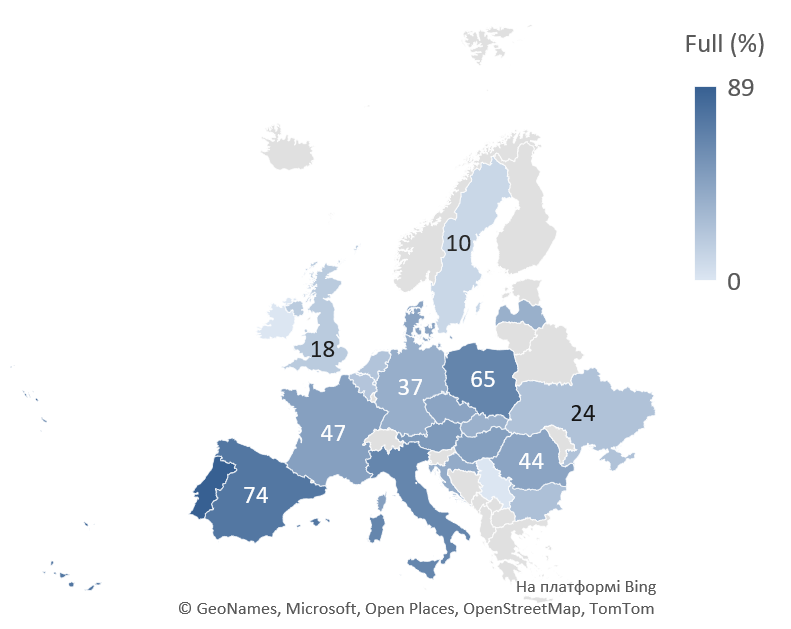
Storage is filling up, but supplies remain weak. As of 18.06.2026, EU capacity was 45.56% with a daily increase of about 0.27%, which is approximately 5–6% below last year’s trajectory. Particularly low levels remain in Germany — 37.5%, the Netherlands — 22.6% and Slovakia — 35.0%. Such unevenness forms a price "bottom": even with a decrease in the geopolitical premium, Europe still needs stable summer demand for gas for injection.
The flexibility of EU rules allows for a reduction of the reserve benchmark from the formal 90% to 80% under difficult conditions, but does not remove the physical need to buy gas. Summer contracts are still not cheaper than winter ones, so the economics of injection remain weak.
LNG balance mixed: US supplies to Europe recover in June after weaker May, but Asian imports head for five-month high, with China and Japan more active again. Competition with Asia limits room for TTF to fall. Additionally, the European Commission clarified a complete ban on trading Russian LNG for EU operators from 2027: the effect is small for the near-term contract, but it supports the long-term curve.
For Norwegian gas pipelines, restrictions are in place at Troll, Kollsnes and Nyhamna, which are mostly known to the market and therefore do not in themselves create a new shock. However, there is a risk that they will be extended or new unplanned disruptions may occur.
Natural gas imports from Europe were at 0.8 million cubic meters per day (unchanged from the previous week). Imports were only from Poland. There were no exports from bonded warehouses. Ukraine’s storage facilities contained 11.8 (+2.5%) billion cubic meters of natural gas. There was almost no withdrawal from underground storage facilities, but there was injection - about 37 million cubic meters per day.