Gas price: Ukraine and Europe. Market overview July 20 - 24,2026
In the "Medium and Long-Term Market" section of the UEEX, trading in resources continued in July and August 2026. In total, 9 companies formed positions for the sale or purchase of natural gas: GSC Naftogaz Trading, GTS Operator of Ukraine, Ukrzaliznytsia, Tepla, etc. In total, 735 thousand cubic meters of natural gas were sold in the section - a resource for August 2026 in the GTS. The position for the purchase from Ukrzaliznytsia was successful.
On the short-term natural gas market of the Ukrainian Exchange, participants formed orders on the within-day market in the GTS. In total, 85 deals were concluded with a total volume of 1,919 thousand cubic meters.
This week, European gas contracts rose again. The geopolitical premium on the European gas market has received “physical” reasons for its growth. Prices have now returned to levels close to the highs recorded at the beginning of the conflict. According to tanker tracking data, LNG exports through the Strait of Hormuz practically stopped for several days, and oil tanker traffic has sharply decreased, and the market has reacted not only to the headlines, but also to the real threat of a drop in volumes. Maintaining the blockade of Iran declared by Washington keeps the premium high, while any signal of a ceasefire or restoration of passage can quickly remove part of the premium - as was already the case during the April episode.
TTF M+1 continued the upward movement of the previous week: on Monday, July 20, the contract added more than 3% and renewed the maximum since the end of March, and by the end of the week it was trading in the region of 62–63 €/MWh versus ~57 €/MWh at the close on July 17 — approximately +10% for the week.
Competition for cargo is intensifying on both sides. According to Kpler, July LNG imports to Asia are growing for the fourth consecutive month. As of July 17, JKM was around $20–21/MMBtu versus ~$19/MMBtu in TTF, so the spread remained in Asia’s favor and rather widened during July. For Europe, this is a double whammy: the risk of Qatari volumes being cut off through Hormuz is compounded by the outflow of American LNG to Asian buyers. In June, less than half of US LNG exports went to Europe for the first time in more than 2 years, a 22% decline compared to the same period in 2025.
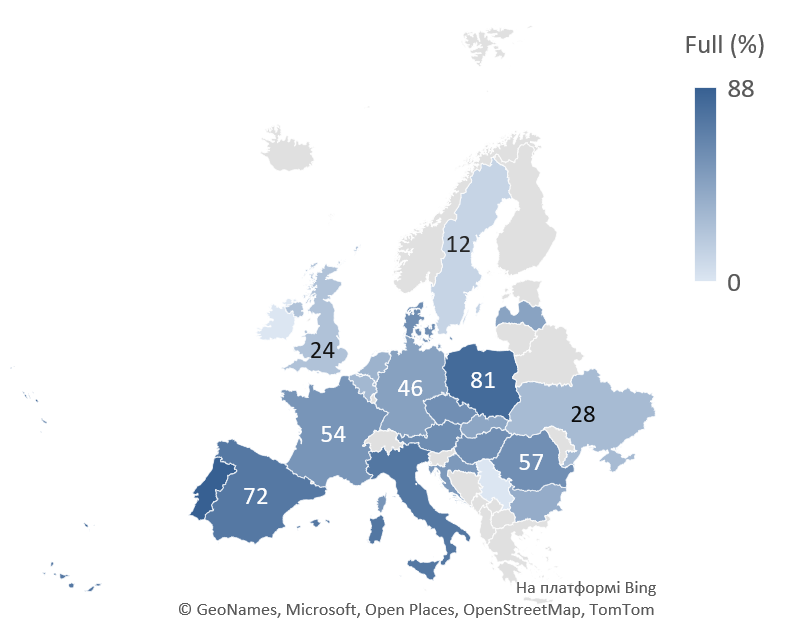
European gas storage remains a key pressure point for the winter outlook. Injection rates have increased over the past 30 days, although they are still behind what is needed to meet the EU’s target for replenishment by November 1. As of 23.07, EU storage is filled to around 54.61% of its operating capacity, compared to 63% at this time last year. Net gas injection in July is 13% below the five-year average. The EU’s softened fill target (to ~80%, with flexibility in timing) reduces the risk of "forced" panic buying, but increases sensitivity to actual stocks before the start of the heating season.
The space for a TTF cut will only open up if shipping through Hormuz resumes simultaneously with weakening Asian demand. Until then, low storage and competition for LNG limit the potential for a drop, and the market remains volatile.
Natural gas imports from Europe were at 1.5 million cubic meters per day (-0.1 million cubic meters from the previous week). Imports were only from Poland. There was no export from the customs warehouse. Ukraine’s storage facilities contained 13.11 (+2.14%) billion cubic meters of natural gas. There was almost no withdrawal from the underground gas storage facilities, but there was injection - about 42 million cubic meters per day.