Gas price: Ukraine and Europe. Market overview January 19 - 23, 2026
On the "Medium and Long-Term Market" section of the UEEX, trading in resources for January, February, and March 2026 continued. In total, positions for the purchase and sale of natural gas were formed by 13 companies, including Ukrnafta, MC Ukrnaftoburinnia, LTK Electrum, SGS, Energo Zbut Trans. The section sold 1.55 million cubic meters of natural gas. Natural gas was mainly sold with delivery to the GTS during February 2026. The prices of the sold positions were in the range of 21,500-22,640 UAH/thousand cubic meters excluding VAT and had increasing dynamics.
On the short-term natural gas market of the UEEX, participants formed applications on the within-day market and the day-ahead market. In total, 25 deals were concluded with a total volume of 743 thousand cubic meters.
On January 21, spot gas prices rose sharply due to a combination of cold weather on the European continent, a sharp jump in natural gas prices in the United States, and geopolitical factors. Gas prices fell across the forward curve on Thursday as temperature forecasts for the rest of January softened somewhat. Despite this adjustment, temperatures are expected to remain below seasonal normals through the end of the forecast horizon on February 6.
The prospect of constructive dialogue brought some modest price declines on the morning of January 23. One potential factor in the price decline is Russia’s confirmation that the first trilateral peace talks between the US, Ukraine and Russia are scheduled for Friday in Abu Dhabi.
Domestic gas prices in the US have surged in the past few days as weather forecasts indicate a sharp drop in temperatures, increasing the cost of producing LNG for export to other countries. In the US, severe cold weather is expected to cause pipelines in Texas to freeze, potentially affecting LNG flows.
The UK Gas Price Index (NBP) is above the European benchmark (TTF). This has led to gas exports via the IUK (UK-Belgium) pipeline falling to 0.6 million cubic metres per day on Thursday. At the end of the week, deliveries via the BBL pipeline, which connects the UK with the Netherlands, showed little increase.
Norwegian pipeline imports are increasingly being redirected towards continental Europe, with the UK volume falling by around 14 million cubic metres per day. According to the EU statistics agency Eurostat, 51.8% of pipeline gas to the European Union came from Norway in the third quarter of 2025. In December, the Scandinavian country exported 11.4 billion cubic meters (bcm) of gas, which is 600 million mcm more than in the previous month.
Reuters reports that electricity generation from gas-fired power plants in the EU has increased by 8% due to reduced availability of hydropower, which has led to an overall 16% increase in gas import costs, totaling 32 billion euros ($37 billion) for the energy sector - the first such increase since the 2022 crisis.
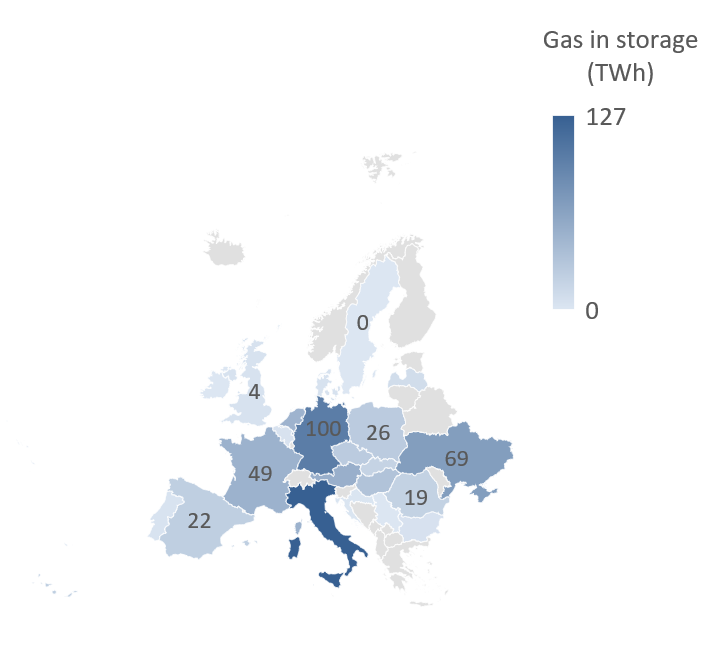
As of January 21, the occupancy rate of EU gas storage facilities decreased to 47.63%.
Natural gas imports from Europe averaged about 22.65 million cubic meters per day (-5.63%). Imports were present from all neighboring European countries. The basis of imports was the Polish direction. Exports from the customs warehouse were present in the amount of up to 3 million cubic meters per day, in the direction of Moldova. In the storage facilities of Ukraine there were 11.12 billion cubic meters of natural gas. The withdrawal was about 60 million cubic meters per day.