
Gas price: Ukraine and Europe. Market overview February 26 - March 1, 2024

Gas price: Ukraine and Europe. Market overview
Over the last week, natural gas prices in Ukraine have been experiencing a downward trend amid fluctuations in supply and demand.
Ukrainian Energy Exchange
Last week, trading in February and March 2024 continued. In total, 3 companies formed positions for the purchase and sale of natural gas: GTS Operator of Ukraine, Ukrnafta, and Naftogaz Trading.
Starting prices of resources decreased throughout the week. As a result, as of Friday, the average starting price of resources in UGS facilities was 1.34% lower than on Monday.
Last week, the Naftogaz sold and bought positions. In total, 50.9 million cubic meters of natural gas were sold.
Of these, Naftogaz Trading purchased 45.9 million cubic meters of natural gas and Ukrnafta sold 5 million cubic meters. The prices of sold items ranged from UAH 11082 to UAH 11419 excluding VAT. There was a trend toward a rapid decline in quoted prices in the first half of the week.
On the short-term natural gas market of the UEEX, participants formed bids in the GTS and UGS. Gas was sold on the within-day market. A total of 44 thousand cubic meters were traded.
The marginal prices formed as a result of the trades are shown in the chart below.
European market
Seasonally low demand, strong LNG supply, and high European inventories led to a decline in TTF gas futures prices in the last week of February. Despite a cooler period ahead, winter is over and last December and February were the third warmest months on record in Europe. Gas prices have also responded to low demand this winter, with the European benchmark TTF falling to a 34-month low of EUR 22.32/MWh early last week, according to Ice Endex.
Industrial demand continued to fall in February. In Europe, demand for gas for heating increased last week amid lower average temperatures and a possible short-term increase in heating demand in the Scandinavian countries. End-user demand in the UK increased by 10 mcm/d due to lower average temperatures, which dropped by about 4⁰C daily, and frost on the first day of the meteorological spring.
Prices of contracts with delivery in the respective period, EUR/MWh, 02/29/2024
| Instrument | THE | CEGH | TTF | TGE/POLPX | CEEGEX/HUDEX | Average price |
|---|---|---|---|---|---|---|
| Day1 | 24,95 | 25,88 | 24,88 | 26,75 | 22,85 | 25,06 |
| M+1 | 25,19 | 26,44 | 24,94 | 28,65 | 25,27 | 26,10 |
| Q+1 | 25,33 | 26,47 | 25,09 | 29,01 | 25,49 | 26,28 |
| S+1 | 25,76 | 26,76 | 25,39 | 29,10 | 25,73 | 26,55 |
Month-ahead contracts at all the analyzed hubs showed the same trend in terms of spot prices, with an average increase of 4.21%. Quarterly forward prices were 4.93% higher than spot prices on average. The season-ahead prices with an average value of EUR 26.55/MWh tended to increase by an average of 6.02% compared to the spot prices.
The April futures for LNG in Asia, the JKM Platts Future index, traded last Thursday, February 29, at USD 299.65 per thousand cubic meters (EUR 26.38/MWh) compared to the equivalent contract on the European hub TTF, which on Thursday was almost EUR 2 off (EUR 24.86/MWh). According to estimates, as long as LNG prices in Asia remain below USD 360 per thousand cubic meters, we should expect an increase in LNG imports to Asia.
Futures for LNG delivered to Northwest Europe (LNG Northwest Europe Marker) were trading at USD 262 per thousand cubic meters. According to market analysts, LNG imports to Europe and Turkey in March will decline year-on-year to about 15 bcm due to continued oversupply and increased competition from Asian buyers.
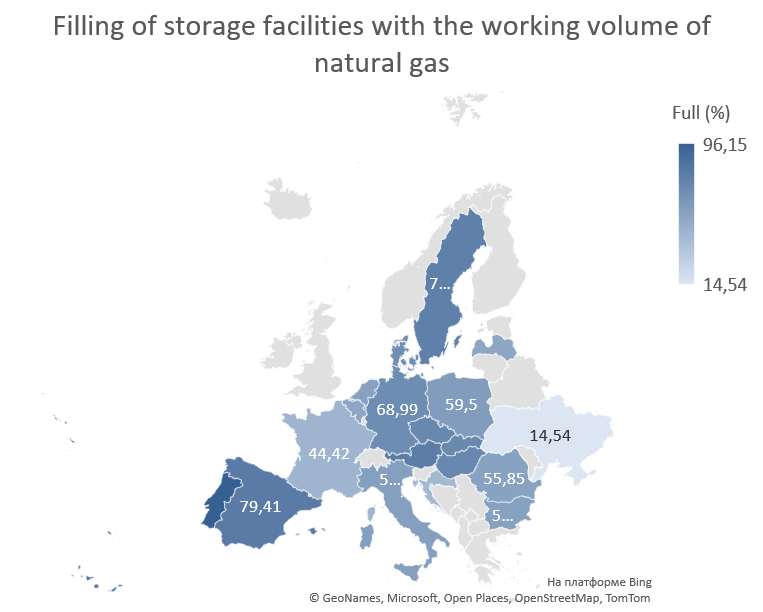
As of February 28, LNG stocks in the EU amounted to 4.736 million cubic meters, according to the Aggregated LNG Storage Inventors. LNG imports to Europe and Turkey fell by 8% in February. Almost 52% of LNG imports in February came from the US.
Russia was the second largest supplier for the second month in a row, followed by Algeria and Qatar.
European LNG terminals operated at an average capacity of 69.78%. The storage capacity of the largest LNG exporter, the United States, according to the latest EIA data as of February 23, 2024, was 2.374 billion cubic feet.
On the related market, Brent crude oil prices remained stable as the market awaits OPEC’s decision to extend the current supply agreement, although news of economic growth in India, which will soon become the world’s third largest economy, may indicate some upward pressure on the price. Brent crude remained in a narrow range and traded at USD 83.24 per barrel on March 1.
Gas balance in Ukraine
Last week, natural gas imports were available from Hungary, at an average daily level of 1.3 million cubic meters. Export flows from the "customs warehouse" to neighboring countries were observed. Exports decreased compared to the previous periods, remaining at an average level of 9.3 mcm per day. Ukraine’s storage facilities held about 8.9 bcm, with daily withdrawals dropping to 44 mcm per day due to the warm weather.
Public procurement
Last week, 10 tender procedures were held for the purchase of natural gas by budgetary institutions and state-owned enterprises. In total, 843.7 thousand cubic meters of natural gas were sold for UAH 9.5 million. The largest contract was awarded to SMID GROUP, which will supply 400 thousand cubic meters of natural gas to the Kremenchuk Road Repair and Construction Department at an initial price of UAH 11.04 per cubic meter. The average price increased and amounted to UAH 11.42 per cubic meter. Prices ranged from UAH 11.04 to UAH 11.64 per cubic meter.
Interesting for the week
EU energy ministers are set to agree on March 4 to extend gas demand caps to levels at least 15% lower than they were before the energy price crisis. The European Commission has proposed extending the current EU interim target by a year to March 2025 to ensure winter supply.
The Ministry of Energy is working on unblocking biomethane exports. The lifting of the ban on natural gas exports imposed with the start of the full-scale invasion will depend on the impact of such a decision on Ukraine’s national security, Deputy Energy Minister Svitlana Hrynchuk said on the sidelines of the forum "Results of the 2023/2024 Heating Season: Economy Under Fire," Interfax-Ukraine reports. "For our part, we are actively working to get biomethane out of the ban. As for natural gas, we will discuss it with our partners and assess the situation internally, to see what the risks are," said Hrynchuk. She added that the Ministry of Energy expects the Verkhovna Rada to adopt draft law No. 9456 on customs clearance of biomethane in the near future, which will open the way for its export. This draft law was adopted in the first reading on February 7 this year.