

Gas price: Ukraine and Europe. Market overview February 19-23, 2024

Gas price: Ukraine and Europe. Market overview
Last week, natural gas prices in Ukraine fluctuated, following the trends of European hubs.
Ukrainian Energy Exchange
Last week, trading in February and March 2024 continued. In total, 3 companies formed positions for the purchase and sale of natural gas: Kyivvodokanal, Naftogaz Trading, and Ukrnafta.
Starting prices of resources decreased throughout the week. As a result, as of Friday, the average starting price of resources in UGS facilities was 1.45% lower than on Monday.
Last week, the purchase positions were sold. In total, 28190 thousand cubic meters of natural gas were sold. Of this amount, 27,800 thousand cubic meters of February’s resource was purchased by Naftogaz in UGS facilities and 390 thousand cubic meters of March’s resource was purchased by Kyivvodokanal with delivery to the point of commercial gas metering.
On the short-term natural gas market of the UEEX, participants formed bids in the GTS and UGS. Gas was sold on the within-day market. A total of 37 thousand cubic meters of gas were sold.
The marginal prices formed as a result of the trades are shown in the chart below.
European market
Last week, the price of M+1 gas at the Dutch TTF hub reached a 9-month low. The equivalent contract for NBP in the UK fell to £1.96/kWh on Thursday, February 22, continuing a trend that began in January. By the end of the winter season, storage levels in the UK and Europe are expected to exceed 50%, reducing the need for competition for spot gas supplies. In the short term, prices may resume their upward trend with the emergence of greater instability in the Middle East due to the Israeli government’s plans to launch a major offensive on Rafah next month if hostages are held.
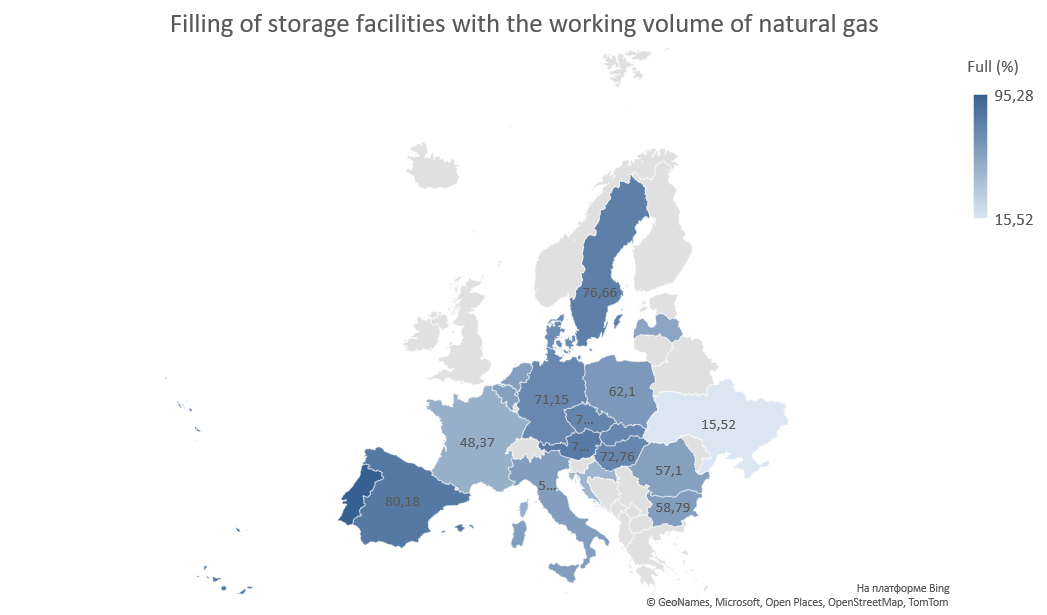
Mild weather is limiting demand for gas for heating. In addition, weak industrial and economic activity is expected to further weigh on market sentiment.
The April futures for LNG in Asia, the JKM Platts Future index, traded last Thursday, February 22, at USD 292 per thousand cubic meters. Traders are assessing the impact of the events in the Red Sea and travel on longer routes when selling to Asia, where demand was lower than expected.
LNG prices in Europe declined last week as mild weather, supported by ample gas stocks, kept additional demand for LNG at bay. Despite favorable factors, such as colder weather in countries such as France and Germany, as well as tensions in the Red Sea, prices did not show a significant increase during the week. Futures for LNG delivered to Northwest Europe (LNG Northwest Europe Marker) were trading at USD 251 per thousand cubic meters. At the moment, the arbitration between Asia and Europe over LNG supplies in April is effectively closed.
A gas leak at the Norwegian Korsto plant affected supplies to the UK, whose imports fell by 1 million cubic meters per day to 87 million cubic meters per day. Norwegian pipeline flows to the continent increased to 340 million cubic meters per day, and LNG shipments totaled ~3.5 bcm last week, although below the monthly high of 3.7 bcm seen the week before.
The level of gas storage in the EU has fallen to 64% of capacity, according to the latest Aggregated Gas Storage Inventory data as of February 21.
Prices of contracts with delivery in the respective period, EUR/MWh, 22.02.2024
| Instrument | THE | CEGH | TTF | TGE/POLPX | CEEGEX/HUDEX | Average price |
|---|---|---|---|---|---|---|
| Day1 | 23,14 | 23,99 | 23,04 | 24,68 | 22,44 | 23,46 |
| M+1 | 23,61 | 24,5 | 23,17 | 28,27 | 24,12 | 24,73 |
| Q+1 | 23,89 | 24,86 | 23,52 | 28,06 | 23,87 | 24,84 |
| S+1 | 24,12 | 25,11 | 23,81 | 28,15 | 24,05 | 25,05 |
Month-ahead contracts at all the analyzed hubs showed the same trend in terms of spot prices, with an average increase of 5.35%. Quarter-ahead prices were 5.81% higher than spot prices on average. The seasonal forward prices with an average value of EUR 25.05/MWh tended to increase compared to the spot prices by an average of 6.70%.
LNG stocks in the EU stood at 4.594 million cubic meters as of February 21, according to the Aggregated LNG Storage Inventors. High storage levels at this time of year also put pressure on prices.
European LNG terminals operated at an average capacity of 69.78%.
The storage capacity of the largest LNG exporter, the United States, according to the latest EIA data as of February 16, 2024, was 2.470 billion cubic feet.
On the adjacent market, Brent crude was trading at USD 82.91 per barrel on February 23.
The US central bank has made it clear that rate cuts could be postponed for up to 2 months, potentially curbing economic growth and oil demand. In addition, last Thursday it was reported that US oil stocks increased by 3.5 million barrels compared to expectations of an increase of 3.9 million barrels.
Gas balance in Ukraine
There were no imports of natural gas last week. Exports from the customs warehouse to neighboring countries were observed. Exports increased compared to the previous periods, remaining at an average level of 10.2 million cubic meters per day. Ukraine’s storage facilities held about 9 bcm, with daily withdrawals increasing to 59 mcm per day due to an increase in exports from the customs warehouse and the persistence of cool weather in the first half of the week.
Public procurement
Last week, 7 tender procedures were held for the purchase of natural gas by budgetary institutions and state-owned enterprises. In total, 822 thousand cubic meters of natural gas worth UAH 9.5 million were sold at the largest tenders. The largest contract was awarded to STATUS ENERGO, which will supply 450 thousand cubic meters of natural gas to the Bila Tserkva Housing and Maintenance Department at an initial price of UAH 11.58 per cubic meter. The average price amounted to UAH 11.67 per cubic meter. The prices ranged from UAH 11.17 to UAH 12.08 per cubic meter excluding VAT.
Interesting for the week
In March, GTSOU will continue to purchase gas for its own needs through Prozorro and the UEEX. This was announced by Vadym Rybachuk, Commercial Director of GTSOU, during a meeting with Ukrainian gas producers and traders organized by the Association of Gas Producers of Ukraine (AGPU). "In 2024, GTSOU plans to be constantly present in the gas procurement market - to buy the resource for its own needs on a monthly basis. We want to expand the range of suppliers and attract producers, resident and non-resident traders," he said.
Austria, the Czech Republic, Hungary and Slovakia have warned that in the third year of Russia’s full-scale war in Ukraine, they will be forced to increase imports of Russian pipeline gas rather than reduce them as a result of the customs tariffs imposed by Germany. These four countries continue to receive Gazprom’s gas via the Ukrainian GTS. Therefore, their policy affects the conditions of operation of our main gas pipelines after the expiration of the transit contract between Gazprom and Naftogaz in December 2024, Gas United reports.


