Gas price: Ukraine and Europe. Market overview December 22, 2025 – January 2, 2026
On the "Medium and Long-Term Market" section of the UEEX, trading in resources for December 2025, January and February 2026 continued. In total, positions for the purchase and sale of natural gas were formed by 7 companies, including Ukrnafta, MC Ukrnaftoburinnia, LTK Electrum, Ukrzaliznytsia, etc. 8.02 million cubic meters of natural gas were sold in the section. Natural gas was mainly sold with delivery to UGS in January 2026. The prices of sold items, except for delivery to the commercial natural gas metering point, were in the range of 19,140-19,850 UAH/thousand cubic meters excluding VAT.
The GTS Operator of Ukraine also conducted purchases in the "Cross-border" and "Customs Warehouse" sections. About 21.6 million cubic meters of natural gas were purchased with transmission at a point on the border at prices in the range of 34.85-35.77 euros/MWh.
On the short-term natural gas market of the UEEX, participants formed orders on the within-day market and the day-ahead market. In total, 34 deals were concluded with a total volume of 1,425 thousand cubic meters.
A key driver of growth remains forecasts of low temperatures (below seasonal normal) in January in both Europe and the UK, which continues to support heating demand. Current estimates predict that the level of gas reserves in EU storage after winter will be around 34% (7% below average) based on typical withdrawal rates, but persistently low temperatures could lead to a decrease in this level, supporting demand for gas for injection during the summer of 2026. The growth potential in the pre-season period is limited due to expectations of increased LNG supplies throughout 2026, which could potentially contribute to cheaper injection into storage.
Continued high supplies from Norway and LNG exports are offsetting lower temperatures and lower-than-seasonal wind generation, keeping the forward contract in balance. The Sum-2026 contract is down slightly, driven by strong LNG inflows, which reached a seasonal peak of around 375 million cubic meters per day in the last week of the year, according to Gas Infrastructure Europe (GIE).
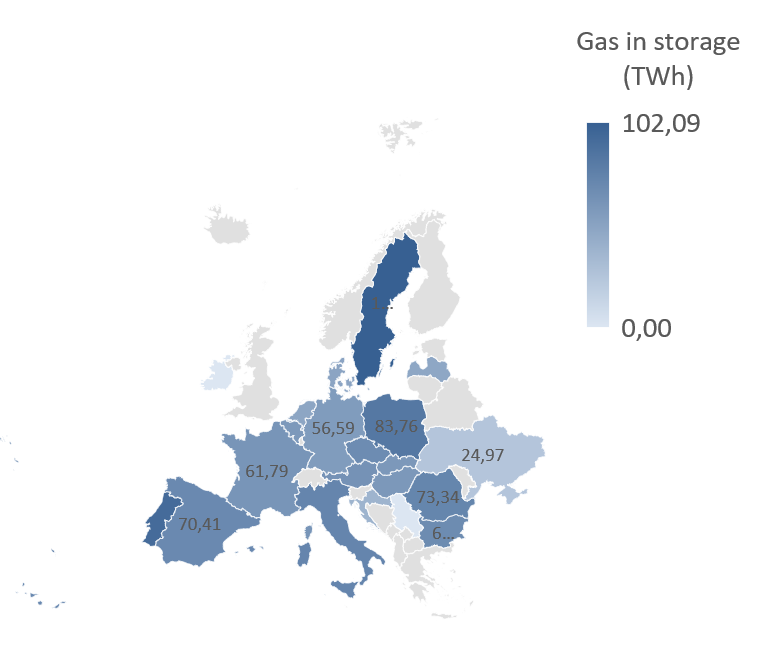
European natural gas storage facilities are currently operating below normal capacity due to the onset of winter. AGSI (Aggregated Gas Storage Inventory) data shows that the average gas storage level in the EU on 31 December was 63.24%, below the record levels of the previous year. There are significant differences in storage levels across Central and Eastern Europe. Poland leads the region, with its storage facilities almost 85% full, driven by strategic diversification and efficient use of terminals on the Baltic Sea. The situation is most difficult in Ukraine, where, due to military destruction and the expiration of transit agreements, the level of gas reserves in storage is only 25%. Ukraine, as before, is largely dependent on supplies from the EU.
In December, gas supplies from Russia to European countries via the TurkStream pipeline increased by 13.6% compared to December 2024, amounting to 1.73 billion cubic meters. This figure is the highest monthly volume of supplies since the start of operation of the gas pipeline in January 2020, as reported by the Caspian Mail publication with reference to TASS.
Natural gas imports from Europe averaged 23.3 million cubic meters per day. Imports were present from all neighboring countries of Europe. The basis of imports was the Hungarian and Polish directions. Exports from the customs warehouse were present in an average amount of 1.5 million cubic meters per day, to Moldova. In the storage facilities of Ukraine there were about 12.2 billion cubic meters of natural gas. The withdrawal was up to 55 million cubic meters per day.