

Gas price: Ukraine and Europe. Market overview December 2 - 6, 2024

Gas price: Ukraine and Europe. Market overview
Last week, natural gas prices in Ukraine stabilized, with trading activity at the beginning of the month decreasing compared to the previous week.
Ukrainian Energy Exchange
Last week, trading in resources of December 2024 and January 2025 continued. In total, 9 companies formed positions for the purchase and sale of natural gas: Ukrnafta, Naftogaz Trading, Nadra-Geoinvest, MC Ukrnaftoburinnya, GTS Operator of Ukraine, Elektro-Gaz, National Resources of Ukraine, Energigaztrade, and Tviy Gazzbut.
Starting prices for resources were rising throughout the week. As a result, as of Friday, the average starting price of January resources in the GTS was 9.16% higher than on Monday.
Last week, positions for sale were sold. In total, 2550 thousand cubic meters of January natural gas were traded in the GTS (prepaid), of which MC Ukrnaftoburinnya sold 1000 thousand cubic meters and Ukrnafta sold 1550 thousand cubic meters. The prices of the sold items were in the range of UAH 15852-15914 per thousand cubic meters excluding VAT.
On the short-term natural gas market of the UEEX, participants formed bids in the GTS and UGS. Prices increased during the week. On Friday, December 6, the weighted average price of the SSP amounted to UAH 15,250 excluding VAT. Last week’s quotation prices in this segment were in the range of UAH 15250-16100 per thousand cubic meters, excluding VAT. In total, 80 thousand cubic meters of natural gas were sold.
European market
The beginning of last week was accompanied by concerns about the ongoing reduction in Russian flows to the EU. On December 5, Russia eased the rules for using foreign currency to pay for its gas, thus circumventing recent US sanctions against Russia’s Gazprombank. Buyers can also purchase rubles outside Gazprombank when paying for goods, whereas previously they could pay for gas in their own currency and the bank converted it for them.
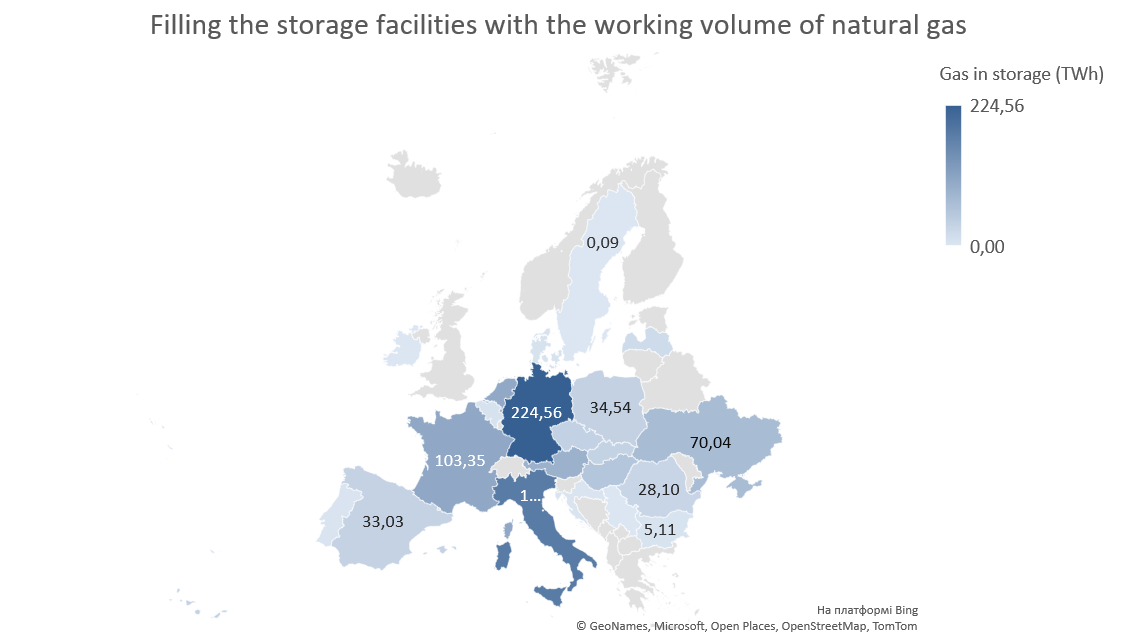
Nevertheless, the temperature forecast for both Europe and the UK is slightly below the seasonal norm for this week and for the second half of December and early January, which could further affect storage. The UK and EU have storage levels of 67% and 83.6% respectively. Prices may need to remain high to encourage more LNG cargoes.
TTF declined slightly after two upward sessions amid expected comfortable supply fundamentals for the winter. Market participants expect TurkStream to operate at full capacity from the beginning of 2025 and do not rule out a situation of a sudden failure, which could cause a lot of problems on the short term in this case.
On the forward curve, Sum-2025 contract prices softened slightly as Australia’s Pluto LNG plant resumed operations without major LNG outages or maintenance work.
British short-term gas prices closed at a fairly stable level last Thursday, with the NBP spot price down 2% to 114.50 f/therm, as warm weather and strong winds reduced gas generation. Along the forward curve, the price of gas for summer 2025 delivery closed 1% lower at 107.82 p/therm, supported by comfortable supply levels.
Prices of contracts with delivery within the relevant period, EUR/MWh, 05.12.2024
| Instrument | THE | CEGH | TTF | TGE/POLPX | CEEGEX/HUDEX | Average price |
|---|---|---|---|---|---|---|
| Day1 | 46,81 | 48,9 | 46,02 | 47,60 | 46,75 | 47,22 |
| M+1 | 47,43 | 47,77 | 46,53 | 46,67 | 48,42 | 47,36 |
| Q +1 | 47,4 | 47,72 | 46,48 | 46,52 | 48,33 | 47,29 |
| S +1 | 45,66 | 46,44 | 44,54 | 43,13 | 46,46 | 45,25 |
Month-ahead contracts at all the analyzed hubs showed a different trend in relation to spot prices, with an average rise of 0.35%. Quarterly forward prices were 0.19% higher than spot prices on average. Season-ahead prices with an average value of EUR 45.25/MWh tended to decrease by an average of 4.14% compared to spot prices.
The January futures for LNG in Asia, the JKM Platts Future index, settled on December 5 at USD 539.33 per thousand cubic meters. Gas prices have risen since last Tuesday, driven by the redirection of LNG to Asia. The LNG North West Europe Marker closed last Wednesday at USD 514.98 per thousand cubic meters.
European LNG reception terminals operated at an average capacity of 77.39%.
As of December 4, LNG stocks in the EU amounted to 4.610 million cubic meters, according to the Aggregated LNG Storage Inventors.
The storage capacity of the largest LNG exporter, the United States, according to the latest EIA data as of November 29, 2024, was 3.937 billion cubic feet.
As for Russian pipeline gas, the EU has reduced its imports of Russian natural gas to less than 10%. The European Commission wants the bloc to be free of Russian fossil fuels after 2027.
On related oil markets, the price of Brent crude oil settled at USD 72.15 per barrel on December 5, despite the fact that the Organization of the Petroleum Exporting Countries (OPEC+) postponed the planned increase in supply by three months to April and extended deep production cuts until the end of 2026. These actions by OPEC+ emphasize weak demand, especially in China.
Gas balance in Ukraine
No natural gas was imported last week, while exports from the customs warehouse averaged 0.73 mcm per day to Poland and Slovakia. Ukraine had about 11.25 billion cubic meters in storage facilities. Withdrawals amounted to about 57 million cubic meters per day.
Interesting for the week
Moldovan Prime Minister Dorin Recean calls for a state of emergency in the energy sector. Energy Minister Viktor Parlikov was dismissed after President Maia Sandu signed the order. The Prime Minister said he would take over his duties until a new minister is appointed. Dorin Rechan also called for the dismissal of Energocom’s CEO, accusing him of mismanaging gas purchases for the current winter. In addition, the prime minister calls for the dismissal of a member of Moldovagaz’s supervisory board who allegedly blocked profitable purchases of natural gas.
Among the important areas of the Company’s work this year, the GTSOU CEO noted joining the Vertical Corridor initiative, creating guaranteed capacities with the Republic of Moldova and increasing them with Hungary. “Our task as the Gas Transmission System Operator is to increase the technical capability of importing natural gas to Ukraine. For the first time since independence, a guaranteed capacity of 1 million cubic meters per day was created on the border with the Republic of Moldova with the prospect of increasing to 7 million cubic meters. Earlier this year, the guaranteed capacity from Hungary was increased from 8 million cubic meters to 9.8 million cubic meters per day. We are also actively cooperating with the GTS operators of the Slovak Republic and the Republic of Poland to increase the guaranteed capacities in these areas,” said Dmytro Lypa.


