

Gas price: Ukraine and Europe. Market overview August 5 – 9, 2024

Gas price: Ukraine and Europe. Market overview
Last week, natural gas prices in Ukraine were more stable than those on European hubs.
Ukrainian Energy Exchange
Last week, trading in August and September 2024 continued. In total, 3 companies formed positions for the purchase and sale of natural gas: Ukrnafta, GTS Operator of Ukraine, and Naftogaz Trading.
The starting prices of resources decreased slightly during the week. As a result, as of Friday, the average starting price of August resources in the GTS was 0.67% lower than on Monday.
Last week, both sell and buy positions were realized. A total of 39,500 thousand cubic meters were sold. Ukrnafta sold the entire volume - August and September resources - to the market. The quotation prices formed as a result of the trades are shown in the chart below.
On the short-term natural gas market of the UEEX, participants formed bids to the GTS and UGS facilities. Gas was sold on the within-day market. In total, 19 agreements were concluded with a total volume of 478 thousand cubic meters. No significant price fluctuations were recorded on the short-term market during the week.
Margin prices formed as a result of trading are shown in the chart below.
European market
Last week, prices at the TTF gas hub rose to their highest level in eight months amid concerns about lower transit volumes, which may be reduced before the end of the agreement with Gazprom. Market participants also continued to point to the possible risk of gas supply disruptions due to growing tensions in the Middle East. Despite this, the underlying gas fundamentals show a much weaker balance as demand in Asia weakens and the market sees increased LNG availability as a result.
On Thursday, the M+1 TTF settled at EUR 40.08/MWh. NBP spot prices declined due to strong pipeline flows and lower generation demand, which led to a 5% drop in the NBP spot price. Conversely, the gas price for Win-2024 increased by more than 3% as the conflict over key Russian gas transit points intensified. The price difference between continental Europe and the UK continues to widen. On Wednesday, the difference in price was 12.5 p/ term. under the influence of fears of a larger war, which will affect energy exports to Europe.
Prices of contracts with delivery within the relevant period, EUR/MWh, 08.08.2024
| Instrument | THE | CEGH | TTF | TGE/POLPX | CEEGEX/HUDEX | Average price |
|---|---|---|---|---|---|---|
| Day1 | 39,40 | 42,06 | 39,40 | 38,35 | 37,82 | 39,41 |
| M+1 | 40,15 | 41,99 | 40,08 | 38,64 | 41,66 | 40,50 |
| Q +1 | 42,77 | 43,76 | 42,18 | 42,29 | 43,49 | 42,90 |
| S +1 | 43,29 | 43,94 | 42,64 | 39,69 | 43,65 | 42,64 |
Month-ahead contracts at all the analyzed hubs showed a different trend in relation to spot prices, with an average increase of 2.87%. Quarter-ahead prices were higher than spot prices by an average of 8.98%. The seasonal forward prices with an average value of 42.64 EUR/MWh tended to increase compared to the spot prices by an average of 8.29%.
September futures for LNG in Asia, the JKM Platts Future Index, rose and settled last Thursday at a five-week high of USD 450 per thousand cubic meters due to tensions in the Middle East, maintenance in Norway and supply disruptions in Australia.
The LNG North West Europe Marker closed last Thursday at USD 402 per thousand cubic meters. At the same time, according to Spark Commodities, if insurance, congestion, longer travel time and other costs are taken into account, the profitability of shipping American cargo loaded in September or October was higher to Europe than to Asia via the Cape of Good Hope.
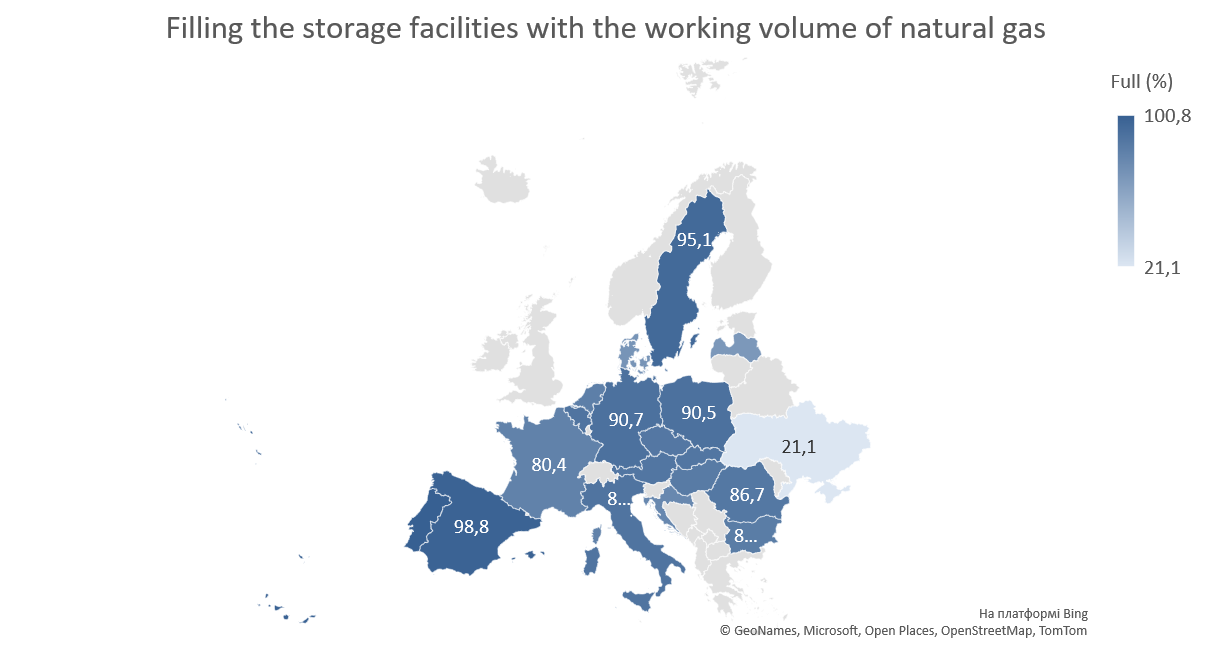
Storage facilities in the EU are 86.65% full, according to the latest Aggregated Gas Storage Inventory data as of August 7, compared to about 80% a month ago.
By the end of July, European monthly LNG imports were close to a 3-year low of only 8.7 bcm, with China and South Korea being the main destinations. Last week, LNG supplies to northwestern Europe continued to decline. European LNG terminals operated at an average capacity of 70.67%. LNG market fundamentals remained largely bearish through August, with good storage levels in Europe and muted buying interest in South Asia and China. Goldman Sachs predicts that global LNG supplies will grow by 50% over the next five years, cutting gas prices in half.
As of August 7, LNG stocks in the EU amounted to 4.724 million cubic meters, according to the Aggregated LNG Storage Inventors.
The storage level of the largest LNG exporter, the United States, according to the latest EIA data as of August 2, 2024, was 3.270 billion cubic feet.
Gas supplies through pipelines from Norway last Friday were at 343.7 million cubic meters per day, according to TSO Gassco, due to an unplanned shutdown at the Norwegian gas processing plant Kollsnes.
On the related market, Brent crude oil prices rose to USD 79 per barrel, gaining some momentum amid rising tensions in the Middle East, declining global oil reserves, and some production disruptions in Libya.
Gas balance in Ukraine
Last week, natural gas imports were present from Hungary and Moldova, averaging 0.8 mcm per day. Imports decreased compared to the previous week, while exports from the customs warehouse were absent due to seasonality. Ukraine’s storage facilities contained about 11 billion cubic meters. Injections amounted to approximately 26 million cubic meters per day.
Public procurement
From Monday to Thursday, nine tender procedures were held for the purchase of natural gas by budgetary institutions. In total, 437 thousand cubic meters of natural gas worth UAH 5.82 million (excluding VAT) were sold at the largest tenders. The largest contract was awarded to Mykolaiv Electricity Supply Company, which will supply 190 thousand cubic meters of natural gas to Lesya Ukrainka Volyn National University at an initial price of UAH 13.29 per cubic meter. The average price increased and amounted to UAH 13.37 per cubic meter. Prices ranged from UAH 13.25 to UAH 13.55 per cubic meter, excluding VAT.
Interesting for the week
The transit of Russian gas through the Ukrainian gas transportation system dropped to 37.3 million cubic meters on August 8, according to the GTSOU. Transit volumes decreased by 6% compared to the previous day. This is the lowest transit value since May 1, 2023. Traditionally, the volume of Russian gas transit through Ukraine has been about 42 million cubic meters per day. The reasons for the reduction in transit are currently unknown. As of August 9, transit amounted to 38.5 million cubic meters. On Wednesday, August 7, Telegram channels reported that the Armed Forces of Ukraine had taken control of the Sudzha gas metering station in the Kursk region of Russia. The Sudzha gas interconnector is a key facility for the supply of Russian gas to Europe through Ukraine. Currently, Sudzha is the only point through which Russian gas enters Ukraine for transportation to European customers.
Ukrnaftoburinnya, a gas production company seized by court order and transferred to Ukrnafta’s management, begins to resume operations. The State Service of Geology and Subsoil issued an order revoking its previous order revoking the company’s special permit.


