Gas price: Ukraine and Europe. Market overview August 3 - 7, 2026
In the "Mid- and long-term market" section of the UEEX, trading of the August 2026 resource continued in GTS and UGS. In total, positions for the sale or purchase of natural gas were formed by 7 companies: GSC Naftogaz Trading, GTS Operator of Ukraine, Ukrnafta, LTK Electrum, etc. In total, 3.35 million cubic meters of natural gas were sold in the section - a resource for August 2026. Purchase positions from the GTS Operator of Ukraine and Cherkasyteplokomunenergo were successful.
On the short-term natural gas market of the UEEX, participants formed applications on the intraday market, in the GTS and UGS. In total, 81 agreements were concluded with a total volume of 2,275 thousand cubic meters.
European gas markets are under pressure from several directions. In the first week of August 2026, the European gas market showed signs of stabilization and a decrease in the geopolitical premium. The signal for buyers is clear: short-term risks are increasing and the gap between short-term and long-term contract prices remains significant. After reaching highs of €63.7/MWh in July, M+1 futures on the TTF hub fell by 9%, reaching a three-week low of €52.4/MWh on August 5. However, as of August 6, the quotations recovered somewhat, closing at EUR 54.45/MWh. Despite the current decline, prices remain almost 70% higher than in the same period last year.
The main driver of the price decline was news of a potential de-escalation in the Middle East. Iran announced that it had reached an agreement with Oman on a safe shipping route through the Strait of Hormuz. In addition, according to Qatari representatives, mediation efforts between the US and Iran have entered an advanced stage - the parties have already prepared a draft agreement, which added to market optimism. US and Qatari sources suggest the Strait of Hormuz could be reopened by the end of this week.
Despite positive diplomatic developments, physical risks to global supplies remain high. About a fifth of global LNG supplies are still disrupted by shipping delays in the Middle East, complicating Europe’s gas-storage campaign amid fierce competition from Asian buyers. The situation is also being exacerbated by unusually hot weather in central and southern Europe, which is keeping demand for gas for power generation high: water levels in the Rhine have reached their lowest level since 2018, and generation from French nuclear power plants is declining. Against this background, disruptions in the supply of Norwegian pipeline gas are putting additional pressure on prices. In total, since the beginning of the year, Norwegian operator Gassco has transported 69.67 billion cubic meters of gas to Europe, and the current European daily flow is 316.2 million cubic meters.
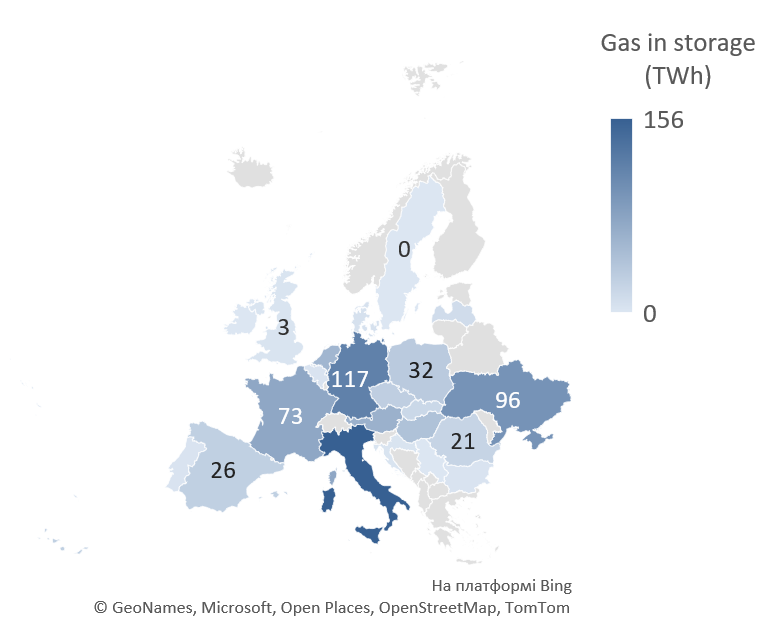
According to the GIE AGSI+ platform, as of August 6, 2026, the occupancy rate of European underground storage facilities is at 58.1%. This is the lowest seasonal gas storage rate in almost two decades (since 2009), and is significantly below historical averages.
However, despite the partial reduction of hedge funds (now the equivalent is 244 TWh), in general they continue to expect further growth in gas prices and hold their assets in such a way as to continue to profit from the increase in the price of European gas (TTF hub).
Natural gas imports from Europe were at 1.6 million cubic meters per day (+ 0.8 million cubic meters from the previous week). Imports were present only from Poland. Exports from bonded warehouses were absent. Ukraine’s storage facilities contained 13.7 (+2.07%) billion cubic meters of natural gas. Withdrawals from underground storage facilities were almost non-existent, but there was injection - about 36 million cubic meters per day.