

Gas price: Ukraine and Europe. Market overview August 19 – 23, 2024

Gas price: Ukraine and Europe. Market overview
Last week, natural gas prices in Ukraine stabilized, following the trends of European hubs.
Ukrainian Energy Exchange
Last week, trading in August and September 2024 continued. In total, 8 companies formed positions for the purchase and sale of natural gas: PPC, MC Ukrnaftoburinnya, GTS Operator of Ukraine, Ukrnafta, PPC Oil and Gas Trading, Nadra-Geoinvest, Electricity UA, and Energo Zbut Trans.
Starting prices of resources had a diverse trend throughout the week. As a result, as of Friday, the average starting price of August resources in the GTS was 0.57% higher than on Monday.
Last week, the purchase positions were sold. In total, 2,400.00 thousand cubic meters of natural gas were sold. The entire volume was purchased by the GTS Operator of Ukraine, namely: 600 thousand cubic meters of September resource at a price of UAH 14500 and 1800 thousand cubic meters at a price of UAH 14395.
On the short-term natural gas market of the UEEX, participants placed bids in the GTS and UGS facilities. Gas was sold on the intraday market. In total of 44 thousand cubic meters were traded. During the week, no price fluctuations were recorded on the short-term market. On Friday, August 23, the weighted average price of the SSP amounted to UAH 14263.46, excluding VAT.
European market
Gas prices started a downward correction last week: after rising to a high of 42.90 EUR/MWh on Monday of the previous week, M+1 TTF mostly lost its risk premium. This is mainly due to the fact that EU storage facilities reached 90% capacity well before November, as well as the reduced risk of damage to the gas metering point in the Kursk region. The price drop was duplicated for seasonal contracts.
Market participants assess the situation as tense due to the sensitivity of reactions to changes in flows, scheduled maintenance of gas infrastructure in Norway, the situation of the Russian invasion of Ukraine, and concerns about possible reductions in gas supplies from Ukrainian and Russian pipelines.
The price difference between continental Europe and the UK continues to widen. On Thursday, the NBP discount to TTF DA dropped to 4.47 p/term, down from 8 p/term at the start of the week, reaching its lowest level since July 31. This spread has decreased significantly compared to last week, but it still stimulates exports from the UK. On Thursday, the spot price of NBP closed at 85.10 p/therm. Meanwhile, the price of Win-2024 gas fell by more than 1% to 102.33 p/therm due to high storage levels.
Prices of contracts with delivery in the respective period, EUR/MWh, 08/22/2024
| Instrument | THE | CEGH | TTF | TGE/POLPX | CEEGEX/HUDEX | Average price |
|---|---|---|---|---|---|---|
| Day1 | 35,85 | 37,87 | 35,92 | 36,78 | 36,37 | 36,56 |
| M+1 | 36,55 | 38,46 | 36,59 | 37,25 | 37,98 | 37,37 |
| Q +1 | 39,54 | 40,63 | 38,98 | 40,72 | 41,82 | 40,34 |
| S +1 | 40,45 | 41,05 | 39,85 | 41,37 | 41,19 | 40,78 |
Month-ahead contracts at all analyzed hubs showed the same trend as spot prices, with an average increase of 2.22%. Quarter-ahead prices were higher than spot prices by an average of 10.36%. Season-ahead prices with an average value of EUR 40.78/MWh were higher than spot prices by an average of 11.58%.
In Asia, particularly in Japan and South Korea, strong regional cooling demand has supported import requirements. The October futures for LNG in Asia, the JKM Platts Future index, rose and settled last Thursday at USD 492.25 per thousand cubic meters. The futures for LNG delivered to Northwest Europe (LNG North West Europe Marker) closed last Thursday at USD 435.51 per mcm. US dollars per thousand cubic meters. Asian prices also received continued support from the European gas market, despite a slight weekly decline in TTF prices.
Storage facilities in the EU are at 90.5% capacity, according to the latest Aggregated Gas Storage Inventory data, which is 0.2% more than the previous day. However, the level of occupancy may slow down in September due to intensive repairs of Norwegian lines.
European LNG terminals operated at an average capacity of 70.64%. The weekly Kpler ship tracking data showed that LNG imports to Europe and Turkey decreased last week.
LNG stocks in the EU stood at 4.629 mcm as of August 21, according to Aggregated LNG Storage Inventors.
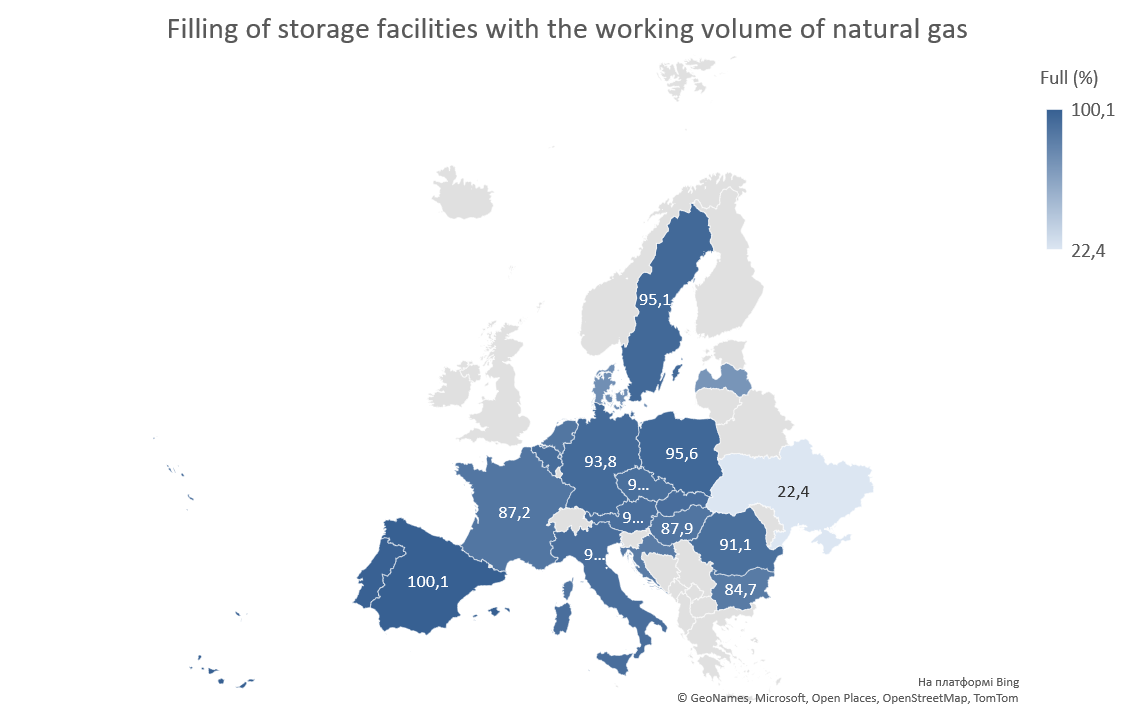
Gas supplies through pipelines from Norway fell last Friday to 317.3 million cubic meters per day, according to TSO Gassco.
On the related oil market, the summer peak demand was weakening last week. Prices remained relatively stable. However, attention was focused on the escalating tensions in the Middle East involving Israel and Iran, as any further military action could exacerbate supply disruptions already felt due to tanker attacks in the Red Sea. Brent crude oil prices rose and traded at USD 78.47 per barrel on August 23, as expectations of a US interest rate cut sparked some fear of a slowdown in the economy, which could reduce oil demand.
Gas balance in Ukraine
Last week, natural gas imports were present from Hungary and Moldova, averaging 0.7 mcm per day. Imports slightly decreased compared to the previous week, while exports from the customs warehouse were absent. Ukraine had about 11.43 bcm in storage facilities. Injections amounted to approximately 29.4 million cubic meters per day.
Interesting for the week
Smart Energy resumed gas production after a one-year break. Smart Energy Group has resumed gas production at Vasyschyvske field in Kharkiv region. Ukrgasvydobutok and Prom-Energo Product, which are part of the group, have not been operating for over a year due to the suspension of licenses as a result of sanctions against businessman Vadym Novynskyi (the government considers him a beneficiary of Smart Energy, the group denies this). In June 2024, the licenses were renewed after sanctions were clarified. “After unblocking the special production permits, it took us a month to get the first company back to work,” said Oleksii Zayets, acting CEO of Smart Energy.
Germany strengthens the role of bioenergy. The German Federal Ministry for the Economic Affairs and Climate Change last week announced that it will present a “comprehensive biomass package”. In future tenders for biomass, preference will be given to installations connected to a heating network or building network that provides heat to up to 16 buildings. Biogas plants will also see an improvement in their so-called flexibility premium, which is a major challenge at the moment. With the necessary investments in flexibility, the current 6 GW of biogas capacity could be doubled by 2030 and reached up to 24 GW in 2045.


