Gas price: Ukraine and Europe. Market overview April 6 – 10, 2026
On the "Medium and Long-Term Market" section of the UEEX, trading in the resource continued in April and May 2026. In total, positions for the sale or purchase of natural gas were formed by 8 companies: MC Ukrnaftoburinnia, GTS Operator of Ukraine, Ukrzaliznytsia, Energy Business, etc. During the week, the section sold 2.7 million cubic meters of natural gas (+170%). Natural gas was sold with delivery in April. The positions of the GTS Operator of Ukraine for purchase and MC Ukrnaftoburinnia for sale were successful. Sales prices were in the range of 24,725-25,825 UAH/thousand cubic meters excluding VAT with a growing trend.
On the short-term natural gas market of the UEEX, participants formed orders on the within-day market and the day-ahead market. In total, 65 agreements were concluded with a total volume of 4,161 thousand cubic meters (+154%).
During the week, European energy markets again reacted more to news headlines than to changes in fundamental indicators. The increase in the number of American troops in the Middle East pointed to a potential ground operation in Iran, potentially focused on seizing Kharg Island, Iran’s main oil export facility, or on extracting Iranian nuclear material. The prolonged closure of the strait over the Easter holiday created a potential opportunity for the US to escalate the war in this way without immediate market reaction.
Gas prices fell sharply on Wednesday, April 8, and risk premiums declined despite the lack of a permanent peace settlement.
Monthly and seasonal gas contracts traded mostly on a “positive” note on Thursday. Israeli attacks on Lebanon threatened to disrupt the current ceasefire with Iran, which could lead to a prolonged closure of the Strait of Hormuz and risks escalation with further damage to infrastructure that would interrupt supplies. Prices did give back some of their previous gains late Thursday following reports that Israel is seeking immediate talks with Lebanon amid planned U.S.-Iran talks on April 10. During the planned 10-day ceasefire, Iran will allow two weeks of “safe passage” through the Strait of Hormuz. This could allow already loaded LNG cargoes currently stuck in the Persian Gulf to pass through and provide relief from tight supplies. However, this does not mean a return to the "status quo ante bellum" in terms of shipping. Iran will lift the blockade in exchange for a payment of approximately USD 2 million per vessel, which will be divided between Iran and Oman.
Temperatures through mid-April have been revised higher, weakening heating demand and storage withdrawals, further putting pressure on contracts.
Despite the decline in demand fundamentals, LNG dependence may increase during the second half of April due to increased scheduled maintenance of Norwegian pipelines, with an average of about 48 million cubic meters/day of unavailable capacity from April 16.
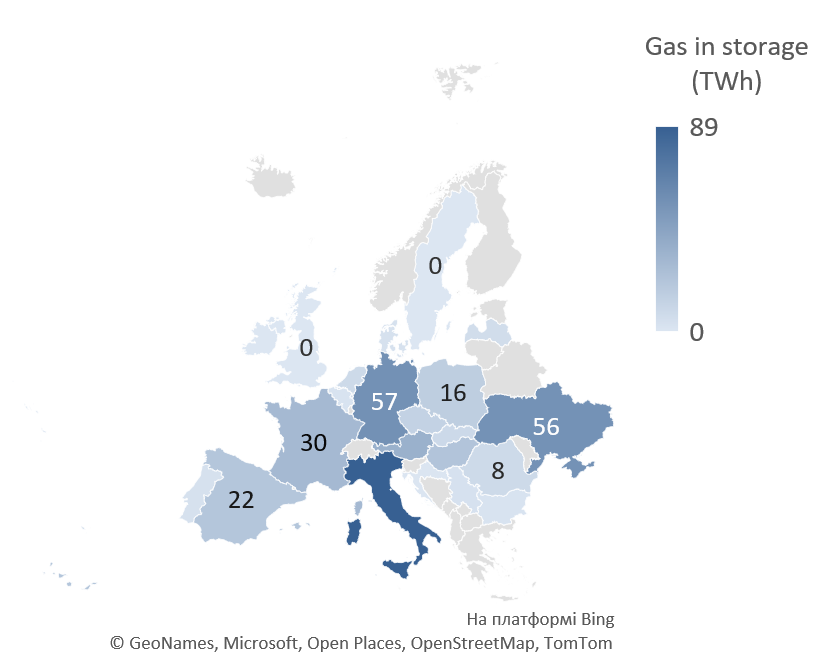
Natural gas imports from Europe in April were at 0.8 million cubic meters per day (unchanged from last week). Imports were present only from Poland. Exports from the bonded warehouse were present to Poland in the amount of 0.3 million cubic meters per day. Ukraine’s storage facilities contained 9.89 (+3.67%) billion cubic meters of natural gas. There was practically no withdrawal from UGS, but small volumes of injection were observed - about 10 million cubic meters per day.