Gas price: Ukraine and Europe. Market overview April 27 – May 1, 2026
On the "Medium and Long-Term Market" section of the UEEX, trading in the May 2026 resource continued. In total, positions for the sale or purchase of natural gas were formed by 7 companies: MC Ukrnaftoburinnia, GTS Operator of Ukraine, BNK Joint Venture, Naftogaz Trading, etc. During the week, 2,970 thousand cubic meters of natural gas were sold in the section (+22.2%). The positions of the GTS Operator of Ukraine and Energo Zbut Trans were successful. The sales prices were in the range of 22452-22577 UAH/thousand cubic meters excluding VAT.
On the short-term natural gas market of the UEEX, participants formed orders on the within-day market and the day-ahead market. In total, 52 deals were concluded with a total volume of 4,172 thousand cubic meters (+3.78%).
European energy markets strengthened again last week, but remained well below their March peak due to lower risks: outages in Norway, weak winds, limited LNG availability, tight storage positions and an active blockade of the Strait of Hormuz, which supports a geopolitical premium.
Gas prices fell 2.5% on Thursday for most 2026 contracts. Gas prices have already risen slightly since Friday morning. The rise is in line with comments by a senior Iranian official in the Islamic Revolutionary Guard Corps, who threatened strikes if the US attacks again, as well as the start of a gas maintenance period in Norway. Oseberg has been out of action, reducing flows by 26.6 million cubic meters per day, and this will continue for most of May. Other gas assets will join the planned maintenance period over the next few weeks. Domestic gas demand in Norway is growing, risking a decline in exports to the EU and the UK. Gas flows from Norway will be very limited during this period. The busiest period will start on May 18. This is exactly when the market wants stable flows for the injection season.
Futures contracts opened higher on Friday than the previous session’s close as Middle East peace talks remain uncertain and quick results are unrealistic while the US blockade remains in place, increasing the risk of low storage levels. The scale of today’s disruption risk covers contracts through Summer 2028, from which point pricing still offers the best combination of value and lower volatility.
There is also a longer-term signal: the IEA reports that 120 bcm of LNG supplies have been removed from the 2026–2030 forecast, representing about 15% of projected global supplies. Even if near-term conditions ease, such structural reductions will change the shape of future risk.
QatarEnergy оголосила про продовження дії форс-мажору на контрактні поставки СПГ на один місяць. This message concerns some European and Asian countries.
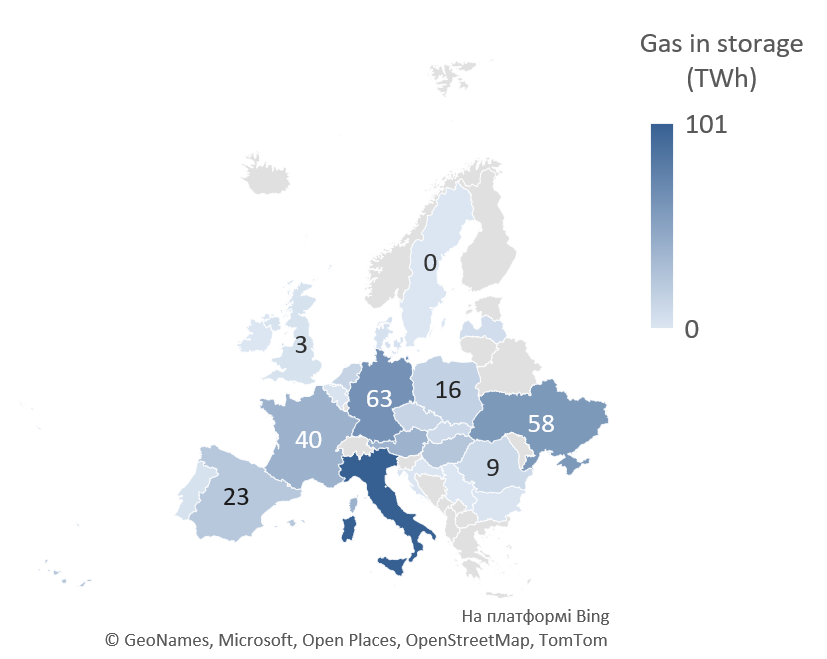
The EU gas storage capacity is 30.4%, which is about 7% lower than the equivalent figure last year. The "Winter 2026" season is "in the firing line" as several disruptions occur simultaneously: maintenance and low hydropower levels in Norway, low availability of nuclear reactors, limited LNG supplies, and an active blockade of the Strait of Hormuz.
Natural gas imports from Europe were at the level of 0.8 million cubic meters per day. Imports were present only from Poland. Exports from customs warehouses were also present to Poland with a total volume of 0.3 million cubic meters per day. Ukraine’s storage facilities contained 10.15 (+0.89%) billion cubic meters of natural gas. Withdrawals from underground storage facilities were practically absent, but small volumes of injection were observed - about 13 million cubic meters per day.