Gas price: Ukraine and Europe. Market overview April 13 - 17, 2026
On the "Medium and Long-Term Market" section of the UEEX, trading in the resource continued in April, May 2026 and subsequent months. In total, positions for the sale or purchase of natural gas were formed by 8 companies: MC Ukrnaftoburinnya, GTS Operator of Ukraine, Ukrzaliznytsia, GSC Naftogaz Trading, etc. During the week, 270 thousand cubic meters of natural gas were sold in the section. The positions of Kyiv Metro and Teplobud PCF LLC were successful. Sales prices were in the range of 25300-25792 UAH/thousand cubic meters excluding VAT.
On the short-term natural gas market of the UEEX, participants formed orders on the within-day market and the day-ahead market. In total, 27 deals were concluded with a total volume of 1,339 thousand cubic meters.
European energy markets rose sharply during the week under review following a significant escalation in the Middle East, with the US announcing a naval blockade of the Strait of Hormuz. Political developments in Hungary add another layer of uncertainty to European gas supplies. As one of the last routes for Russian gas to mainland Europe, any change in Hungary’s position could put additional strain on TurkStream, the only other major Russian gas pipeline to Europe. Market pricing continues to reflect expectations of a prolonged period of instability rather than short-term disruptions.
During Thursday’s session, it was confirmed that Israel and Lebanon had agreed to a 10-day ceasefire, and President Trump also said the US was "close" to a deal with Iran. The news lifted sentiment in energy markets on Friday morning, with gas contracts trading lower at the open.
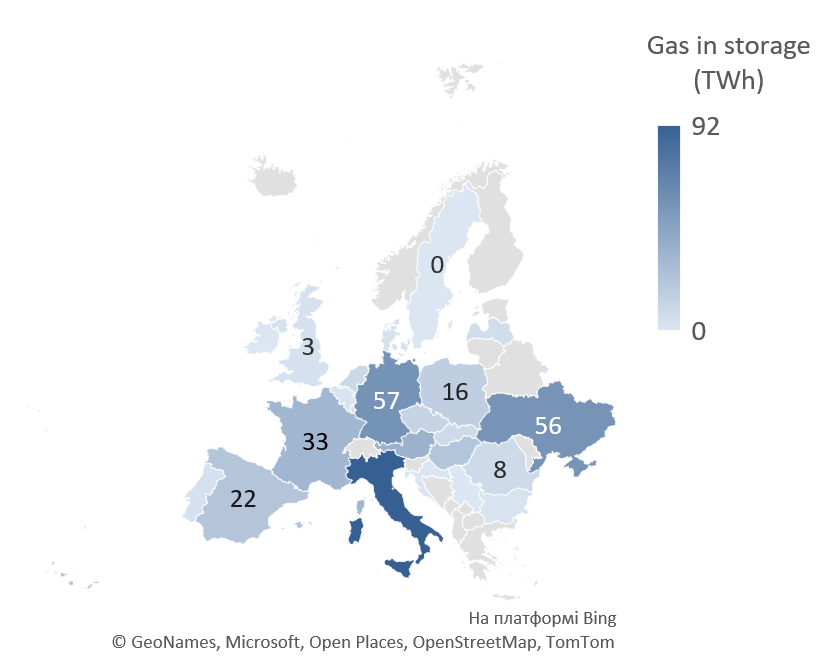
Additionally, storage levels in the UK and EU remain low for this time of year, at 32% and 28% respectively. The European supply situation remains tight and continues to exacerbate global risks, with gas storage utilisation rates falling to their lowest levels since 2021.
The current price gap between summer and winter gas contracts for 2026 is very narrow. This limits the incentive to inject gas as expected profits remain small. If this trend continues, gas to fill storage will be purchased later in the summer before winter demand arrives, potentially driving up prices. This reflects increased competition for LNG supplies. Disruptions in the Middle East are significantly affecting Qatar’s exports, narrowing global availability and pushing cargoes to more expensive markets in Asia. As a result, Europe is competing for fewer supplies, increasing upward pressure on prices.
Natural gas imports from Europe in April were at 0.8 million cubic meters per day (unchanged from last week). Imports were present only from Poland. Exports from customs warehouse were present to Poland in the amount of 0.3 million cubic meters per day. Ukraine’s storage facilities contained 9.96 (+0.6%) billion cubic meters of natural gas. Withdrawals from underground storage facilities were practically absent, but small volumes of injection were observed - about 17 million cubic meters per day.