

Gas price: Ukraine and Europe. Marker review January 9 - 13, 2023

Gas price: Ukraine and Europe. Market overview
During the last week natural gas prices in Ukraine had a downward trend, following the tendency of European hubs.
Ukrainian Energy Exchange
Trade with Ukrnafta resouce in UGS continued last week. In general were formed 9 positions for the sale of natural gas, of which 6 were sold.
Resources starting prices were decreased during the week. As the result, as of Friday, average starting price of January resource in UGS was lower than the Monday’s index by 2,04%.
In general 17,78 mln.c.m. of natural gas were sold and 22 exchange certificates were concluded.
At UEEX short-term natural gas market participants have formed applications in GTS and UGS. Gas was sold on the withing-day market in the GTS. In general, 5 agreements with the volume of 17 t.c.m. were concluded. During the week the short-term market recorded a decline in prices. Thus, on Friday, the exchange rate of the intraday market in the GTS amounted to UAH 21650 per thousand cubic meters excluding VAT.
European market
Amid warm weather, spot natural gas prices continue to decline at the Dutch TTF hub, and heating demand in Europe has been below average over the past 10 years. Traders have revised their positions on possible supply shortages.
At the end of last week, gas futures in Europe rose amid forecasts of a cold snap in the second half of January and expectations of a decline in wind generation. As of January 12, the price of gas futures for February delivery on the TTF hub was 66,67 euros/MWh.
The share of LNG imports to the EU is 40% and mainly comes through terminals. Continued LNG supplies to Europe have provided a fairly significant support to EU gas stocks for this period of the year. The US remains the largest supplier of LNG to Europe, before that the share of pipeline gas was significant. The main suppliers of pipeline gas to the EU were russia and Norway.
Contract prices with delivery within the relevant period, EUR/MWh, 12.01.2023
| Instrument | THE | CEGH | TTF | TGE/POLPX | CEEGEX/HUDEX | Average value |
|---|---|---|---|---|---|---|
| Day1 | 65,82 | 68,56 | 64,91 | 65,98 | 67,84 | 66,62 |
| M+1 | 67,47 | 68,34 | 66,69 | 69,09 | 67,46 | 67,81 |
| Q+1 | 69,67 | 72,06 | 68,82 | 72,87 | 69,52 | 70,59 |
| S+1 | 70,34 | 76,45 | 69,52 | 74,24 | 70,28 | 72,17 |
Month-ahead contracts at all analyzed hubs had a different trend compared to spot prices - a decrease in price by 1,79% on average. Quarter-ahead prices were higher than spot prices by an average of 5,97%. Season ahead prices with an average value of 72,17 EUR/MWh tended to increase compared to spot prices by an average of 8,34%.
Since the beginning of last week, Gazprom has maintained gas transit through Ukraine at 35+ mcm, compared to 40 mcm in recent months.
Against the backdrop of the abolition of China’s anti-covid restrictions and rising demand on January 12, Brent futures were trading around USD 83,9 per barrel. Futures for Brent rose in price on January 13 to USD 84,58 per barrel.
Urals traded last week in the range of $51-56 per barrel - below the EU and G7 oil price caps. The EU embargo and restrictions on the price of russian oil have made russia increasingly dependent on China, India and Turkey, and therefore russia is forced to sell oil at a discount to compete with supplies from the Middle East. In addition, russia sells ESPO, Sokol, Vityaz, Arco and Novy Port brands, which used to be almost entirely supplied to Europe, and Varandey, which are not subject to sanctions.
Gas balance in Ukraine
The price situation on European markets was favorable for imports. It came from all three European directions. The largest volumes were from Slovakia. There were no export deliveries.
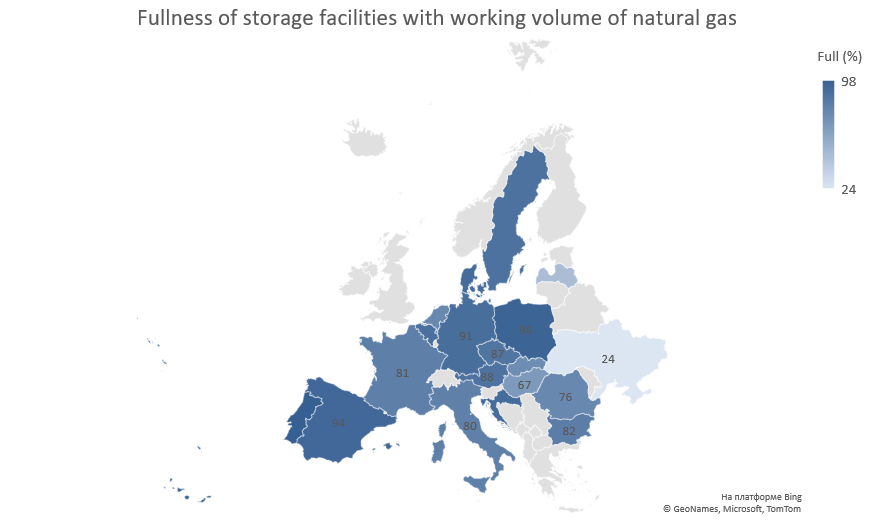
As of January 11, there were about 11,8 billion cubic meters of natural gas in Ukraine’s storage facilities. Withdrawals from UGS facilities amounted to 57 million cubic meters per day.
Compared to the storage facilities of European countries, Ukraine has quite significant free capacities. Now European UGS facilities have 33-34 billion cubic meters of gas more than last year. Their occupancy level is 82% against 51% at the beginning of January 2022.
Interesting for the week
Norway will be able to maintain gas production at last year’s increased level at least until 2026 thanks to investments of 300 billion Norwegian krone (USD 30 billion) in new offshore fields. "Rarely have we seen as much oil and gas produced offshore Norway as last year, and only rarely have we seen such important investment decisions," the Norwegian Petroleum Directorate said in its annual report. Norway has become the most important supplier of natural gas to Europe after russia’s decision to cut gas supplies to the continent following its invasion of Ukraine. According to the NPD, production in the Scandinavian country grew by 8% in 2022 to 122 billion cubic meters, the highest level in five years.
At the end of 2022, the European Union became the world’s largest buyer of liquefied natural gas, bypassing China, Japan and South Korea. Against the background of a sharp decline in russian pipeline gas supplies, the EU countries in 2022 increased purchases of liquefied natural gas by 58%, to 101 million tons. This allowed the EU to become the largest buyer of this type of fuel, bypassing the former leaders - China, Japan and South Korea.
The Government of Moldova has approved the decision on the necessary amendments to the legislation, which opens up opportunities for all companies to use the backhaul service (virtual reverse) at the point of connection with Ukraine. Ukrainian customers will be able to transport gas of non-russian origin through the Trans-Balkan corridor - from LNG terminals in Greece and Turkey or gas produced in Azerbaijan. Previously, this mechanism was used mainly by customers from Moldova itself.


