

Gas price: Ukraine and Europe. Marker review January 23 - 27, 2023

Gas price: Ukraine and Europe. Market overview
During the past week, natural gas prices in Ukraine decreased, following the trends of European hubs.
Ukrainian Energy Exchange
Last week, the January 2023, February 2023 resource was traded. In general, positions for the purchase and sale of natural gas were formed by 3 companies: Ukrnafta, Energo Zbut Trans, Eastern Geological Union.
The starting prices of resources did not have a pronounced trend, but differed depending on the conditions of the position.
Over the past week, sell and buy positions were implemented. A total of 375,000 cubic meters of natural gas were sold.
Ukrnafta was the initiator of trades every day, except Monday, offering a resource in PSG. The company was able to sell 50,000 cubic meters of natural gas with transfer in January. The sale price was UAH 21,050 excl. VAT.
On Friday, January 27, a position was initiated for the purchase of the resource in February at the GTS of Ukraine Energo Zbut Trans, the company purchased 325 thousand cubic meters at a price of 18,582 UAH/ thousand cubic meters excl. VAT.
On the UEEX short-term natural gas market, participants formed applications in GTS and UGS. The sale of gas took place on the intraday market in GTS. In total, 5 agreements with a volume of 10,000 cubic meters were concluded. During the week, the short-term market recorded a decrease in price. So, on Friday, the exchange rate was UAH 19,950 per thousand cubic meters excl. VAT.
The weighted average prices of SSP and marginal prices for natural gas, formed by the results of the UEEX auctions, are shown in the graph below.
European market
The middle of the winter season is marked by intensive LNG supplies in conditions of moderate temperatures. Since the beginning of last week, natural gas prices have been lower than prices in the third week of January on news that a major USA export facility intends to resume LNG supplies.
Exchange prices on the European spot gas market continue to decline, with the price of gas on the spot market at the TTF hub in the Netherlands falling to EUR 55.75/MWh on January 26, compared to €66.65/MWh on January 23, the price of futures as of January 26 with gas delivery in February also fell.
As of the end of January, natural gas is cheaper than a year ago. This is facilitated by both the record storage capacity and the reduction of supplies from russia to a minimum level, which reduces risks. In addition to China, russian gas flows will be directed to Kazakhstan and Uzbekistan, which are discussing the possibility of increasing russian gas supplies. Norway has acquired the role of the main supplier of natural gas to the EU, which was once held by russia.
Prices of contracts with delivery in the corresponding period, EUR/MWh, January 26, 2023
| Instrument | THE | CEGH | TTF | TGE/POLPX | CEEGEX/HUDEX | Average price |
|---|---|---|---|---|---|---|
| Day1 | 56,37 | 59,39 | 55,75 | 63,74 | 61,83 | 59,42 |
| M+1 | 55,67 | 57,32 | 54,1 | 61,719 | 55,69 | 56,90 |
| Q+1 | 57,08 | 58,45 | 56,36 | 62,37 | 57,41 | 58,33 |
| S+1 | 57,71 | 58,81 | 56,99 | 67,2 | 58,25 | 59,79 |
Contracts for a month in advance at all analyzed hubs had the same trend in terms of spot prices – a decrease in price by an average of 4.16%. Quarter-on-quarter prices were lower than spot prices by an average of 1.70%. Prices for the season ahead with an average value of EUR 59.79/MWh had a tendency to increase compared to spot prices by an average of 0.65%.
Global LNG prices fell after a much milder-than-expected winter in Europe. Asian spot LNG prices have tumbled nearly 67% from record highs reached last August. Asian markets are still quite attractive, which could lead to a redistribution of LNG supplies. While China’s "revival" will boost LNG demand, it may not be a key driver of gas prices in 2023. Last year, it accounted for just 8.9% of total energy demand in this country, where there are few affordable alternatives to expensive LNG (coal and russian pipeline gas).
Easing of measures to combat COVID-19 in China contributed to the upward trend in Brent crude oil futures during the fourth week of January on expectations of a recovery in demand in that country. March futures for Brent rose on Friday on the London exchange ICE Futures to 88.62 per barrel, which is more than USD 10 higher than this year’s low.
Global oil demand is forecast to increase by 1.5 million barrels per day in 2023, with China accounting for 650,000 barrels per day, followed by India’s oil market.
Gas balance in Ukraine
The price situation on European markets was favorable for imports. It came from all three European directions. The largest volumes are from Slovakia. Export deliveries were minimal.
As of January 25, there were about 11.09 billion cubic meters of natural gas in Ukraine’s storage facilities. Withdrawal from PSG increased in connection with the cooling and amounted to 47 million cubic meters per day.
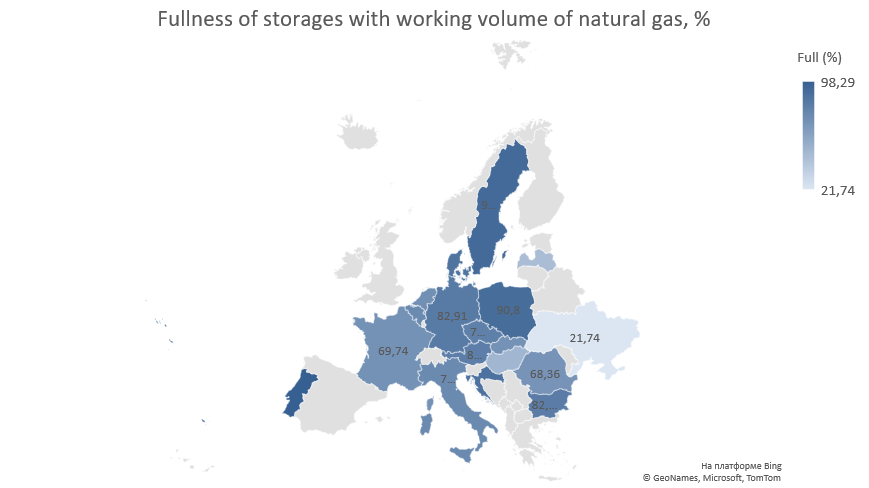
Compared to storage facilities in European countries, Ukraine has quite significant free capacities.
Public procurements
Last week, 5 tender procedures for the purchase of natural gas by budget institutions and state enterprises were held. In total, 355.69 thousand cubic meters of natural gas were sold in the amount of UAH 11.12 million. The largest contract was given to the ENERGY OPERATOR, which will deliver 249.99 thousand cubic meters of natural gas to the Specialized Utility Enterprise at the initial price of UAH 35.08/cubic meter. The average price increased and amounted to UAH 26.41. per cubic meter. Prices ranged from UAH 20.12 to UAH 35.08 per cubic meter.
Interesting for the week
Germany will need at least three years to create the energy infrastructure necessary to completely replace Russian gas with LNG supplies. By 2026, Germany intends to create the infrastructure necessary to import 56 billion cubic meters of LNG - this is the amount of gas Germany imported from russia in 2021. By 2030, the capacity should reach 76.5 billion cubic meters is about 80% of the total gas consumption in Germany in 2021. In 2022, the share of russian gas in Germany’s consumption structure fell to about 20% from 55% a year earlier. Germany has managed to reduce its dependence on russian gas by reducing consumption, importing LNG through neighboring European countries and increasing pipeline supplies from Norway and the Netherlands.
At its meeting on January 24, the NEURC adopted the resolution "On approval of the Procedure for the certification procedure of the gas storage operator." The procedure was developed by the NEURC for the purpose of implementing the norms of European legislation, ensuring the certification of the gas storage operator, bringing its activities to international standards and complying with the requirements to prevent risks to the safety of natural gas supply and to meet the requirements of the current legislation of Ukraine.


