


Electricity: Ukraine and Europe September 2 – 6, 2024

Ukrainian Energy Exchange: bilateral contracts market
Last week, UEEX held 8 auctions for the purchase/sale of electricity in the unilateral auction mode, including 3 in the commercial sections and 5 in the specialised sections. The initiators included: Guaranteed Buyer, Ukrhydroenergo, Starokostiantynivtsukor, Nizhnednistrovska HPP, USP and DSO, etc.
Ukrhydroenergo initiated the auctions, offering base load with different delivery periods for September. As a result of the auctions, the company sold 16800 MWh of baseload at a weighted average price of 5084,82 UAH/MWh with a delivery period from 5 to 11 September and 12264 MWh at a weighted average price of 5294,73 UAH/MWh with a delivery period from 10 to 16 September.
During the reporting period, Starokostiantynivtsukor initiated an auction offering a base load with a delivery period from 7 to 11 September. As a result, the company sold 120 MWh of electricity at a weighted average price of UAH 5000/MWh.
In addition, last week, in the specialised section, Nizhnednistrovska HPP initiated an auction in accordance with Article 66 of the Law of Ukraine "On the Electricity Market", offering base-load with delivery in September. As a result, the company was unable to sell the volume put up.
The Guaranteed Buyer initiated the auction by offering block positions for daytime hours with a delivery period of the second decade of September. As a result of the auction, the company sold 77500 MWh of block positions at prices in the range of 1526,7 - 4391,7 UAH/MWh.
In the commercial sections, the companies purchased/sold electricity to individual loads.
| Trades type | Sales volume, MWh |
|---|---|
| Auctions pursuant to Article 66 of the Law of Ukraine On Electricity Market | 29 184 |
| Commercial section | 21 429,564 |
| Special sessions for the sale of electricity generated from alternative energy sources | 77 500 |
| In total | 128 113,56 |
As of 6 September, prices for the most commonly used types of sales schedules were formed, as shown in the chart.
Market operator: day-ahead and intraday markets
During the reporting period, the day-ahead market prices were volatile, ranging from 4335,96 to 6661,03 UAH/MWh. Overall, the average weighted average price for the last week increased by 2,6% compared to the same indicator of the previous week and amounted to 5733,25 UAH/MWh. The highest daily price was 6661,03 UAH/MWh on 5 September, and the lowest - 4335,96 UAH/MWh on 1 September. Sales volume for the reporting period 31 August - 6 September amounted to 399,21 thousand MWh, (-4,2%).
During the reporting period, prices on the IDM were volatile. The weighted average prices varied in the range of 5708,80 - 7389,47 UAH/MWh, and the average weighted average price for the reporting period increased by 21% compared to the same period last year and amounted to 6562,87 UAH/MWh. The total volume of sales and purchases for the reporting period amounted to 51,05 thousand MWh.
European market
Last week, prices rose in most major European markets despite a decline in the average weekly gas price. Decreased wind and solar power production and rising demand in most markets contributed to this upward trend.
European spot prices had a mixed trend. The spot price for electricity in Germany increased by 18% to reach EUR 76,13/MWh due to a decline in renewable generation. Meanwhile, in France, nuclear production affected prices. Thus, the spot price of electricity in France fell by almost 9% to close at EUR 78,80/MWh due to the increased availability of nuclear generation.
Electricity generation from wind turbines in Europe over the first four days of last week averaged 11,8% of the region’s needs, according to the WindEurope Association. The largest volumes were generated by the following countries: Spain, Germany, France, Poland and Sweden.
Solar energy generation in Europe in the first four days of last week decreased by 523 GWh compared to the same period of the previous week and amounted to about 3650 GWh.
Demand for electricity in major European electricity markets began to recover in the first week of September. In the first four days of last week, pan-European demand averaged 298 GW.
In terms of hourly prices, the German, Belgian and Dutch markets recorded negative hourly prices on 31 August and 1 September. The Belgian market recorded the lowest hourly price: -EUR 53,61/MWh, on Sunday, 1 September, from 13:00 to 14:00.
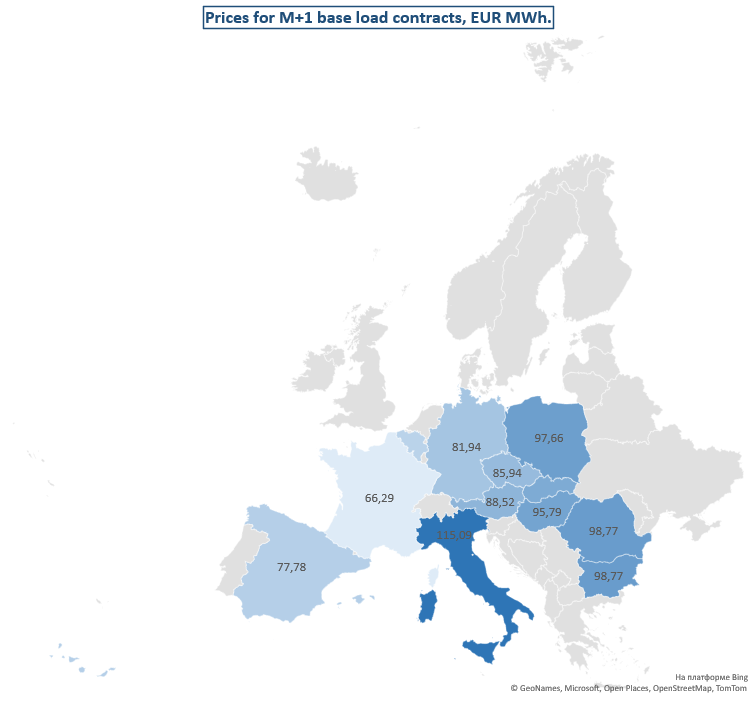
As of 6 September, the price of basic electricity in France was 78,80 EUR/MWh, in Hungary: 130,67 EUR/MWh; in Poland: 90,37 EUR/MWh.
As of October 2024, prices were trading in the range of EUR 66-98/MWh in the above countries.
Monthly electricity futures for November 2024 increased by 16,4% in the countries analysed; for December 2024, prices fell by 3,7% in France and increased by an average of 2,5% in Hungary and Poland.
The benchmark German energy contract Cal’25 closed at EUR 90,16/MWh, while the French equivalent remained at the previous day’s level with a price of EUR 76,72/MWh.
Futures contract prices, EUR/MWh, 05.09.2024
| Type | Contract | Date | France | Hungary | Poland |
|---|---|---|---|---|---|
| Base | Моnth | Oct/24 | 66,29 | 95,79 | 97,66 |
| Nov/24 | 88,39 | 106,29 | 102,37 | ||
| Dec/24 | 91,67 | 104,04 | 99,39 |
European carbon prices hit a fresh six-week low due to selling pressure late in last Thursday’s session. EUAs, which expire in December 2024, settled at EUR 66,20 per ton on 5 September and continue to reflect the recent price declines seen in European gas markets. The price of EU carbon permits traded at EUR 67,15 per tonne on 6 September.
On 5 September, the spot price of thermal coal in Europe (API-2) was 102,87 EUR per ton.
In the Asian market, demand is expected to increase from mid-September as China restocks for the winter and Indian buyers replenish stocks for the upcoming festival celebrations.
Last week, Ukraine received imports from Hungary, Slovakia, Romania, Poland, and Moldova. There were no exports.
Public procurement
Over the past week, more than 10 electricity procurement tenders were held by customers. The volume of the 10 largest contracts sold totalled 5,35 million kWh for a total value of UAH 32,31 million excluding VAT. The average price was UAH 6,19 per kWh, excluding VAT. The largest contract was awarded to Dnipro Energy Services LLC, which will supply 2,5 million kWh of electricity to the Main Department of the National Police in Dnipropetrovska oblast at a starting price of UAH 5,85 per kWh, excluding VAT. Other tenders are shown in the graph below. Prices ranged from UAH 5,80 to 7,20 per kWh.
News from the wholesale electricity market
Ukraine reduced electricity imports by 43% in August 2024
In August 2024, Ukraine reduced electricity imports by 43% compared to the previous month, to almost 474 thousand MWh. Electricity imports from Poland decreased the most, by 57,5% to 48,2 thousand MWh. Hungary continues to account for the largest share in the import structure, 43%. Electricity exports have been absent since 12 May 2024. Compared to August 2023, electricity imports have increased 4 times this year. In total, more than 2,1 million MWh of electricity was imported in June-August 2024, which is almost three times more than the total imports for the whole of 2023. As previously reported in ExPro, the peak of electricity imports this year was in June - more than 858 thousand MWh.
Finnish NPP starts using American fuel instead of Russian
Finnish state-owned energy company Fortum has started using nuclear fuel from the US company Westinghouse Electric to replace Russian supplies. This is stated in a statement by Fortum, LIGA.net reports. ‘The first batch of Westinghouse Electric Company nuclear fuel was loaded into Fortum’s Loviisa NPP during its annual shutdown in August,’ the statement said. The Loviisa nuclear power plant in Finland was dependent on nuclear fuel from Rosatom’s subsidiary TVEL. After the outbreak of full-scale war in Ukraine, Fortum started looking for a replacement for Russian fuel. Fortum’s two nuclear reactors in Loviisa account for about 10% of Finland’s total electricity production.