


Electricity: Ukraine and Europe November 4 – 15, 2019


In early November, trade activity was quite high. There were 22 auctions held for electricity sell on basic, peak and offpeak loads. In total, 332 thousand MWh of electricity were sold at auctions that do not fall under the PSO. For the first time, 16200 MWh of base load electricity by the company TAS Energy Kraiiny were sold at the auctions. Also 10080 MWh of base load were sold by other companies. Centrenergo initiated auctions with peak and offpeak load resources and managed to sell 135 and 175.5 thousand MWh of electricity in accordance for two auctions. During the auctions, the price was traditionally reduced. For example, the selling price of the base load resource was lower than the starting price by 2% on average. Sellers offered resource of base load at prices in a fairly wide range - 1600-2400 UAH, peak load - 2020 - 2355 UAH, and offpeak load - at the price of 1400 UAH.
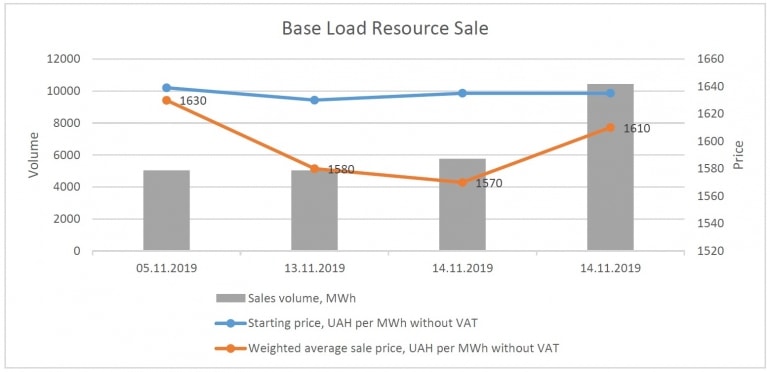
As of November 15, the exchange quotations of electricity at the Ukrainian Energy Exchange were as follows: the resource of base load - 1595.78 UAH/MWh, peak load - 1620 UAH/MWh.
In addition, 5.3 mln MWh of base load electricity were sold at the Ukrainian Energy Exchange at regulated prices by the company entrusted with special duties in the new electricity market - SE NNEGC Energoatom.

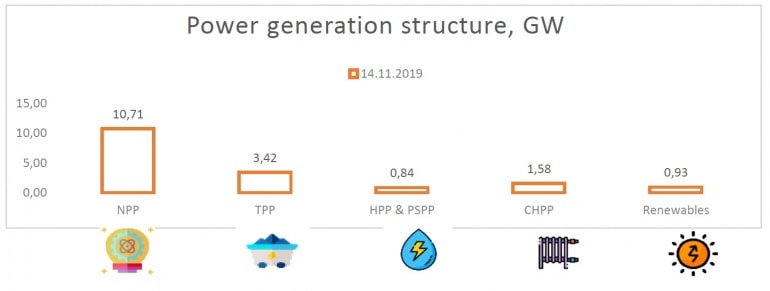
As of November 14, the share of nuclear power generation was 61%, and TPPs - 20%. In November, there is a significant surplus of electricity in the IPS, which led to forced restrictions on some generating capacities. Thus, as compared to October 31, the share of nuclear generation increased by 7 p.p.(percentage points) while the share of TPPs in the structure of average daily electricity production decreased by 10 p.p. In physical terms, NPP electricity generation increased by 7% to 10.71 GW, and TPPs dropped by 37% to 3.42 GW. The total electricity production on November 14 amounted to 17480 MW, which is 5.2% less than on October 31 and 1.3% more than on November 7, 2019. Traditionally, the demand for electricity and generation has been growing during the cold season. Warm weather in Ukraine this month makes changes to the seasonal generation schedule. For example, on November 14 last year, electricity production was significantly higher - 20,860 MW.

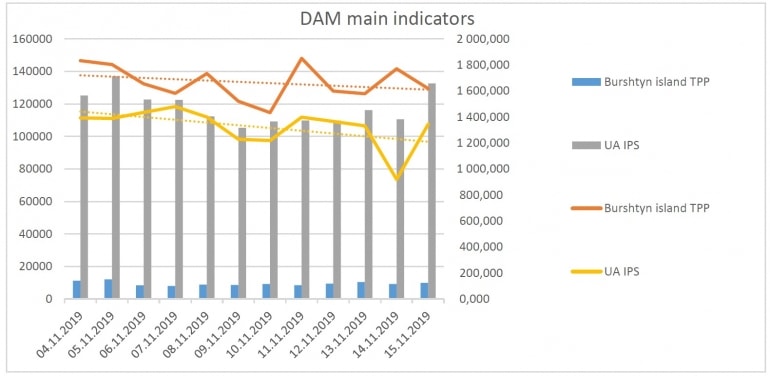
In recent weeks, the day-ahead market has undergone significant changes. As a result of the introduction of imports and off-season warm weather prices have decreased. Particularly sharp decline was observed in the trades on November 14. Then the prices in the UA IPS decreased to 920 UAH/MWh, which is a record low since the introduction of the new electricity market. This situation was provoked by a significant difference between the demand and supply, due to the growth of supply from Energoatom and the general drop in demand against the background of warm weather. It should also be noted that on this day, unlike the UA IPS prices, the price of Burshtyn Island rose by 12% from the previous day’s level - up to 1770 UAH/MWh. The next day the price in the UA IPS resumed. The aggravation of the problem situation of trading on November 13 was avoided, including due to the professionalism of the dispatching service of UA IPS.
During the last weeks of the new electric power market work 118 thsn MWh of electric power were sold in average daily in the UA IPS at the average daily price of 1325 UAH per MWh and 9,5 thsn MWh of electric power for Burshtyn Island at the average daily price of 1665 UAH per MWh. Average daily gap between the prices of UA IPS and Burshtyn Island amounted to 340 UAH per day. If we compare the prices of UA IPS and Burshtyn Island for the last two weeks, we see that the downward dynamics in UA IPS is more distinctive than in the territory of Burshtyn Island.
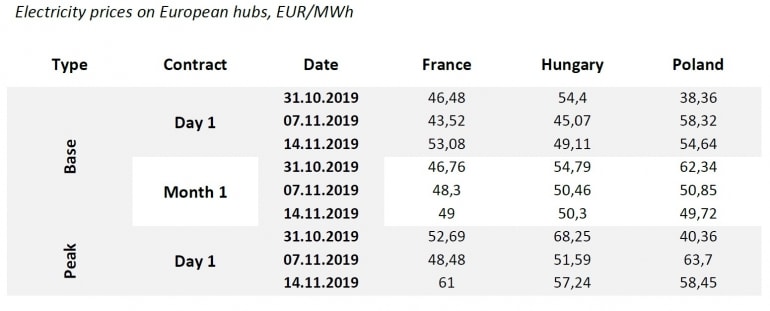
Spot prices in Europe were volatile, but the overall trend in spot prices was sideways, except in France, where the increase in prices this week was caused by the stoppage of several nuclear reactors for preventive purposes after the November 11 earthquake. In general, the weather situation in Ukraine in November is typical of the South-Eastern European region as a whole: warm weather limits consumption and contributes to the persistence of off-season low prices. Thus, on November 14, the price of base electricity in France was 53.08 EUR/MWh, in Hungary - 49.11 EUR/MWh, in Poland - 54.64 EUR/ MWh. Electricity for December was traded at prices in the range of 46-63 EUR/MW in November.
An additional type of sales schedule for electricity trading was introduced at the UEEX. The relevant amendments to the Regulations on the organization and conduct of electronic auction for the sale of electricity on CE "Ukrainian Energy Exchange" were agreed on November 6 by the decision of the Auction Committee for the sale of electricity under bilateral contracts. This decision introduced an additional type of sales schedule for the sale of electricity called HOLIDAYPEAK. The time of day, during which bilateral agreements with the use of HOLIDAYPEAK are to be executed - from 9 am till 11pm on holidays, non-working days and weekends (non-working days).
Warm autumn weather creates a daily surplus of about 2 GW of power in the grid. Rather high air temperature, as for November, leads to a decrease in electricity consumption in the power system against the background of its high supply, which is due to the imbalance of IDM, the work of suppliers and the growth in the capacity of nuclear units that are being repaired, resulting in a power surplus of about 2 GW per day. Such information on the current state of the energy system operation was reported by Vitalii Zaichenko, Deputy Director for Operations, Chief Dispatcher of NEC Ukrenergo.
Ukrainian energy companies suffered losses due to electricity imports from Russia. Yurii Nedashkovskyi, President of SE NNEGC Energoatom, said that the growing import of Russian electricity forced the company to enter the balancing market, which is an additional financial burden. On November7, the head of NEC Ukrenergo Vsevolod Kovalchuk, admitted at a press conference that due to the import of electricity from Russia, it became possible, thanks to the "Gerus amendment", that it had to restrict electricity production at Ukrainian power plants.
The Verkhovna Rada voted in favour of draft law №2233 on amending the law "On the Electric Power Market". A total of 295 people’s deputies voted for this decision. "The draft law №2233 proposes to settle the issue of fulfillment of special commitments on electric energy purchase according to the "green" tariff, provides for prevention of uncontrolled growth of electric power prices, as well as the right to oblige electric power producers to submit applications for electric power sale on the DAM at prices that do not exceed the limits, in order to make it impossible to create artificial deficits, that took place in September," Andrii Gerus said before voting. The law stipulates that the NERC will have the right to set maximum prices in the day-ahead market, balancing market and intra-day market starting from July 1, 2023.
However, a lot of experts have a negative attitude to the initiative of setting price ceilings. "The innovation with price regulation contradicts the idea of the market, when pricing should take place in accordance with the balance of supply and demand in all segments of the market. Such an attempt to regulate may call into question how ENTSO-E integration will be prepared. And the European Energy Community has expressed its concern about these restrictions. We are getting such a "market is not really a market", - said Andrian Prokip, an energy expert of the Ukrainian Institute for the Future.

Oksana Zaporizka
Analyst,
UEEX