


Electricity: Ukraine and Europe May 13 – 17, 2024

Ukrainian Energy Exchange: bilateral contracts market
Last week, the UEEX held 8 auctions for the purchase/sale of electricity in the unilateral auction mode, including 4 in commercial sections, 3 in specialized sections, and an auction in the electricity import/export section. The initiators included: Guaranteed Buyer, Nyzhnodnistrovska HPP, Euro-reconstruction, USP and DSO, etc.
Last week, the Guaranteed Buyer initiated an auction in the specialized sections, offering block positions of daytime hours for delivery in the last decade of May. According to the results of the auction, the company sold 69300 MWh of block positions at prices in the range of 1128.95 - 3418.95 UAH/MWh.
Last week, the Nyzhnodnistrovska HPP sold 384 MWh of baseload electricity in specialized sections at a weighted average price of UAH 3,800 and delivery in the second half of May.
In the commercial sections of the company, the purchase/sale of electricity was carried out by the load of an individual profile.
| Type of trades | Sales volume, MWh |
|---|---|
| Auctions pursuant to Article 66 of the Law of Ukraine On Electricity Market | 384 |
| Commercial section | 30 565,964 |
| Special sessions for the sale of electricity generated from alternative energy sources | 69 300 |
| In total | 100 249,964 |
As of May 17, prices for the most commonly used types of sales schedules were formed, as shown in the chart.
Market operator: day-ahead and intraday markets
During the reporting period, the day-ahead market prices were volatile, ranging from 3875.12 to 5039.30 UAH/MWh. Overall, the average weighted average price over the last week increased by 10% compared to the same indicator last week and amounted to 4461.73 UAH/MWh. The highest daily price amounted to 5039.3 UAH/MWh on May 15, and the lowest - 3875.12 UAH/MWh on May 12. The volume of sales for the reporting period of May 11-17 amounted to 434.18 thousand MWh, (+3.5%).
Prices for IDM were volatile during the review period. The weighted average prices varied in the range of 4698.75 - 6456.27 MWh, and the average value of the weighted average prices for the reporting period increased by 33.6% compared to the same period last year and amounted to 5469.55 UAH/MWh. The total volume of sales and purchases for the reporting period amounted to 93.19 thousand MWh.
European market
Last week, prices in most of the analyzed European electricity markets declined due to a significant increase in renewable energy generation. Prices rose at the end of the week amid a decline in renewable energy sources. The spot price of electricity in Germany increased by almost 40% to slightly over 69 EUR/MWh, while the French DA contract increased by more than 41% to 43.27 EUR/MWh.
Below-average wind power generation in the UK supported DA prices and electricity contracts traded 0.5% higher on May 17 at 72.5£/MWh (7.2p/kWh). The UK is currently a large importer of electricity: it receives more than 5 GW of electricity from neighboring continental countries, but sends some small remaining volumes to Ireland and Belgium.
Electricity generation from wind turbines in Europe in the first four days of last week provided 16.5% of the region’s needs, according to the WindEurope Association. The leading countries were Spain, Denmark, Germany, Poland and France.
Solar power generation continued to grow in Germany and declined in Italy and Spain last week. The Portuguese market broke the record for solar energy generation on Sunday, May 12, with a total production of almost 20 GWh. Germany broke historical records for daily solar photovoltaic power generation on Sunday, May 12, with 382 GWh of power produced using this technology. On Tuesday, German solar generation reached another record high of almost 47.1 GW, surpassing the previous record.
Lower average temperatures recorded in a large part of the markets contributed to the decline in demand. The demand for gas for electricity generation in the UK is relatively insignificant: the fossil fuel power plant fleet consumes 40-43 million cubic meters per day from the grid on weekdays and 38 million cubic meters per day on weekends.
The general trend of weather forecasts remains unchanged over the next 10 days: temperatures are returning to seasonal norms in most of Northwest Europe, and precipitation is expected to increase by the end of this week.
As for hourly prices, negative prices were recorded on most of the analyzed European markets on May 11 and 12. The only exceptions were the UK and Italian markets, where there were no negative prices, and the Portuguese market, where negative prices were recorded only on May 11. The Dutch market reached its lowest hourly price of EUR 200.00/MWh on Sunday, May 12, from 13:00 to 14:00. Other analyzed markets registered negative hourly prices on Monday, May 13. In Germany, the hourly price from 13:00 to 14:00 at the Monday auction for delivery on Tuesday fell to -42.95 EUR/MWh. On Wednesday, exchange data showed three hours of negative prices, with the cheapest of them at -0.71 euros starting at 13:00. In total, there have been 139 negative prices in Germany this year, with the main increase coming from an increase in solar power production in May.
Spot prices in Scandinavia remained low in the range of EUR 10-15/MWh due to low demand, high levels of renewable energy generation and a day off in Norway on Friday.
As of May 17, the price of basic electricity in France amounted to 43.27 EUR/MWh; in Hungary: 92.81 EUR/MWh; in Poland: 58.40 EUR/MWh.
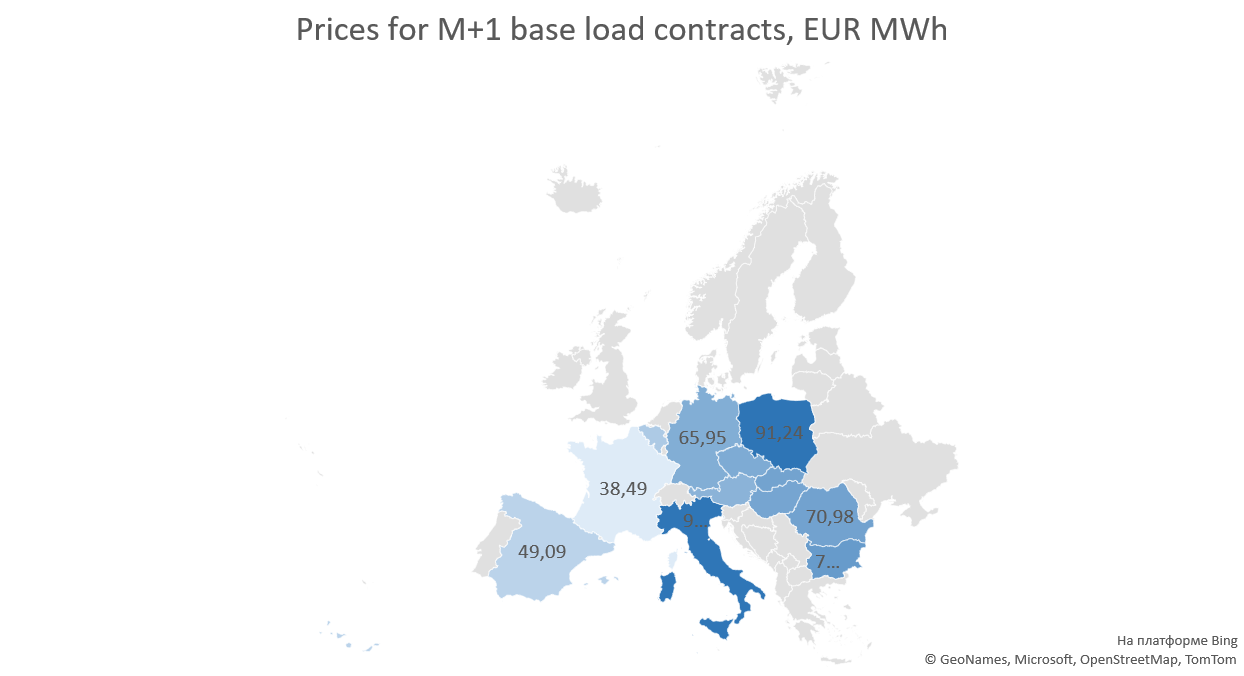
As of June 2024, electricity was traded in the range of 38 - 91 EUR/MWh in the analyzed countries.
Monthly electricity futures for July 2024 increased by an average of 24% in France and Hungary and decreased by 1.7% in Poland. As of August 2024, prices increased by an average of 2.1% in the analyzed countries.
Germany’s benchmark energy contract Cal ’25 settled at 81.81 EUR/MWh, while the price of French electricity Cal ’25 was 92.96 EUR/MWh, with both contracts up more than 1% on the day.
Futures contract prices, EUR/MWh, 05/16/2024
| Type | Contract | Date | France | Hungary | Poland |
|---|---|---|---|---|---|
| Base | Моnth | Jun/24 | 38,49 | 69,60 | 91,24 |
| Jul/24 | 53,37 | 76,70 | 89,70 | ||
| Aug/24 | 53,88 | 78,92 | 92,00 |
The estimated price for carbon emissions in Europe last Thursday, May 16, was 70.1 EUR per tonne, which is 4.3% lower than the price the day before last Thursday. On May 17, in the afternoon, the EUA’24 price was trading at 70.18 EUR per ton. Carbon prices continue to track the movements of the TTF and NBP, as five auctions are scheduled for next week, with supply remaining strong.
According to a market analyst, the decommissioning of coal and lignite-fired power plants in EU member states could lead to the voluntary cancellation of up to 160 million EUA by 2030, with more to be removed after that date, leading to higher prices as market volumes decline.
The new carbon pricing scheme, known as ETS2, could lead to an increase in demand for emission allowances in 2027 and thus a higher price for carbon emissions. A study by the German think tank Agora Energiewende suggests that the price could rise to EUR 200 per ton, although EU lawmakers promised that prices would remain below EUR 45 per ton of CO2 when the system was agreed upon in 2023.
On May 16, the spot price of thermal coal in Europe (according to API-2) amounted to 97.89 EUR per ton.
Russian shelling of energy facilities resulted in the loss of 8 GW of the country’s generating capacity. Ukrenergo applied controlled emergency outages for industrial and residential consumers in all regions of Ukraine. There was a deficit in the power system due to Russian shelling and increased consumption due to the cold snap, and emergency assistance was called in daily. Imports came from 5 countries: Slovakia, Romania, Moldova, Hungary, and Poland at the level of 23.5 thousand MWh-23.7 thousand MWh. The maximum import capacity in some hours reaches 1653 MWh, which almost reaches the maximum technical capacity of electricity supplies from Europe to Ukraine and Moldova of 1700 MWh.
Public procurement
Last week, 10 tenders were held for the purchase of electricity by budgetary institutions for a total amount of more than UAH 88.53 million, excluding VAT. The sold volume of all contracts amounted to 17.71 million kWh. The average price was UAH 4.86 per kWh, excluding VAT. The largest contract was awarded to Donetsk Energy Services LLC, which will supply 10.05 million kWh of electricity to the Housing and Maintenance Department of Luhansk at a starting price of UAH 5.48 per kWh, excluding VAT. Other tenders are shown in the graph below. Prices ranged from UAH 3.82 to UAH 6.30 per kWh.
News from the wholesale electricity market
Hyundai will build new nuclear units in Ukraine. As part of the agreement with Energoatom, the Korean company Hyundai has the opportunity to build nuclear units in Ukraine. It is assumed that this will help Ukraine replace the capacity of the Zaporizhzhia NPP, which is temporarily occupied. South Korea has been actively helping Ukraine during the war: last year they donated 60 diesel generators to Ukraine, and this year they plan to donate another 200, EnergoZhynka reports.
The marginal crossing price for electricity imports from Hungary reached 117 EUR/MWh at 5 p.m. on May 15. This is evidenced by the results of auctions on the JAO platform. In general, on average, for the delivery period from May 8 to 15, the price of the Hungary-Ukraine crossing is 76 EUR /MWh, which is 4 times higher than the same indicator for the period from May 1 to 7. Currently, the peak of the marginal crossing price in this direction falls at this hour. At the same time, in the second half of April and early April, the maximum prices were observed at 18-19 hours, according to Expro.