


Electricity: Ukraine and Europe July 22 - August 9

On July 24, Energoatom sold 4.79 million MWh of base load electricity, and Ukrhydroenergo sold 216 thousand MWh of peak load electricity at PSO auctions (for the population needs and to compensate electricity losses in networks).
At non-PSO auctions, generating companies and traders sold 829 thousand MWh electricity of all kinds of load schedules.
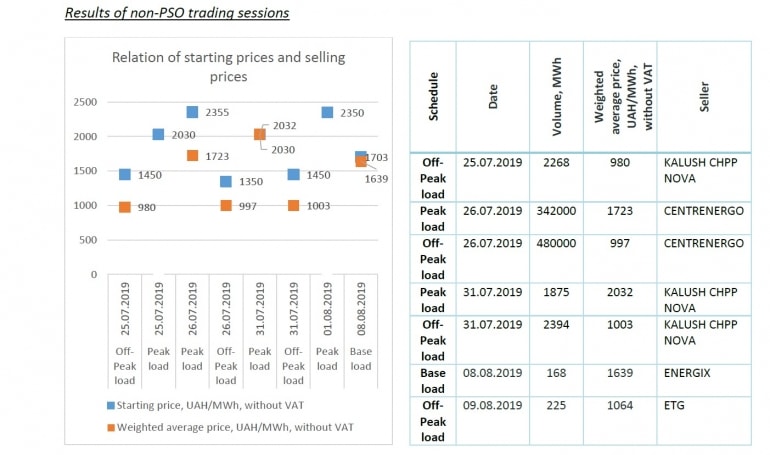
For the first time on August 1, a private trader Energix, offered to sell peak load electricity, but was unable to sell it. However, the company sold electricity on the second attempt - at the auction on August 8, 168 MWh of base load were sold at the price of 1 639 UAH/MWh. Also, on August 9, ETG Company was the first to sell off-peak electricity at the auction.
A common trend in all auctions conducted over the last three weeks is to set high starting prices and further reduce them during the trading session
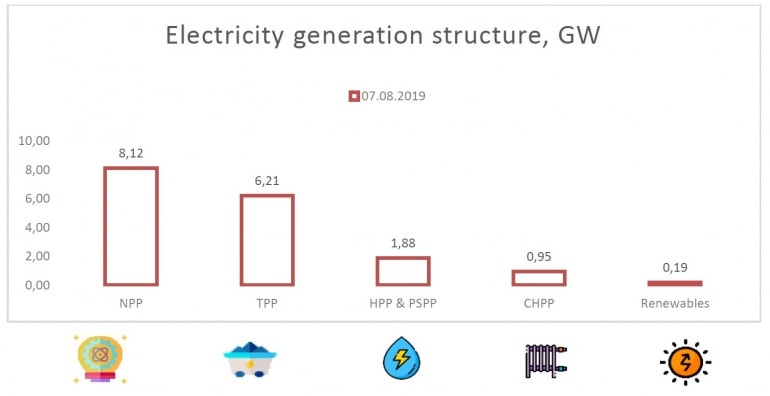
As of August 7, nuclear power accounted for 47% of electricity. Thus, in the last studied period, the share of atomic generation decreased, instead the share of TPP and Renewables increased. On August 6, the President of Ukraine signed an important law for Renewables, which guarantees the possibility of owners of home solar power plants with a capacity of up to 30 kW to sell electricity to the grid at a "green" tariff without limiting their installation location. Thus, the obligation to buy electricity from Renewables increases the impact on the price situation in the electricity market.
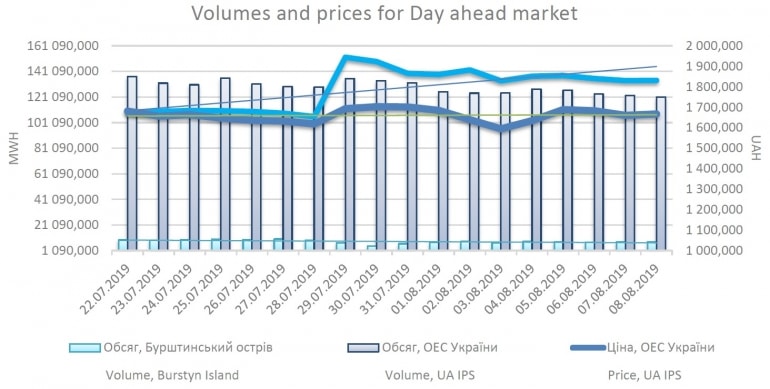
According to the information provided in the report of the Market Operator for July, in the first days of the month, the volume of trades on Day Ahead and Intraday made up 40-45% of consumption on the UA IPS on average, at the end of the month the percentage decreased to 30-37%. In the Burstyn Island, the average volume of bidding for Day Ahead and Intraday accounted for 65% of Burstyn Island consumption. In the future, the proportion of Day Ahead and Intraday should decrease.
During the last three weeks of the new electricity market operation, were sold 2 429 GWh of electricity in the UA IPS at the average daily price of 1 661 UAH per MWh and 155 GWh electricity for Burstyn Island at the average daily price of 1 791 UAH per MWh. There were no significant price fluctuations, as in the first weeks of operation. The weighted average price of Burstyn Island remains 8% more expensive than the price of the UA IPS.
In general, there is a growing price dynamics in the territory of Burstyn Island (the price has increased by 160 UAH/MWh since July 22).
In terms of delivery hours, peak and off-peak hours were as close as possible to the NKREKP marginal prices.
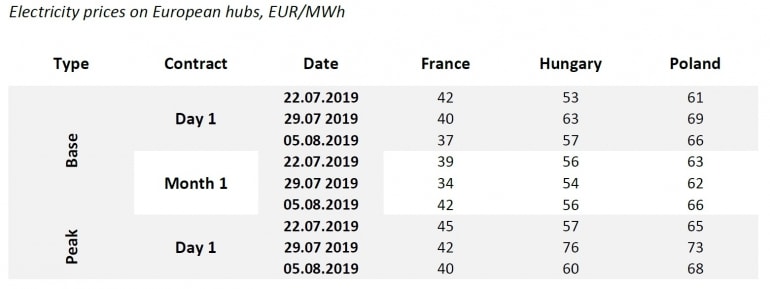
At the beginning of August, prices in Europe changed mainly under the influence of electricity generation from Renewables. The current week spot prices have fallen amid rising wind power in Western Europe.
In the near future, temperatures are likely to drop, reducing the need for air conditioning, which fuelled prices in June and July.
In general, the prices of electricity in the UA IPS, and especially within the Burstyn Island TPP trade zone, are comparable and as close as possible to those of neighbouring Poland and Hungary.
In July, Ukraine imported 275 million kWh of electricity. During July 2019, Ukraine imported 275 million kWh of electricity from Belarus to the UA IPS and from Europe to Burstyn. In July 2019, electricity exports amounted to 494 million kWh, which is 24.8% more than in the same period in 2018. Thus, in July 2019 imports amounted to 55.7% of electricity exports.
Ukrhydroenergo operates in emergency mode after the electricity market launched. Ukrenergo forces Ukrhydroenergo to operate in the pre-emergency or emergency mode by providing incorrect commands. This is stated in the letter of Acting General Director of Ukrhydroenergo Vadym Rassovskyi to the address of Ukrenergo. The letter says that due to the lack of reserves for balancing energy at thermal power plants at night and the low unloading of hydroelectric power plants in the daytime, Ukrhydroenergo’s work at night leads to additional losses.
Ukrenergo’s press service clarified on this letter: “Currently, Ukrenergo dispatchers really give lots of commands that need immediate implementation, especially for HPP and PSPP. This is due to the fact that in the free market deviations from the planned load schedules (ie electricity consumption) occur much more often than in the old market model. Another reason for the large number of commands for hydropower plants that require immediate implementation is the lack of quick reserves for balancing the power system (unloaded, ready-to-operate power units or under-loaded ones). They are missing out on the fact that there is currently no ancillary services market in which market participants are compensated for maintaining reserves.”
In July the Guaranteed Buyer paid 1.5 billion UAH to alternative generation. Total payments to green generation for the first month of the new market reached 51.1% of the full amount. From the paid amount, 454 mln UAH was received from Ukrenergo for the service to increase the share of electricity generation from alternative sources, the estimated value of which in July was 1.92 billion UAH. As of August 8, 2019 Ukrenergo has a debt to the Guaranteed Buyer of 1.47 billion UAH.
Ukraine’s energy system needs the development of new segments, including high-maneuverability generation. The instruments and means of ensuring the balance reliability of the UA IPS were in focus of a roundtable organized by the European-Ukrainian Energy Agency. Representing the position of the Ministry of Energy and Coal, Olha Buslavets, Director General of the Energy Markets Directorate, emphasized the urgent need to develop new generating capacities with the dynamic characteristics necessary for the grid, in particular, high-maneuverability generation. This is critically important to ensure the reliable operation of the grid in the context of a rapid increase in the share of renewable energy with a non-guaranteed electricity supply schedule. Especially, taking into account the not yet synchronized with ENTSO-E operating mode of the main part of the Ukrainian IPS, which makes it impossible to buy / sell electricity on the balancing market with the EU countries.

Oksana Zaporizka
Analyst,
UEEX