


Electricity: Ukraine and Europe January 09 – 13, 2023

Ukrainian Energy Exchange: the bilateral contracts market
During the past week, 9 auctions for the purchase/sale of electricity were held at the UEEX in the one-way auction mode, of which 3 were in commercial sections and 6 were in specialized sections. Among the initiators were presented: Energoatom-Trading, Guaranteed Buyer, Dniprovska TPP, and USP and DSO.
In the review period, the Guaranteed Buyer initiated auctions, offering block positions of daytime hours with delivery in the second and third decades of January. According to its results, the company realized 33.5 thousand MWh block positions at weighted average prices in the range of UAH 3,950 - UAH 3,964.7/MWh.
During the review period, the Energoatom-Trading company initiated an auction in accordance with Art. 66 Law of Ukraine "On the electricity market", where it offered a base load with delivery for February. The company was able to realize the entire volume of production - 1,008,000 MWh - with delivery during February at a weighted average price of UAH 3,250.64/MWh.
In addition, in specialized sections last week, Dniprovska CHPP sold electricity 720 MWh of the base load. In the commercial sections, the companies purchased electricity by the load of an individual profile.
| Type of trades | Sales volume, MWh. |
|---|---|
| Auctions in fulfillment of Article 66 of the Law on the Electricity Market | 1 008 720 |
| Special sessions on the sale of electricity produced from alternative energy sources | 33 510 |
| Commercial section | 43 538,22 |
| In total | 1 085 768,22 |
As of January 13, prices were formed for the most frequently used types of sales charts presented on the chart.
Market operator: Day-ahead market and Intraday market
During the review period, prices were stable, being in the range of 3,422.57 - 3,528.44 UAH/MWh, within ± 1.5% of the deviation relative to the average weekly value. In general, the average value of the weighted average price for the last week increased relative to the similar indicator of the previous week and amounted to UAH 3,491.40/MWh. (+2.1%). During the period of martial law in russian federation, significant imbalances between supply and demand are observed. The share of suppliers in the purchase structure is 80%, the rest is occupied by network operators, traders and producers of electricity. A total of 432.6 thousand MWh was sold at the DAM the last week (+8 %).
During the review period, prices were dynamic for the russian federation. Average weighted prices varied in the range of 3,470.53 - 3,847.1 MWh, and the average value of weighted average prices for the review period increased by 3% relative to the similar indicator of the previous period and amounted to UAH 3,717.24/MWh. The total volume of sales during the review period amounted to 49.9 thousand MWh.
European market
Due to the warm weather, the exchange price of gas in Europe has been at its lowest level since last January, in the absence of any signs of demand for LNG in Asia and against the backdrop of moderate temperatures that will persist until January 17. This had an impact on electricity prices in most markets, which maintained the dynamics of the previous week. Prices for base load electricity did not exceed 180 EUR/MWh against the background of the growth of wind generation and the decrease in demand for EUA.
Last week, wind generation increased in almost all analyzed markets. In the first four days of the week, wind energy installations provided an average of 27.2% of the EU’s energy balance, according to data from the WindEurope association. Germany, France, Great Britain, Spain and Sweden became the leaders in wind generation. The growth of wind energy in Finland and Germany allowed to set a record for electricity production and significantly reduce prices in the respective markets. Solar generation is at the lowest level in all European countries, which is typical for the month of January.
Under conditions of seasonal growth in electricity consumption, demand grew in the vast majority of analyzed European markets. The need for heating and electricity remains at average statistical levels in Finland, Sweden, Norway and the Baltic countries, in other regions of Europe the temperature is 3–5 degrees above the average level. The governments of some countries fear that tariff reductions and compensations to the population may stimulate demand in the future.
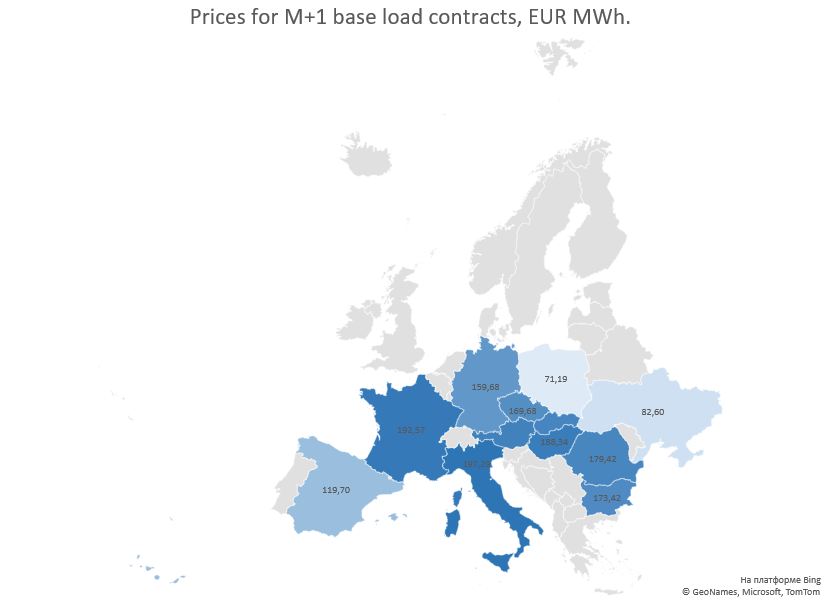
As of January 13, 2023, the basic electricity price in France was EUR 78.81/MWh, in Hungary - EUR 162.02/MWh, in Poland - EUR 122.59/MWh. As of February 2023, in the above-mentioned countries, electricity was traded at prices in the range of 71-193 EUR/MWh.
Monthly futures for February 2023 on electric energy in the analyzed countries decreased by an average of 3.4%. As of April 2023, they decreased by an average of 2.5%.
Prices of futures contracts, EUR/MWh, 12.01.2023
| Type | Contract | Date | France | Hungary | Poland |
|---|---|---|---|---|---|
| Base | Моnth | Feb /23 | 192,57 | 188,34 | 71,19 |
| Mar/23 | 179,27 | 181,75 | 71,40 | ||
| Аpr/23 | 168,97 | 174,44 | 72,96 |
The price of O2 emission allowances in the European Emissions Trading System (ETS) remained high during last week’s trading. On Thursday, January 12, 2023 CO 2 futures prices on the EEX market for benchmark December 2023 contracts reached a price value of EUR 80.24/t, up 1.8% from last week’s price. According to analytical estimates, the EU ETS will move from oversupply to a significant deficit by the end of the decade.
The spot price of coal in Europe declined during the first half of last week on the back of weak demand and sufficient coal stocks in warehouses. On Thursday, January 12, the price of thermal coal in Europe (according to API-2) began to rise and amounted to EUR 160.77/t, which is 1.7% higher than last week’s indicator. European industrial enterprises saw a steady increase in the transition of production from coal to gas. Today, China, South Korea, Turkey, India, and Japan remain the largest importers of Russian coal.
In Ukraine, a significant cooling has occurred, consumption has increased and the deficit in the energy system has increased. Last week, emergency power outages were implemented in nine regions due to exceeding the limits. The most difficult situation with electricity supply is in the east and south due to damage to power grids.
Public procurements
Over the past week, about 250 tenders were held for the purchase of electricity by customers. The realized volume of the 10 largest contracts is 490.51 million kWh for a total cost of more than UAH 1.88 billion excluding VAT. In general, the average price was UAH 4.79 per kWh excluding VAT. The largest contracts were awarded to New Energy Ukraine LLC and South Energy Sales LLC, which will deliver a total volume of 470.01 million kWh of electricity to PJSC Ukrnafta at the initial price of UAH 4.68 and 4.41 per kWh excluding VAT. Other tenders are shown in the graph below. Prices ranged from 4.41 to 5.64 UAH/kWh.
News of wholesale electricity market
Sweden is preparing legislation that will allow the construction of new nuclear power plants to increase electricity production and strengthen energy security. The new legislation overturns existing rules that limit the total number of reactors to 10 and prohibit the construction of reactors in locations other than where they currently exist, opening the door to the construction of smaller reactors. Sweden now has six reactors in operation, half of what it used to have, and the temporary closure of some of them for maintenance has led to higher electricity prices in the Scandinavian country in recent months.
Nuclear energy in France continues to gain momentum. The country already has 44 operating nuclear reactors out of 56, their total capacity is 43 GW. The restart of reactors after repairs made it possible to increase the use of the French nuclear park to 78%. During January and February, they plan to continue restarting nuclear power units. The first reactor at Civaux NPP should start operating soon.
Belgium has reached an agreement with French energy company Engie to extend the life of two nuclear reactors for 10 years. "On January 9, Belgium cancelled its plan to exit nuclear power in 2025 and changed its energy strategy due to russia’s full-scale invasion of Ukraine. The last of the seven reactors in Belgium - Doel 4 and Tihange 3 reactors were supposed to be permanently closed in 2025, but will be restarted in November 2026 after the necessary work and will continue to operate for 10 years," the statement said. The Belgian electricity grid operator warned that without nuclear support, Belgium will face a significant energy shortage in the winter of 2026-2027.