


Electricity: Ukraine and Europe August 7 – 11, 2023

Ukrainian Energy Exchange: Bilateral Contracts market
During the week, 9 auctions for the purchase and sale of electricity in unilateral auction mode were held, of which 5 in commercial session, 4 in specialized. Among the initiators were: Guarranteed Buyer, Ukrhydroenergo, Kharkiv HPP-5, Nizhnednistrovska HPP, USP and DSO, etc.
During the reporting period, the Guaranteed Buyer initiated auctions, offering block positions for daytime hours with delivery in August. According to their results, the company sold 41230 MWh of electricity at prices in the range of UAH 1758,48 - 2964,72/MWh with different delivery dates for August.
Kharkivska TPP-5 initiated an auction where it offered a base load at a starting price of 5000 UAH/MWh. As a result, the company was able to sell 25200 MWh of electricity at a weighted average price of 3950 UAH/MWh with delivery in August.
In the commercial sections, the company mainly purchased electricity for individual load.
| Trades type | Sales volume, MWh |
|---|---|
| Auctions to implement Article 66 of the Law of Ukraine On Electricity Market | 25 200 |
| Commercial section | 45 456,482 |
| Special sessions for the sale of electricity generated from alternative energy sources | 41 230 |
| Totaly | 111 886,482 |
As of August 11, prices for the most commonly used types of sales schedules were formed, as shown in the chart below.
Market operator: day-ahead and intraday markets
During the reporting period, prices were dynamic, ranging from 3680,56 to 4590,40 UAH/MWh, within ±11% deviation from the weekly average. In general, the average weighted average price for the last week increased compared to the same indicator of the previous week and amounted to UAH 4132,29/MWh (+2,8%). In total, 413,5 thousand MWh were sold on the DAM during the reporting period (+6%).
During the reporting period, prices on the DAM were even more dynamic. The weighted average prices varied in the range of 3364,40 - 4841,65 MWh, and the average value of the weighted average prices for the reporting period increased by 4% compared to the same period last year and amounted to 4317,79 UAH/MWh. The total volume of sales and purchases for the reporting period amounted to 36,46 thousand MWh.
European market
Last week, European electricity markets recorded price increases compared to the first week of the month in most markets, as the resumption of the trend of rising average temperatures in some markets led to an increase in demand for electricity in these countries. Negative spot electricity prices were recorded in Slovakia, Hungary, Belgium, Austria and other European countries.
Electricity production from wind turbines in Europe in the first three days of last week covered 20,6% of the region’s needs, according to the WindEurope Association. The leading countries were Germany and Sweden.
A year-on-year decline in electricity consumption was recorded in July 2023 in all the analyzed European markets. Last week, demand for electricity decreased in some markets, such as Italy and Germany, due to lower average temperatures, and this week it is also expected to decrease due to the Assunzione della Vergine holiday. Demand increased in other markets.
According to the EU Climate Monitor, 2023 is currently the third warmest year on record, by 0,43°C above the recent average. July 2023 was the hottest month on record, with extreme heat and forest fires across the Northern Hemisphere. Demand for gas and electricity rose sharply amid high temperatures in countries such as Italy, Spain and Greece, as recorded in July 2023.
In terms of prices, as of July 2023, the average monthly price was below EUR95/MWh in almost all European electricity markets, except for the IPEX market (Italy), where prices increased by more than 6% and the average price amounted to EUR112/MWh.
In terms of hourly prices, several markets recorded zero or negative prices on August 6 and 7. In Spain, six consecutive hours with zero prices in euros per MWh were recorded on August 6 from 11:00 to 20:00, which was below the historically recorded previous lowest daily price, which was reached in April and amounted to 28.15 euros/MWh. On this day, the EPEX SPOT market in France recorded zero prices from 1:00p.m. to 5:00p.m. The EPEX SPOT market in Belgium recorded negative prices for several hours on August 6 and 7, with the lowest price of EUR51,42/MWh reached on August 7 at 2:00 pm. The EPEX SPOT market in the Netherlands also recorded negative prices for several hours on these two days, with the lowest price of -41.85 EUR/MWh also recorded on August 7 at 2:00 pm. Similarly, the EPEX SPOT market in Germany and the Nord Pool market recorded several hours of negative prices on Monday, August 7.
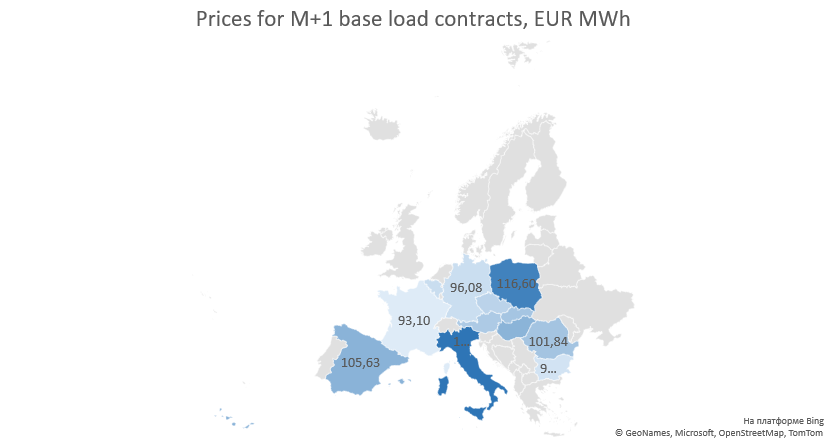
As of August 11, the price of basic electricity in France amounted to 96,26 EUR/MWh, in Hungary 80,88 EUR/MWh, and in Poland 117,04 EUR/MWh. As of September 2023, electricity was traded in the range of 93-117 EUR/MWh.
Monthly futures for October 2023 for electricity increased by an average of 6% in the analyzed countries. As of November 2023, prices increased by 24% in Hungary, 6% in Poland and 41% in France.
Futures contract prices, EUR/MWh, August 10, 2023
| Type | Contract | Date | France | Hungary | Poland |
|---|---|---|---|---|---|
| Base | Моnth | Sep/23 | 93,10 | 105,50 | 116,60 |
| Oct/23 | 108,55 | 114,24 | 108,35 | ||
| Nov/23 | 153,43 | 141,42 | 113,85 |
European carbon prices in July reached an average price of EUR 88,02 per tonne, which is 0,4% higher than the previous month’s average of EUR 87,65 per tonne. Compared to the average for July 2022 for the benchmark contract from December of the same year, which was 81,72 euros per ton, the average for July 2023 was 7,7% higher.
CO 2 prices under the EUA declined last week during "weak" trading on Monday, while natural gas prices showed strong gains, even as further industrial production declines were reported in the EU’s largest economy, Germany. On August 8, the UKA to EUA discount rose above 40 euros per ton. Prices for CO 2 futures on the EEX market for the benchmark December 2023 contracts on Thursday, August 10, reached a settlement price of EUR 84,90 per tonne.
European carbon traders are preparing for more volatility in August as auction volumes will fall sharply due to lower activity during this period, although last August, EU quotas rose to almost EUR100 per tonne amid a sharp drop in auction volumes.
Japan’s carbon market participants will be preparing to launch some trading platforms, including Japan’s national carbon market GX-ETX.
On Thursday, August 10, the spot price of thermal coal in Europe (API-2) amounted to 104.97 euros per ton. According to forecasts, a further expected heat wave in Europe may also contribute to the displacement of coal.
Market participants are seeing the first signs of a weakening in Russian exports, which are likely to persist in the second half of the year, leaving annual coal sales below the 2023 level. Russian coal exports are slowing down from the peak reached in 4Q2022 and 1Q2023 as favorable discounted supplies have weakened following the recent price increases. Buyers have the opportunity to purchase coal at a discount and are rapidly shifting to cheaper and alternative sources, including Australian coal.
In Ukraine, consumption grew throughout the week due to rising temperatures. The demand was covered by imports from Moldova and Slovakia. Aggressors continue to shell the territory of Ukraine. The damage to the energy system from Russian attacks amounts to about USD 11 billion.
Public procurements
Last week, 9 tenders were held for the purchase of electricity by customers. The total volume amounted to 32,54 million kWh for a total cost of UAH 138,35 million excluding VAT. The average price amounted to UAH 4,49 per kWh, excluding VAT. The largest contract was awarded to Khmelnytskenergozbut LLC, which will supply 30,56 million kWh of electricity to Khmelnytskvodokanal at an initial price of UAH 4,23 per kWh excluding VAT. Other tenders are shown in the graph below. The prices ranged from UAH 4,13 to 5,68 per kWh, excluding VAT.
News of the wholesale electricity market
State of generation. Currently, 24 power units at TPPs have been repaired and are undergoing repairs. This is 62% of the total number. This was stated by Prime Minister of Ukraine Denys Shmyhal at a government meeting. 70% of TPPs have been repaired, and another 30% are currently under repair, the Prime Minister said. According to the Ministry of Energy, five nuclear units have been repaired. Four more units are under repair. Hydroelectric power plants. 32 hydroelectric units have been repaired or are under repair, or 68% of their capacity. "The repair campaign is going according to plan. On the part of Ukrenergo, we have almost 80% of the work on the repair of trunk grids. High-voltage substations have already been restored to the pre-war level.
France overtook Sweden to become the largest exporter of electricity in Europe, while Germany turned from an exporter to an importer during the first half of this year. Total net electricity exports from France amounted to 17.6 terawatt-hours, with most of the electricity going to the UK and Italy, according to a report by EnAppSys Ltd. As noted, French nuclear power is the cornerstone of the European electricity market. Even with capacity fluctuations of about 50%, French nuclear power plants remain an important resource for the energy market, even amid outages and the active use of renewable energy sources, including solar. The increase in exports from the country was due to "the increased availability of the country’s nuclear assets," said Jean-Paul Harremann, director of EnAppSys. He noted that although the level of availability remains 10-15% below the normative level, the increase in capacity by 5-10 GW compared to last year helped to change the balance of energy flows in France in favor of exports. At the same time, Sweden slipped to second place, Spain overtook Germany and became the third largest net exporter of electricity in Europe with a total net outflow of 8,8 terawatt-hours. Meanwhile, Germany, after the closure of its nuclear power plants, became dependent on electricity imports.