


Electricity: Ukraine and Europe April 29 – May 3, 2024

Ukrainian Energy Exchange: bilateral contracts market
Last week, the UEEX held 8 auctions for the purchase/sale of electricity in the unilateral auction mode, including 2 in commercial sections and 6 in specialized sections. The initiators included: Guaranteed Buyer, Ukrhydroenergo, Aquaresurs-1, USP and DSOs, etc.
Ukrhydroenergo initiated auctions offering base load with different delivery periods. As a result, the company sold 29160 MWh of base load at prices in the range of 3300 - 3337.19 UAH/MWh with delivery in the first half of May.
In addition, in the specialized section last week, Aquaresurs-1 initiated an auction in accordance with Article 66 of the Law of Ukraine “On the Electricity Market”, where it offered base load with delivery in May. As a result, the company sold 18,600 MWh of baseload at a weighted average price of UAH 3365/MWh in May.
During the reporting period, the Guaranteed Buyer initiated the auction, offering block positions of daytime hours with different deliveries for the third decade of April. According to the results of the auction, the company sold 338190 MWh of block positions at prices in the range of 1154.95 - 2821.35 UAH/MWh.
In the commercial sections, the companies bought/sold electricity to loads with individual profiles.
| Type of trading | Sales volume, MWh |
|---|---|
| Auctions pursuant to Article 66 of the Law of Ukraine On Electricity Market | 47 760 |
| Commercial section | 33 576,661 |
| Special sessions for the sale of electricity generated from alternative energy sources | 338 190 |
| In total | 419 526,661 |
As of May 3, prices for the most commonly used types of sales schedules were formed, as shown in the chart.
Market operator: day-ahead and intraday markets
During the reporting period, the day-ahead market prices were volatile, ranging from 3187.06 to 4067.72 UAH/MWh. In general, the average weighted average price over the past week increased by 14.7% compared to the same indicator last week and amounted to 3722.72 UAH/MWh. The highest daily price amounted to 4067.72 UAH/MWh on May 3, and the lowest - 3187.06 UAH/MWh on April 30. The volume of sales for the reporting period of April 27 - May 3 amounted to 436.26 thousand MWh, (+1.5%).
Prices for IDM were volatile during the review period. The weighted average prices varied in the range of 2875.44 - 4302.75 MWh, and the average value of the weighted average prices for the reporting period decreased by 14.6% compared to the same period last year and amounted to 3654.05 UAH/MWh. The total volume of sales and purchases for the reporting period amounted to 42.45 thousand MWh.
European market
Last week, a number of European countries recorded negative spot prices due to high levels of renewable energy production and subdued demand due to the weekend. Spot electricity prices in Europe rose last Thursday, driven by a sharp drop in renewable energy production. The spot price for electricity in Germany rose 114% to EUR 77.81/MWh, while the French day-ahead contract rose about 40% to EUR 24.47/MWh. Y+1 electricity prices also rose on Thursday, along with rising gas and carbon prices. The resumption of trading after the weekend on Wednesday also supported prices.
Electricity generation from wind turbines in Europe covered 19% of the region’s needs in the first four days of last week, according to the WindEurope Association. The leading countries were Germany, Spain and Italy. Solar power generation increased in most major European electricity markets compared to the previous week. Last week, solar power generation increased in Germany and decreased in Italy and Spain.
Last week, changes in average temperatures were not uniform: in Southern Europe and the UK, average temperatures decreased, while in the rest of the markets analyzed, average temperatures increased by up to 0.8 °C. In Germany, Italy, the Netherlands, France, Belgium, Spain, and the UK, demand declined or was subdued due to public holidays.
On Sunday, April 28, most of the analyzed European markets registered negative prices. On April 30, German hourly electricity prices at the day-ahead auction fell to their lowest level since July 2023: within 8 hours starting at 10:00 CET, prices ranged from -0.97 EUR/MWh to -120.07 EUR/MWh. On Wednesday, the base load for public holidays was set at 4.39 EUR/MWh, the lowest on the German market since December 25, 2023.
Other European countries also recorded negative hourly prices, in particular, in the Netherlands prices were at -200 EUR/MWh, followed by Belgium at -123.18 EUR/MWh and Austria at -105.99 EUR/MWh. French prices fell to -11 EUR/MWh, while prices in Denmark fell to -2.45 EUR/MWh.
As of May 3, the price of basic electricity in France amounted to 24.47 EUR/MWh; in Hungary: 78.17 EUR/MWh; in Poland: 71.61 EUR/MWh.
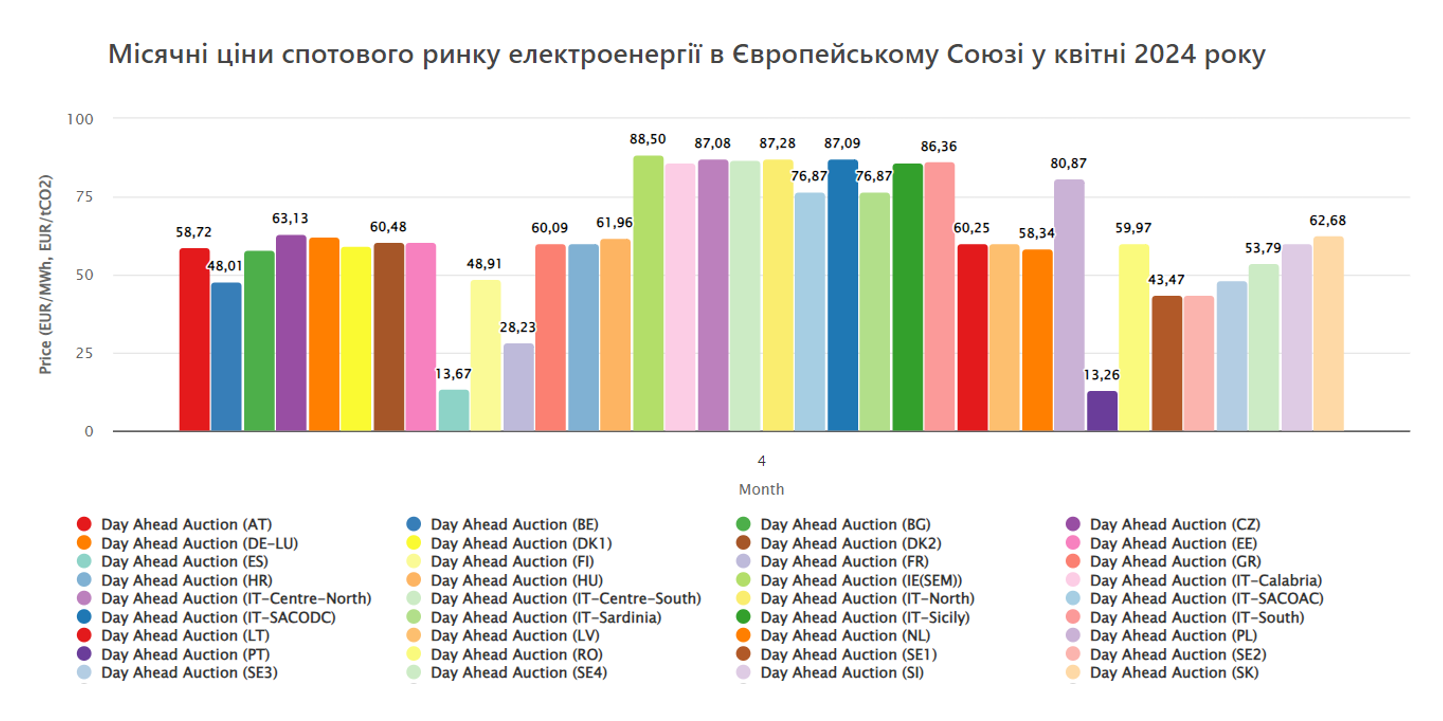
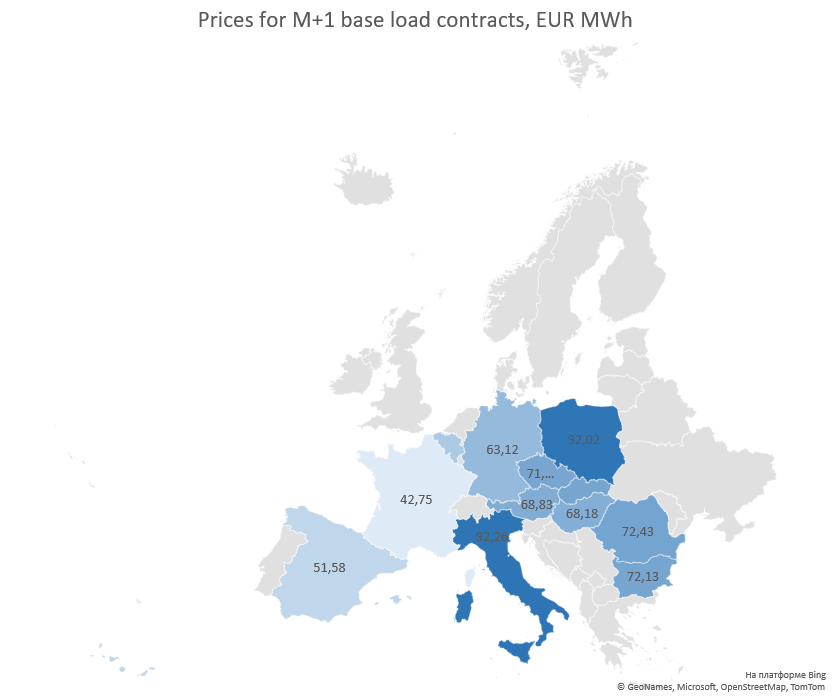
As of June 2024, electricity was traded in the range of 42 - 92 EUR/MWh in the analyzed countries.
Monthly electricity futures for July 2024 increased by an average of 13% in the countries analyzed. As of August 2024, prices increased by an average of 2% in Poland and Hungary, and decreased by 2.6% in France.
Germany’s benchmark energy contract Cal ’25 stabilized at 93.71 EUR/MWh last Thursday, while France’s Cal ’25 remained at 83.38 EUR/MWh, with both contracts up 5% from the previous session.
Futures contract prices, EUR/MWh, 02.05.2024
| Type | Contract | Date | France | Hungary | Poland |
|---|---|---|---|---|---|
| Base | Моnth | Jun/24 | 42,75 | 68,18 | 92,02 |
| Jul/24 | 56,69 | 74,27 | 90,05 | ||
| Aug/24 | 55,23 | 75,11 | 90,74 |
The estimated price for carbon emissions in Europe last Thursday, May 2, showed the second largest one-day increase in a year and amounted to 72.51 euros per tonne, as prices felt the rise in gas prices in the afternoon. This price increased by about 7% on the day. On May 3, in the morning, the EUA’24 price was trading at 72.1 euros per ton. This week’s auction schedule is shortened, and on the supply side, the German government announced the cancellation of 12.25 million tons of EUA, which may give a certain boost to prices.
In its long-term forecast, the Carbon Market Expert Group expects carbon prices in the EU to triple in 2035 to around 200 euros.
On Tuesday, the Commission announced that funds totaling EUR 720 million to be raised from the sale of CO2 emission allowances under the EU emissions trading scheme will be allocated to 7 projects that have received subsidies for hydrogen production. According to the results of the first pan-European auction for the production of hydrogen from renewable sources, Spain and Portugal take most of the EU’s hydrogen premium.
On May 2, the spot price of thermal coal in Europe (according to API-2) amounted to 100.21 euros per ton.
In the last month, electricity imports to Ukraine increased to 225 thousand MWh, while electricity exports amounted to 12 thousand MWh. Last week, electricity was imported from Slovakia, Romania, Moldova, Hungary, and Poland. Exports were directed to Romania and Moldova.
Public procurement
Over the last week, more than 20 electricity procurement tenders were held by customers. The sold volume of the 10 largest contracts amounted to 1.92 million kWh for a total value of UAH 7.32 million excluding VAT. Overall, the average price amounted to UAH 3.83 per kWh, excluding VAT. The largest contract was awarded to Dniprovsky Energy Services LLC, which will supply 430.81 thousand kWh of electricity to the Department of Education, Youth and Sports of the Executive Committee of the Tomakivka Village at an initial price of UAH 2.94 per kWh, excluding VAT. Other tenders are shown in the graph below. Prices ranged from UAH 2.94 to 5.37 per kWh.
News from the wholesale electricity market
Regulator launches regulatory procedure to change price caps in the electricity market
The regulator has approved the draft resolution “On Price Caps on the Day-Ahead Market, Intraday Market, and Balancing Market” for comments and suggestions. The decision was made at a meeting on April 30. “This is the beginning of the procedure, not a decision. The decision will be made after open public discussions,” said Valeriy Tarasyuk, Chairman of the NEURC. Currently, the following price caps are proposed in the published draft resolution: 1) on the day-ahead market (hereinafter - DAM): maximum marginal prices from 00:00 to 07:00 and from 23:00 to 24:00 - 4,000.00 UAH/MWh; from 07:00 to 08:00 and from 11: 00 to 17:00 - 5,600.00 UAH/MWh; from 08:00 to 11:00 - 6,900.00 UAH/MWh; from 17:00 to 23:00 - 7,500.00 UAH/MWh; minimum price cap - 10.00 UAH/MWh; 2) on the intraday market: maximum marginal prices from 00:00 to 07:00 and from 23:00 to 24:00 - 4,000.00 UAH/MWh; from 07:00 to 08:00 and from 11:00 to 17:00 - 5,600.00 UAH/MWh; from 08:00 to 11:00 - 6,900.00 UAH/MWh; from 17:00 to 23:00 - 7,500.00 UAH/MWh; minimum marginal price - 10.00 UAH/MWh; 3) on the balancing market: maximum price caps from 00:00 to 07:00 and from 23:00 to 24:00 - UAH 5,000.00/MWh; from 07:00 to 23:00 - UAH 8,250.00/MWh; minimum price cap - UAH 0.01/MWh. If the current version is adopted, the new price caps may come into force on May 30.
G7 countries agree to close coal-fired power plants by 2035
The ministers agreed to issue a communiqué outlining the G7’s commitments to decarbonize their economies, Reuters reports. Pichetto said that the ministers also considered possible restrictions on Russian imports of liquefied natural gas to Europe, which the European Commission is to propose in the near future. “This issue is on the technical and political agenda of the (G7). We are working on it, I cannot say more. If there is a final decision, I will announce it,” said Italian Energy Minister Gilberto Piketto-Fratin. The coal agreement marks a significant step in the direction set by last year’s United Nations climate summit COP28 to phase out fossil fuels, of which coal is the most polluting. Last year, Italy generated 4.7% of its total electricity through several coal-fired power plants. Rome currently plans to shut down its plants by 2025, except for the island of Sardinia, where the deadline is 2028. In Germany and Japan, coal plays a larger role, with the share of electricity generated from this fuel exceeding 25% of the total last year. Nuclear power and biofuels will be mentioned in the final communiqué among the options that the G7 countries can choose to decarbonize electricity generation and transportation.