


Electricity: Ukraine and Europe 26 – 30, August 2024

Ukrainian Energy Exchange: bilateral contracts market
During last week 22 auctions for the purchase and sale of electricity in unilateral mode were held, of which 6 – in commercial, 16 – in specialized sections. Among the initiators were: Guaranteed Buyer, Ukrhydroenergo, Donbasenergo, Aquaresource-1, Euro-Reconstruction, Cherkasy Chemicals, TKE ChMR, DTEK Zakhidenergo and DTEK Dniproenergo, USP and DSO, etc.
Ukrhydroenergo initiated auctions to offer baseload power with a delivery period from 1 to 7 September. According to the results of the auctions, the company sold 8064 MWh of baseload at a weighted average price of 5104,21 UAH/MWh.
During the reporting period, Donbasenergo initiated an auction offering baseload with different delivery periods for September. As a result, the company sold 28800 MWh of electricity at a weighted average price of 4791,4 UAH/MWh with delivery from 1 to 6 September and 38400 MWh at a weighted average price of 4862,6 UAH/MWh with delivery from 23 to 30 September.
DTEK Dniproenergo and Zakhidenergo initiated auctions in accordance with Article 66 of the Law of Ukraine “On the Electricity Market”, where they offered block positions with a delivery period of the first half of September. The companies were able to sell 426030 MWh at prices in the range of UAH 4070 - 5661/MWh.
In addition, in the specialised section last week, Cherkasy Chemical Fibre and Euro-Reconstruction initiated auctions in accordance with Article 66 of the Law of Ukraine On the Electricity Market, where they offered base-load for September delivery. As a result, the companies sold 50400 MWh of baseload at a weighted average price of UAH 4957,14/MW, respectively.
Aquaresurs-1 initiated the auctions offering baseload power for September delivery. As a result, the company sold 18000 MWh at a weighted average price of UAH 5004,4/MWh.
The company TKE ChMR initiated an auction where it offered a base load with a delivery period of September. As a result, the company sold 21600 MWh at a weighted average price of 5000 UAH/MWh.
During the reporting period, the Guaranteed Buyer initiated an auction offering block positions of daytime hours with different delivery periods for the first decade of September. As a result of the auction, the company sold 84160 MWh of block positions at prices in the range of 1400,00 - 4002 UAH/MWh.
In the commercial sections, the companies purchased/sold electricity to individual loads.
| Trades type | Sales volume, MWh |
|---|---|
| Auctions pursuant to Article 66 of the Law of Ukraine On Electricity Market | 641 694 |
| Commercial section | 72 926,149 |
| Special sessions for the sale of electricity generated from alternative energy sources | 84 160 |
| In total | 798 780,149 |
As of 30 August, prices for the most commonly used types of sales schedules were formed, as shown in the chart.
Market operator: day-ahead and intraday markets
During the reporting period, the day-ahead market prices were less volatile, ranging from 5219,29 to 6415,1 UAH/MWh. Overall, the average weighted average price for the last week decreased by 1% compared to the same indicator of the previous week and amounted to 5587,41 UAH/MWh. The highest daily price was 6415,1 UAH/MWh on 28 August, and the lowest - 5219,29 UAH/MWh on 25 August. The volume of sales for the reporting period of 24 August - 30 August amounted to 416,17 thousand MWh, (-7,3%).
During the reporting period, prices on the IDM were volatile. The weighted average prices varied in the range of 4411,12 - 6772,12 UAH/MWh, and the average weighted average price for the reporting period decreased by 14,7% compared to the same period last year and amounted to 5409,31 UAH/MWh. The total volume of purchases and sales for the reporting period amounted to 42,82 thousand MWh.
European market
Last week, despite the decrease in demand, prices remained at a high level. Trading activity was weak and market conditions were typical of late August when many market participants were on vacation. Spot electricity prices in Europe fell on Thursday, reflecting lower demand in the region. Germany’s spot electricity price fell 6% to close at EUR 106,64/MWh, while France’s spot electricity price fell 4% to EUR 95,19/MWh.
Wind generation fell in most major European markets during the week. On the other hand, over the weekend, daily wind power generation reached record highs in some places: on Saturday, August 24, the French market generated 181 GWh, the highest daily production since June 15; On August 25, the Spanish market registered 188 GWh, the highest figure since July 15. Wind power generation in Europe in the first four days of last week averaged 14,5% of the region’s needs, according to the WindEurope association. At the same time, the largest volumes were generated by the following countries: France, Spain, Germany, Finland and Sweden.
Solar energy generation in Europe increased by 270,5 GWh in the first four days of last week compared to the same period of the previous week and amounted to about 4,173 GWh. Solar energy generation increased in Germany with an average value of 321,9 GWh during these days. At the same time, it continued to decrease in Spain with an average value of 173 GWh and in Italy with an average value of 101 GWh.
During the past week, electricity demand in the main European electricity markets differed compared to the previous week. Demand growth took place in the markets of France, Spain, Italy, Portugal, Belgium, and Germany. During the first four days of last week, the overall European demand was at the level of the average value of 305 GW.
Regarding hourly prices, most of the analyzed European markets registered negative prices on Sunday, August 25. In addition, the German, Belgian, French, Dutch and Scandinavian markets also had negative prices on August 24. On the other hand, on Saturday, August 24, from 14:00 to 15:00, the Dutch market registered the lowest hourly price for the week – 44,92 EUR/MWh.
As of August 30, the price of basic electricity in France was 95,19 EUR/MWh; in Hungary: 145,45 EUR/MWh per year; in Poland: 146,56 EUR/MWh.
As of August 30, the price of basic electricity in France was 95,19 EUR/MWh; in Hungary: 145,45 EUR/MWh per year; in Poland: 146,56 EUR/MWh.
Monthly futures for October 2024 on electricity increased by 6.9% in France and decreased by an average of 4,3% in Hungary and Poland. As of November 2024, prices increased by an average of 14,3% in the analyzed countries.
Cal-25 electricity prices have seen a slight decrease with no significant market changes to react to. The benchmark German energy contract Cal’25 fell by 0,5% to 96,52 EUR /MWh, while the French equivalent decreased by 0,7% to 83,52 EUR/MWh.
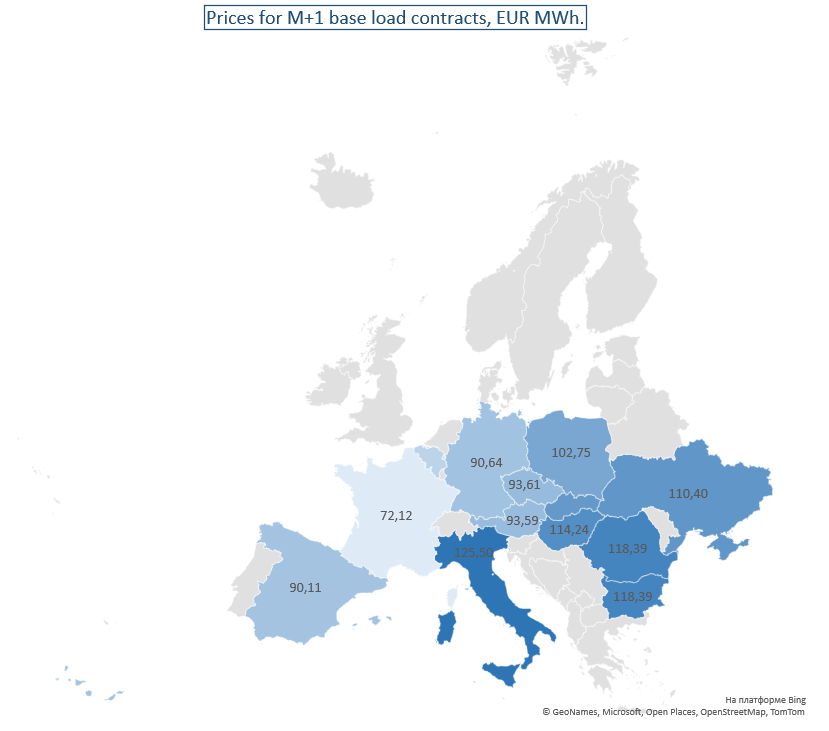
Prices of futures contracts, EUR/MWh, 29.08.2024
| Type | Contract | Date | France | Hungary | Poland |
|---|---|---|---|---|---|
| Base | Моnth | Sep/24 | 72,12 | 114,24 | 102,75 |
| Oct/24 | 77,11 | 106,54 | 100,82 | ||
| Nov/24 | 98,49 | 116,85 | 106,41 |
European carbon prices remained steady at the EUA, which expires in December 2024. The price of carbon emission permits in the EU traded at EUR 71,18 per ton on August 30.
The spot price of thermal coal in Europe (according to API-2) on August 29 was EUR 109,26/ton.
Last week, on August 26, the Ukrainian energy infrastructure was subjected to one of the largest Russian attacks: on the territory of the country. Damaged infrastructure in 10 regions. Emergency electricity imports came from Slovakia and Poland.
Last week, imports came to Ukraine from Slovakia, Romania, Hungary, Poland, and Moldova. Export was not carried out.
Public procurements
Last week, more than 30 tenders were held for the purchase of electricity by customers. Sold volume of the 10 largest contracts is 4,21 million kWh. for a total cost of UAH 27,15 million excluding VAT. In general, the average price was UAH 6,38 per kWh excluding VAT. JOINT-STOCK COMPANY ENERGY COMPANY OF UKRAINE received the largest contract, which will supply 1,67 million kWh of electricity to UKRVODSERVIS at the initial price of UAH 6,53 per kWh excluding VAT. Other tenders are shown in the graph below. Prices ranged from UAH 5,92 to UAH 6,58/kWh.
News of the wholesale electricity market
Switzerland is preparing a referendum on lifting the ban on the construction of new nuclear power plants
Switzerland has refused to build new nuclear power plants after the Fukushima accident The Swiss government has announced that it is preparing changes to the current legislation to lift the ban on the construction of new nuclear power plants in the country. This is reported by the Bloomberg agency. The government will prepare legislative changes by the end of the year, the parliament will discuss them already in 2025, and if the deputies support the proposal to cancel the construction of the nuclear power plant, it will be put to a referendum. A ban on building nuclear power plants in Switzerland was introduced in 2018 due to safety concerns following the 2011 accident at the Fukushima nuclear power plant in Japan. There are four nuclear power plants operating in Switzerland, three of which were put into operation in the 1970s, one in the 80s. The Swiss government emphasized in its statement that the current ban is "incompatible with the goal of technological openness and also creates risks for the decommissioning of existing nuclear power plants." Also, without new nuclear power plants, Switzerland will not be able to achieve the goal of zero emissions by 2050.
In Poland, it was proposed to turn mines into gravity batteries
Mine shafts can be used as gravity energy accumulators, which work according to the principle of hydroaccumulative power plants. In Poland, which has promised to close all coal mines no later than 2049, they are thinking about what to do with them after closing. There is an idea to turn them into gravity batteries, writes WNP. Such a proposal was made by Zygmunt Lukaszczyk, professor of the Silesian University of Technology, who previously headed the Silesian Voivodeship (one of the main coal regions of Poland) for seven years. "If there are mine shafts that were drilled for a lot of money, with a depth of up to 800, and in some places even 100 meters, it is worth using them," he said. Lukaszczyk proposes to build on their basis gravitational energy accumulators, which work according to the principle of hydroaccumulative power plants. “But instead of water, they use, for example, concrete blocks, gravel and sand, as well as gravity and kinetic energy. As a result of lifting loads, energy is accumulated, during lowering - generation," he said. Lukaszczyk said that this will not only create a new market, but also guarantee jobs for miners. Another way out is to fill the mines with earth, which he called a waste. He calculated that the power of one gravity battery could be about 120 MW. This will make it possible to build a whole system of power plants in Poland with a total estimated capacity of 5-6 GW.