


Electricity: Ukraine and Europe 15 – 19 July 2024

Ukrainian Energy Exchange: Bilateral Contracts Market
Last week, UEEX held 12 auctions for the purchase/sale of electricity in the unilateral auction mode, including 6 in commercial sections and 6 in specialised sections. The initiators included: Energoatom-Trading, Guaranteed Buyer, Ukrhydroenergo, TSOs and DSOs, etc.
Energoatom-Trading initiated the auction, which resulted in the sale of 143592 MWh of baseload electricity at a weighted average price of 5299,7 UAH/MWh with delivery period in August.
In July, Ukrhydroenergo initiated auctions to offer baseload power with different delivery periods. The auctions resulted in the sale of 576 MWh of baseload at a weighted average price of UAH 5,510/MWh with a delivery period from 18 to 23 July and 1 880 MWh at a weighted average price of UAH 5 136,48/MWh with delivery period from 22 to 31 July.
During the reporting period, Guaranteed Buyer initiated the auction, offering block positions for daytime hours with delivery at the end of July and August. According to the results of the auction, the company sold 25200 MWh of block positions at prices in the range of 1400 - 2800 UAH/MWh for July and 80290 MWh at prices in the range of 1403,53 - 2800 UAH/MWh for August.
In the commercial sections, the companies mainly bought/sold electricity for individual loads.
| Trades type | Sales volume, MWh |
|---|---|
| Auctions pursuant to Article 66 of the Law of Ukraine On Electricity Market | 159 048 |
| Commercial section | 54 541,946 |
| Special sessions for the sale of electricity generated from alternative energy sources | 105 490 |
| Totaly | 319 079,946 |
As of 19 July, prices for the most commonly used types of sales schedules were formed, as shown in the chart below.
Market operator: day-ahead and intraday markets
During the reporting period, the day-ahead market prices were less volatile, ranging from 5044,05 to 6208,71 UAH/MWh. Overall, the average weighted average price for the last week decreased by 1% compared to the same indicator of the previous week and amounted to 5666,4 UAH/MWh. The highest daily price was 6208,71 UAH/MWh on 15 July, and the lowest - 5044,05 UAH/MWh on 17 July. Sales volume for the reporting period 13 July - 19 July amounted to 407,35 thousand MWh, (-1,7%).
During the reporting period, prices on the DAM were volatile. The weighted average prices varied in the range of 3895,24 - 6634,19 UAH/MWh, and the average weighted average price for the reporting period increased by 8,6% compared to the same period last year and amounted to 5690,37 UAH/MWh. The total volume of purchases and sales for the reporting period amounted to 44,21 thousand MWh.
European market
Last week, spot electricity prices in Europe continued to rise as renewable energy supplies declined. Spot electricity prices remained stubbornly high due to a prolonged heatwave, but fell sharply on Thursday following a surge in wind power generation.
Over the first four days of last week, electricity generation from wind turbines in Europe averaged 10% of the region’s needs, according to the WindEurope Association. The leading countries were Spain, Germany and Sweden.
Last week, solar generation declined. The heat caused solar panels to overheat and prevented them from operating at full capacity in the hottest regions. In Europe, solar energy generation decreased by 39 GWh in the first four days of last week. The highest daily solar energy production in July was recorded by the French market, reaching 127,2 GWh on 18 July.
Record high temperatures increased demand in southeastern Europe. In the first four days of last week, pan-European demand increased to around 310 GW. Demand in Germany averaged 53,7 GW, while neighbouring France averaged 44,3 GW, compared to the average of 40,4 GW.
As for hourly prices, on Sunday, 14 July, most of the analysed European markets recorded negative prices. The exceptions were the markets of the UK and Italy. The markets of Germany, France and Northern Europe also reached negative prices on Saturday, 13 July. The Belgian and French markets recorded the lowest hourly price of -74,02 EUR/MWh on Sunday, 14 July, from 14:00 to 15:00. In Germany, on Friday, 19 July, after forecasts showed an increase in renewable electricity production, the DA hours from 12:00 to 16:00 were negative, with the lowest price set at 12:00 at -4.65 EUR/MWh.
As of 19 July, the price of basic electricity in France was 78,58 EUR/MWh; in Hungary 176,93 EUR/MWh; and in Poland 133,46 EUR/MWh.
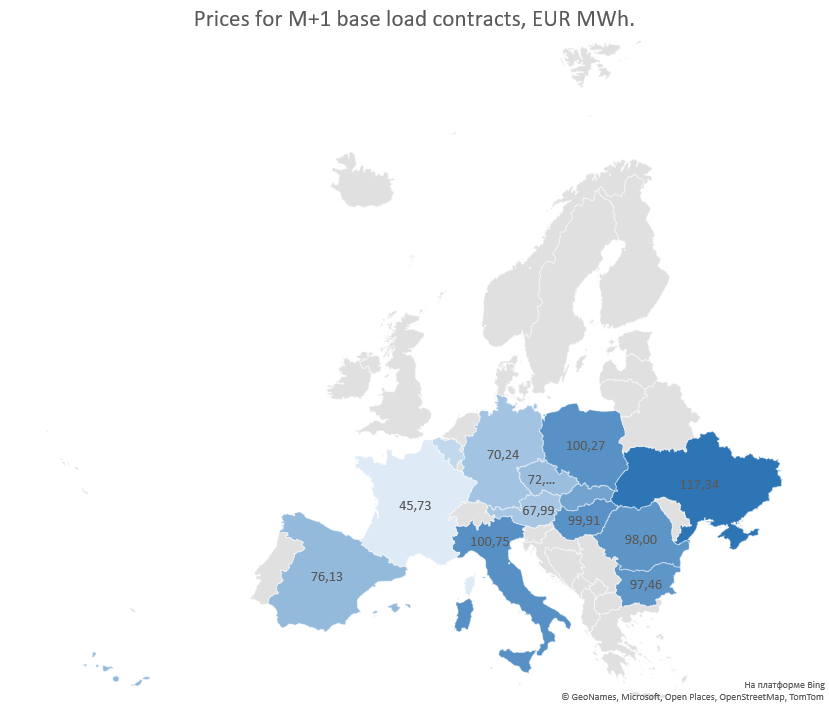
As of August 2024, prices were in the range of EUR 46-100/MWh in the analysed countries.
Monthly electricity futures for September 2024 increased by an average of 14% in France and Poland and decreased by 12,5% in Hungary. As of October 2024, prices increased by 7,1% in France and decreased by an average of 0,9% in Poland and Hungary.
Last Thursday, 18 July, Germany’s benchmark energy contract Cal ‘25 rose by almost 0,3% to settle at 88,07 EUR/MWh. Similarly, the price of electricity in France Cal ’25 rose by more than 1,4% closing at 74,79 EUR/MWh.
Futures contract prices, EUR/MWh, 18.07.2024
| Type | Contract | Date | France | Hungary | Poland |
|---|---|---|---|---|---|
| Base | Моnth | Aug/24 | 45,73 | 99,91 | 100,27 |
| Sep/24 | 58,38 | 87,41 | 100,84 | ||
| Oct/24 | 62,53 | 86,45 | 100,05 |
European carbon prices declined last week amid technical trading and in the absence of firm fundamentals. On 18 July, the price of EU carbon permits stood at EUR 66,44 per ton, down 2,8% from the previous week and the lowest since 30 April. On 19 July, the EUA’24 price was trading slightly lower at EUR 66,27 per ton. The decline was driven by lower demand for permits, which was caused by falling natural gas prices due to stable storage levels and low demand in some European countries.
On 18 July, the spot price of thermal coal in Europe (according to API-2) was 96,74 euros per ton.
Last week, Ukraine received import from Slovakia, Romania, Hungary, and Poland. There were no export.
Public procurements
Over the past week, more than 10 electricity procurement tenders were held by customers. The volume of the 10 largest contracts sold reached 3,41 million kWh for a total value of UAH 20,38 million excluding VAT. The average price was UAH 6,29 per kWh, excluding VAT. The largest contract was awarded to Energy and Investment Group LLC, which will supply 2 million kWh to the Mukachevo district heating company 2,55 million kWh of electricity at a starting price of UAH 5,83 per kWh excluding VAT. Other tenders are shown in the graph below. Prices ranged from UAH 5,83 to UAH 7,38 per kWh.
Wholesale electricity market news
Lithuania will transfer equipment of Vilnius TPP-3 to Ukraine
Lithuanian energy company Ignitis Gamyba will transfer equipment from Vilnius TPP-3 to Ukraine, the company said in a statement. Vilnius TPP-3 was shut down in 2015 because its operating costs were too high and it was determined that the power units did not have a significant impact on the stability of the power system. ‘Despite the fact that the plant has been closed for nine years, we were able to preserve its equipment, which retained its full functionality. The plant, with a total thermal and electrical capacity of almost 1000 MW, had been operating for over 30 years and provided heat to about half of Vilnius. Now this equipment will contribute to the restoration of vital infrastructure in Ukraine,’ added the company’s CEO.
Ukrhydroenergo returns to the Kanivska HPP project
Ukrhydroenergo plans to start construction of the Kaniv pumped storage plant in Cherkasy region in 2025. The company’s CEO Ihor Syrota said this in an interview with Forbes. The design capacity remains at 1000 MW. The cost of such a plant could be USD 1,5-2 billion. The pumped storage plant, which is to be the new Kanivska HPP, requires two reservoirs, one upper and one lower. If there is a surplus of electricity in the system, water is pumped into the upper reservoir and, during peak loads (in the morning and evening), is fed to hydroelectric units to generate electricity. It is planned that the Kanivska HPP will be equipped with four hydraulic units with a capacity of 250 MW each. Preparations for construction and development of project documentation began in 1984. In 1987, a project to build the 3600 MW Kanivska HPP was approved, but after Ukraine gained independence, it was postponed and reduced to 1000 MW in 2006-2007. Ukraine is building another HPP on the Dniester River, where four out of seven hydroelectric units are ready. With the launch of the fourth hydroelectric unit, the capacity of the Dniester HPP reached 1296 MW in generating mode and 1684 MW in pumping mode. According to the original design, the Dniester HPP is to consist of seven hydraulic units with a total capacity of 2268 MW in generating mode and 2947 MW in pumping mode.